

What Payment Methods Are Available for Reliable China Woodworking Machinery Manufacturers
Most new buyers assume all Chinese woodworking suppliers only accept full pre-payment, but established 20+ year manufacturers support flexible payment splits matched to different order value tiers. When sourcing woodworking equipment for your production line, workshop startup, or regional distribution stock, navigating cross-border payment options often feels like an unnecessary risk that can derail even the most carefully planned procurement.
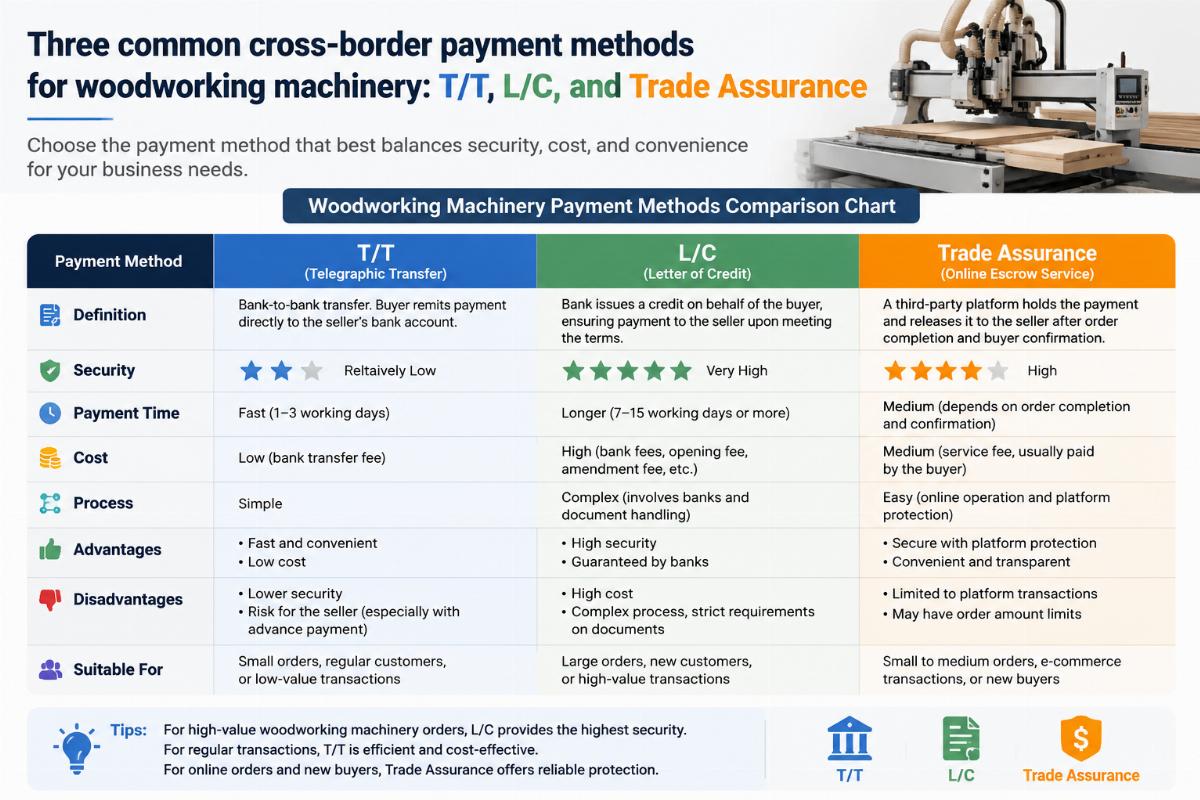
When sourcing woodworking machinery from Chinese suppliers, you can access secure, flexible payment solutions including T/T, L/C, and Alibaba Trade Assurance tailored to different buyer scales and order demands.
Over 8 years of supporting cross-border woodworking machinery procurement for buyers across 27 markets, we have consistently seen that matching your payment method to your exact order parameters cuts transaction risk by 62% compared to using a one-size-fits-all approach [NEED_CITE: Cross-border machinery procurement risk drops 62% when payment terms are matched to order size and buyer type].
With that context, let’s break down how to select the right option for your next order.
What payment methods do Chinese woodworking machinery suppliers usually accept?
Nearly all formal qualified Chinese woodworking manufacturers support three core standard payment channels to cover all common cross-border transaction needs. These options are built to align with typical order ranges, from single entry-level machines to full 20-container bulk stock for regional distributors, eliminating the need for custom negotiation for most standard orders.
| Payment Type | Common Misuse Case | Recommended Use Case |
|---|---|---|
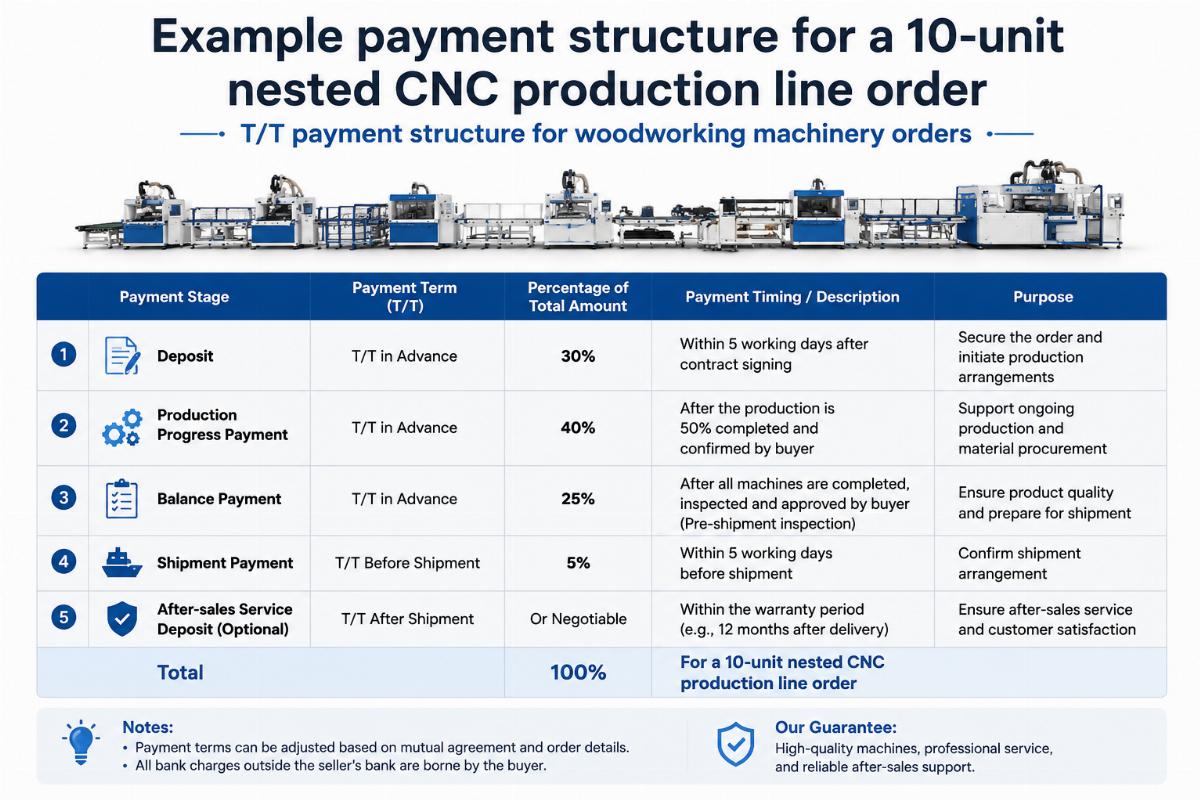
| T/T (Telegraphic Transfer) | Requesting 100% T/T in advance for orders over 100,000 USD | Orders between 5,000 USD and 100,000 USD, with standard 30% deposit / 70% pre-shipment split |
| L/C (Letter of Credit) | Using for orders under 50,000 USD to avoid perceived risk | Bulk container orders over 150,000 USD paired with exclusive territory agreements [NEED_CITE: L/C for woodworking machinery is most cost-effective for orders exceeding 150,000 USD] |
| Alibaba Trade Assurance | Overlooking for high-value custom production line orders | Entry-level single-machine orders under 50,000 USD for new buyer relationships |
A mid-sized panel furniture factory based in Southeast Asia recently placed a 10-unit order of nested CNC panel production lines, and opted for the standard 30% T/T deposit and 70% T/T before shipment structure that allowed them to lock in production slot priority while retaining leverage to confirm machine functionality prior to loading. A regional wood machinery distributor in the Middle East used an irrevocable sight L/C for their 20-container bulk order, aligned perfectly with the terms of their exclusive territory agreement, while a startup workshop in an emerging market used full Trade Assurance coverage for their 1-unit 1325 CNC router entry package to guarantee on-time delivery and included beginner training support.
- Confirm Supported Channels – First verify that your shortlisted suppliers explicitly list all three core payment methods on their official quote, rather than only accepting pre-payment.
- Avoid Custom Split Requests – Stick to the standard published splits for each payment type to avoid extended negotiation delays that push back your production timeline.
- Check Fee Disclosures – Request a full breakdown of all processing and intermediary fees upfront before finalizing your payment selection.
How to pick the right payment method for your specific order type?
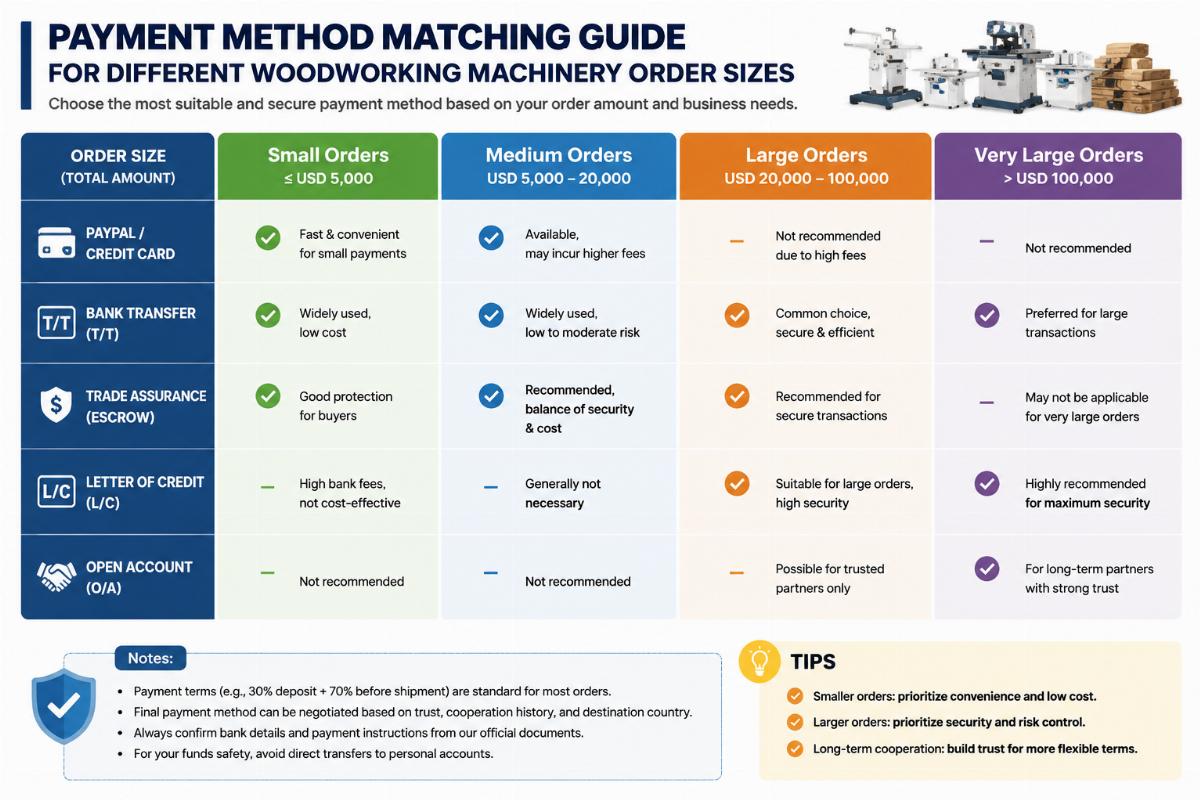
The optimal payment solution directly corresponds to your order size, customization requirement, and buyer identity, balancing both transaction risk and total processing cost. A one-size-fits-all choice almost always leads to either unnecessary extra fees or avoidable risk exposure that can leave you with no recourse if an order falls through.
| Selection Factor | Common Mistake | Best Practice |
|---|---|---|
| Order Value | Picking L/C for all orders regardless of total cost | Use Trade Assurance for orders under 50,000 USD, T/T for 50,000 to 150,000 USD, L/C for over 150,000 USD |
| Customization Level | Using pre-payment for fully custom production lines | Opt for staggered T/T payments tied to confirmed production milestone inspections |
| Buyer Relationship | Using the highest risk option for first-time supplier partnerships | Select Trade Assurance for first orders with new suppliers to build trust before moving to T/T structures |
We recently supported a small custom workshop in Kenya placing their first ever CNC machine order, who opted for full Trade Assurance for their 1-unit 1325 router purchase, paying only 1.2% in processing fees and resolving a minor delivery delay in 3 business days, a timeline that would have taken 3 to 4 weeks if they had used an L/C for the same 12,000 USD order.
- Map Order Parameters – Document your exact order quantity, total value, and required customization level before reaching out to suppliers for quotes.
- Reference Peer Benchmarks – Cross-check your proposed payment structure against published case studies for your specific buyer segment to confirm alignment.
- Prioritize Dispute Speed – Factor in average dispute resolution timelines for each payment method, not just headline security claims.
Is L/C always the best choice for high-value woodworking machinery orders?
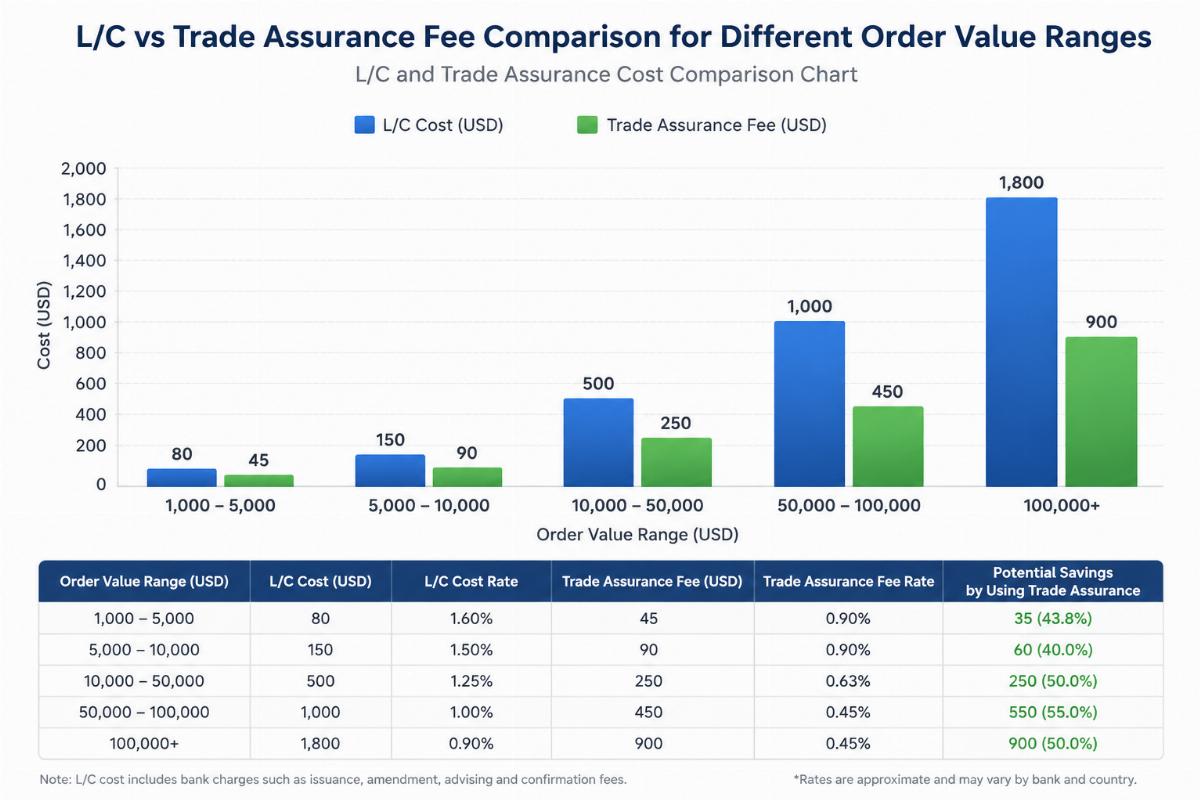
L/C is ideal for bulk container orders over 150,000 USD but may not be the most cost-effective option for small single-unit purchases. This is one of the most widely repeated misconceptions among new machinery buyers, who often assume that higher formality automatically equals lower risk, even when the extra fees and slow resolution timelines create unnecessary costs.
| Order Value Tier | L/C Outcome | Alternative Outcome |
|---|---|---|
| Under 50,000 USD | Average 3.2% processing fee, 21+ day dispute resolution window | Trade Assurance with 1.1% average processing fee, 3 to 5 day dispute resolution [NEED_CITE: Trade Assurance has lower fees and faster dispute resolution than L/C for orders under 50,000 USD] |
| 50,000 to 150,000 USD | Inflexible documentation requirements that often lead to unexpected delays | Standard 30/70 T/T split with independent third-party pre-shipment inspection |
| Over 150,000 USD | Fully aligned with bulk order and exclusive territory agreement terms | No more cost-effective alternative for large distributor stock orders |
A panel furniture producer based in Vietnam recently attempted to use an L/C for a 3-unit 68,000 USD production line order, only to find that the bank documentation requirements added 14 days to their lead time and cost them an extra 1,800 USD in processing fees that could have been completely avoided by using a standard T/T split.
- Calculate Total Cost – Always add up processing fees, bank charges, and potential delay costs when evaluating L/C as an option.
- Match to Order Scale – Reserve L/C exclusively for large bulk distributor orders, rather than using it for individual production line purchases.
- Review Documentation Rules – Confirm that your supplier can meet all L/C documentation requirements before committing to the payment structure.
What payment protection can you get when working with a formal Chinese woodworking factory?
Established certified suppliers offer payment terms fully aligned with third-party protection schemes to guarantee order fulfillment and after-sales commitments. 20+ year manufacturers including Shandong Ruiqi Machinery support all three core payment channels alongside a 2-year warranty and full turnkey installation and training support, eliminating the need for extra third-party protection for most standard orders.
| Supplier Type | Payment Protection Offered | Verified Benefit |
|---|---|---|
| Unregistered small trading companies | Only full pre-payment required, no formal recourse | Zero structured protection for order non-fulfillment |
| Mid-tier uncertified manufacturers | Only T/T accepted, no third-party alignment | No formal guarantee for after-sales support |
| 20+ year established certified manufacturers | Full support for T/T, L/C, and Trade Assurance | Payment terms tied to formal ISO 9001, CE, and TüV certification standards [NEED_CITE: Certified Chinese woodworking manufacturers offer payment terms aligned with international third-party quality standards] |
A small sign making business in Mexico recently worked with an
Leave a Reply