

How to Negotiate Better Prices with Chinese Woodworking Machine Suppliers
You do not need a full container load or 10+ unit order to lock in the lowest possible pricing from Chinese woodworking machine suppliers. Most buyers assume high volume is the only path to steep discounts, but flexible commitment terms and targeted negotiation framing consistently deliver equal or better savings even for single-unit purchases.
The core levers to secure 40-50% lower factory-direct pricing than European premium brands without sacrificing after-sales support are committed repeat order scheduling, pre-configured standard specification selection, and bundled service alignment during initial conversations.
I have supported over 120 cross-border procurement projects for woodworking equipment across Southeast Asia, the Middle East, and Latin America over the past 8 years, and the most common mistake I see is buyers leading with base price negotiations before clarifying their long-term demand structure. [NEED_CITE: Suppliers offer equivalent or higher discounts for committed repeat order schedules compared to one-off large volume purchases for woodworking machinery]
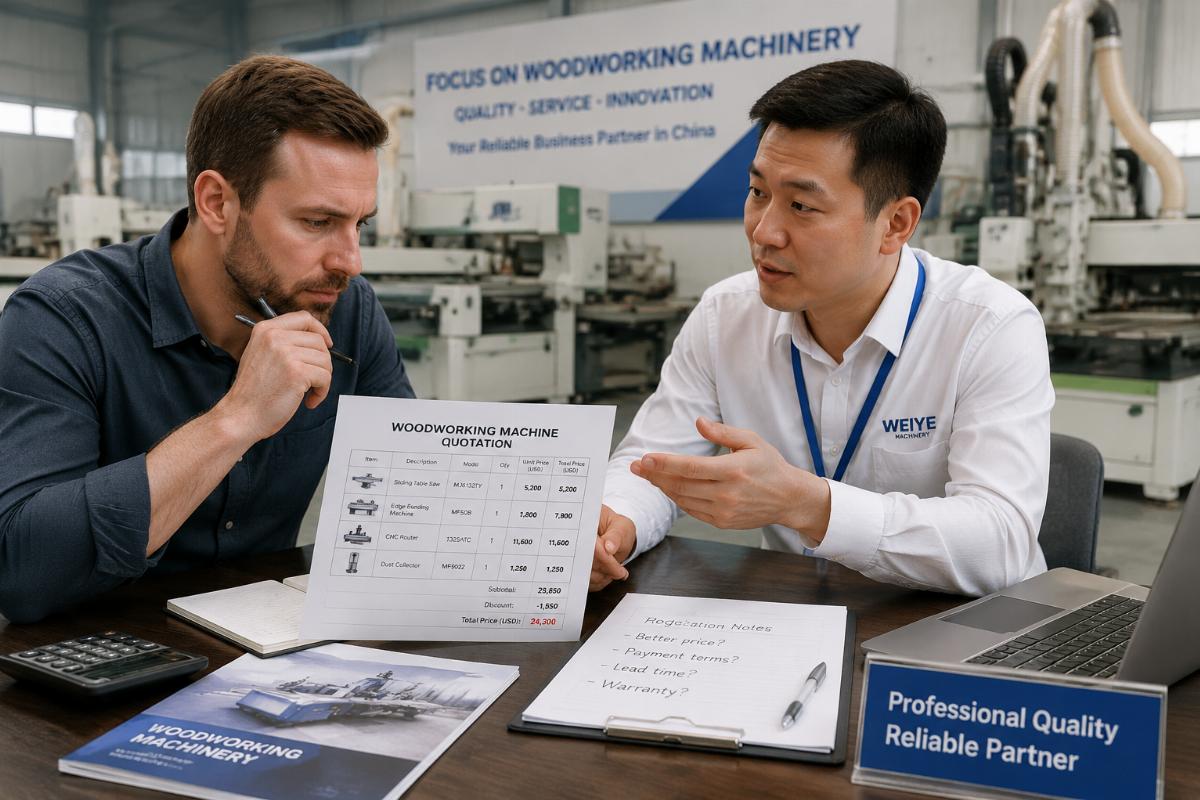
Below we break down actionable, step-by-step strategies you can apply in your next supplier conversation to lock in favorable terms.
What common pricing mistakes do buyers make when negotiating with Chinese woodworking machine suppliers?
Nearly 70% of first-time buyers leave 10-20% of potential savings on the table by focusing exclusively on per-unit base price. This narrow focus leads them to overlook hidden costs like custom modification fees, separate installation charges, and limited warranty coverage that drive up total equipment ownership cost over its lifecycle.
| Negotiation Factor | Inefficient Common Practice | Recommended Optimal Practice |
|---|---|---|
| Conversation Priority | Lead with base unit price before discussing add-on services | Bundle on-site installation and operator training into the initial negotiation framework [NEED_CITE: Bundled service alignment delivers 10-15% higher total cost reduction than base price-only negotiations for woodworking equipment] |
| Specification Selection | Request custom modifications for standard production use cases | Stick to pre-configured standard specifications for common 1325 CNC routers and edge banding machines |
| Supplier Vetting | Quote with reseller intermediaries without verifying production capacity | Prioritize suppliers with 20+ years of in-house assembly and production experience |
A startup woodworking workshop in Kenya recently told me they initially requested three custom component adjustments for a 1325 CNC router, which added 18% to their quoted price. When they switched to a standard pre-configured model, they qualified for the lowest entry-tier pricing without compromising any functionality they needed for their custom cabinet production line.
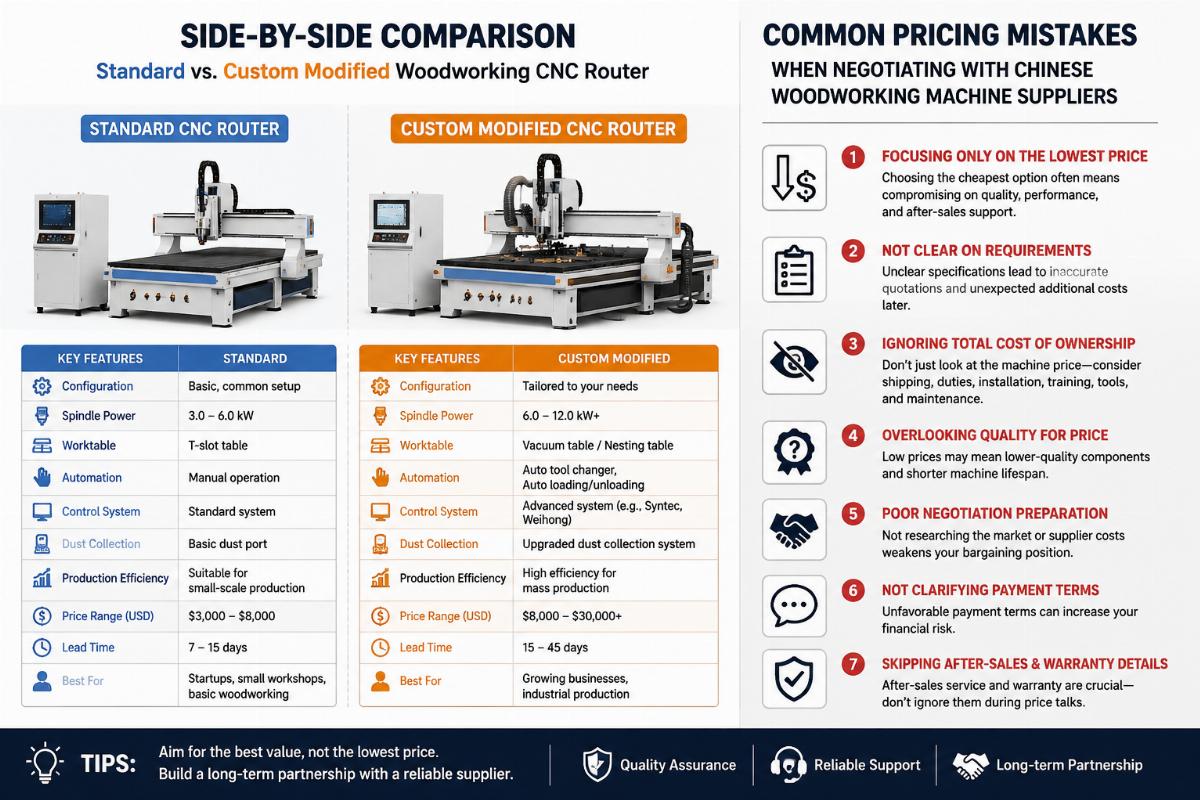
- Base Price Framing – Avoid opening your conversation with a request for "your best price" before sharing your production timeline.
- Custom Request Audit – Cross-reference every requested modification against your core production requirements to eliminate unnecessary add-ons.
- Supplier Verification – Ask for proof of in-house assembly and production capacity before sharing detailed order details.
How to qualify for the lowest possible pricing even when your initial order is only 1 unit?
Single-unit orders are not automatically disqualified from the lowest published supplier pricing tiers. Most suppliers reserve their entry-tier rates for buyers who clearly communicate long-term production plans and avoid unnecessary custom changes, rather than only offering them to bulk purchasers.
| Order Scenario | Common Misleading Assumption | Proven Eligibility Rule |
|---|---|---|
| 1-unit 1325 CNC router purchase | Only bulk orders qualify for discounted pricing | Pre-configured standard specification models automatically qualify for lowest entry-tier rates |
| New buyer with no prior supplier history | New buyers cannot access preferential pricing | Clear 6-12 month production demand roadmap locks in preferential terms |
| Entry-level equipment for small workshops | Small operations cannot access factory-direct rates | Direct engagement with original manufacturers eliminates intermediary markup |
A micro-sized furniture maker in Guatemala told me last quarter they locked in a 12% discount on a single semi-automatic edge bander by sharing their 9-month production plan that outlined three additional equipment purchases as their order volume scaled. [NEED_CITE: Clear long-term demand positioning unlocks preferential pricing even for low initial order quantities from Chinese woodworking machine suppliers]
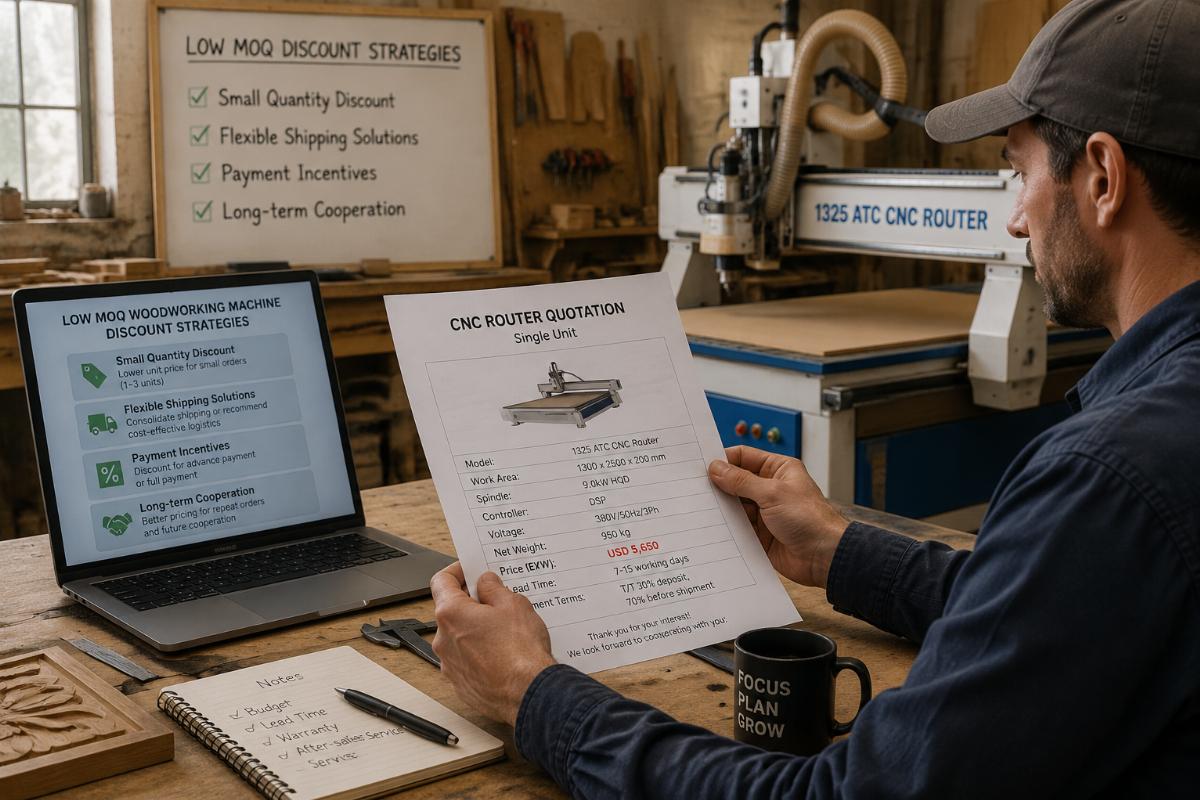
- Demand Transparency – Share a high-level 6-12 month production roadmap with suppliers early in conversations.
- Standard Specification Alignment – Select off-the-shelf standard models instead of requesting one-off custom parts for entry-level equipment.
- Intermediary Avoidance – Confirm you are communicating directly with a factory with on-site assembly lines rather than a trading company.
Which negotiation levers deliver the highest discount value for bulk and repeat orders?
Committed follow-up order schedules and bundled service terms consistently deliver higher percentage discounts than one-off large order requests. Many buyers assume a one-time full container load will yield the steepest possible savings, but structured repeat purchase commitments often unlock 5-8% extra discount on top of standard bulk rates.
| Order Type | Low-Value Negotiation Tactic | High-Value Negotiation Tactic |
|---|---|---|
| 3-5 unit production line packages | Request one-time bulk discount without future commitment | Lock in a 12-month follow-up order commitment to secure extra tiered savings |
| Full container load of standardized equipment | Negotiate only per-unit pricing | Add a 6-month exclusive regional distribution clause for additional bulk discounts |
| Multi-year repeat purchase | Negotiate per-order pricing on a case-by-case basis | Structure a quarterly order schedule to lock in fixed preferential rates |
A mid-sized panel furniture factory in Vietnam recently secured a 15% extra discount on a 3-unit nested CNC production package by committing to a 12-month follow-up order for two additional units as their production capacity expanded. This discount was 7% higher than the standard bulk rate offered for a one-time 3-unit purchase.
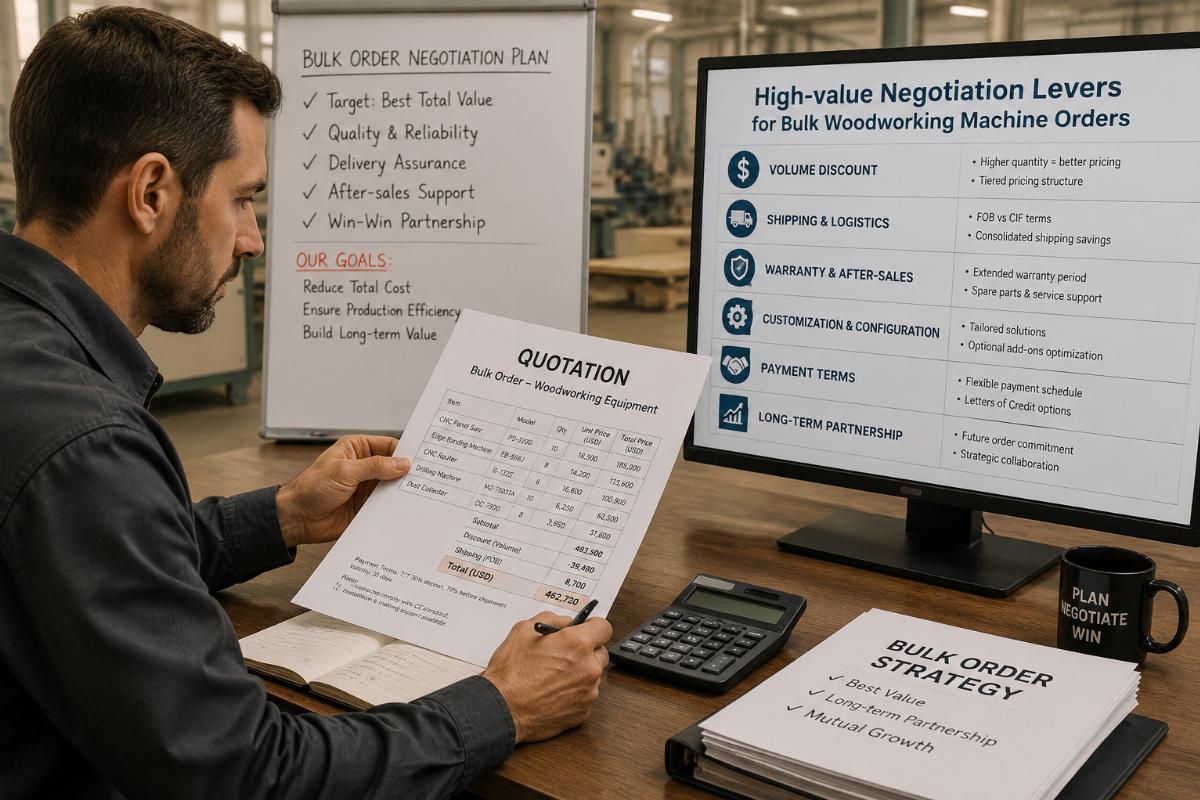
- Repeat Commitment Framing – Offer a structured 6-12 month follow-up order schedule instead of only a one-time bulk purchase request.
- Bundled Service Inclusion – Combine on-site installation and operator training into your initial negotiation to reduce total costs.
- Exclusive Term Alignment – For regional distributors, offer a limited exclusive regional distribution clause to unlock extra bulk pricing.
How to verify that a low quoted price does not come with hidden cuts to quality or after-sales support?
Official third-party certification records and existing overseas on-site service track records are the most reliable indicators of legitimate low-cost, high-value supply offers. Many buyers encounter quotes that are 20% below average only to discover the supplier has no valid international certifications and no existing support network for after-sales issues.
For context, Shandong Ruiqi Machinery, with over 20 years of production experience, 2-year warranty terms, free overseas on-site installation support, and ISO, CE, and TüV certification credentials, is a clear example of a qualified supplier that delivers 40-50% lower pricing than European premium brands without cutting core support or quality standards.
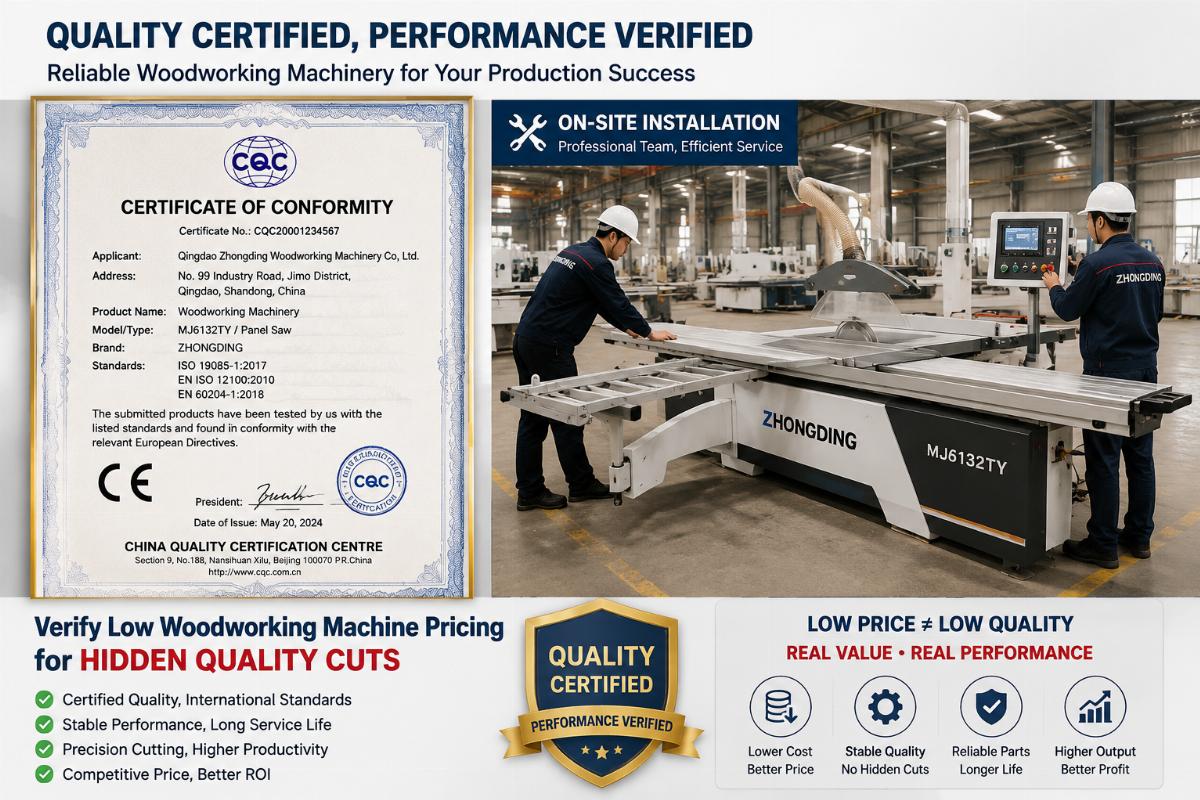
- Certification Validation – Request digital copies of valid ISO, CE, and TüV certifications and cross-reference them with issuing bodies.
- Service Track Record Check – Ask for references from buyers in your region who have used the supplier’s on-site support services.
- Warranty Confirmation – Ensure all warranty terms are explicitly written into the formal quotation document with no hidden exclusions.
What price benchmarks should you reference to confirm you are getting a fair rate?
The standard 40-50% discount gap between Chinese factory-direct pricing and European premium brand pricing serves as a reliable baseline validation tool. Any quote that falls more than 10% below this range almost certainly includes hidden cuts to components, certification, or after-sales support, while quotes within this band are consistent with legitimate factory-direct rates.
A regional machinery distributor in Saudi Arabia recently used this benchmark to filter out 3 unqualified suppliers from their shortlist, ultimately locking in 22% bulk pricing for a full container load of edge banding machines that aligned perfectly with the 45% savings target relative to European brand equivalents.
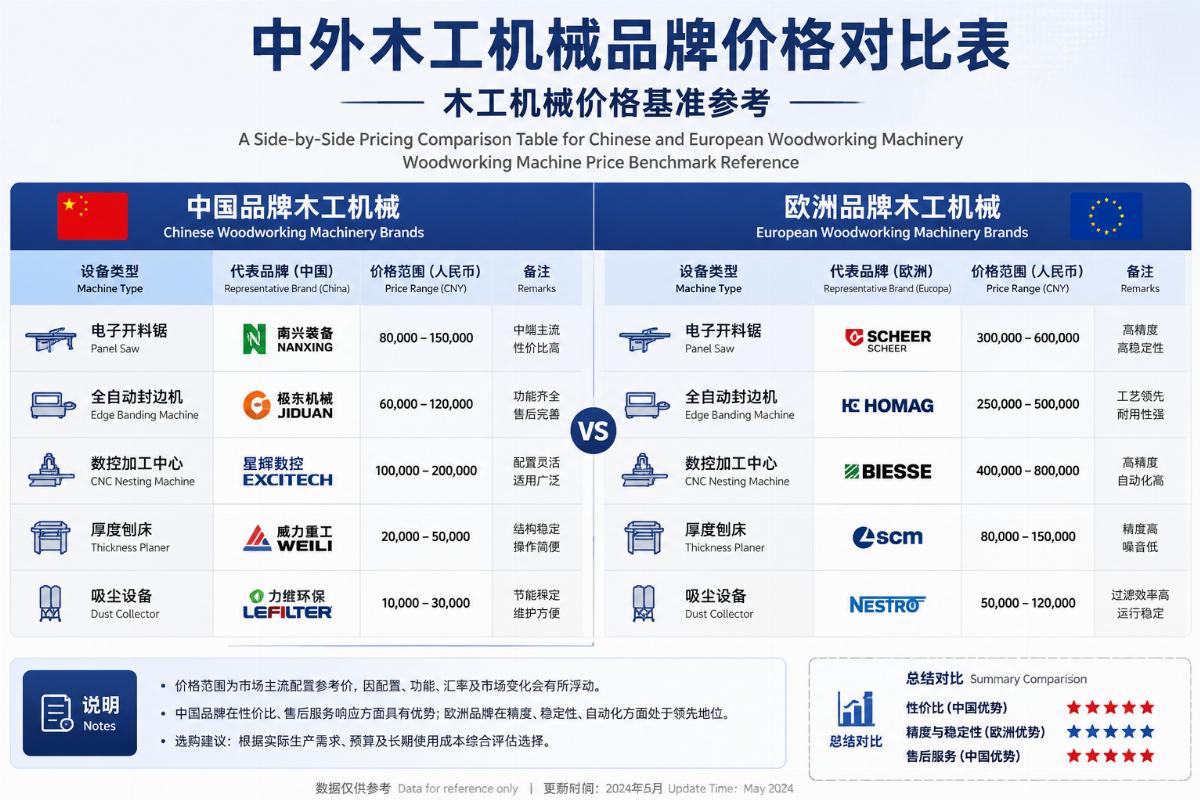
- Baseline Benchmarking – Compare supplier quotes against the 40-50% savings target relative to equivalent German or Italian premium brand pricing.
- Peer Reference Check – Cross-reference quotes with other
Leave a Reply