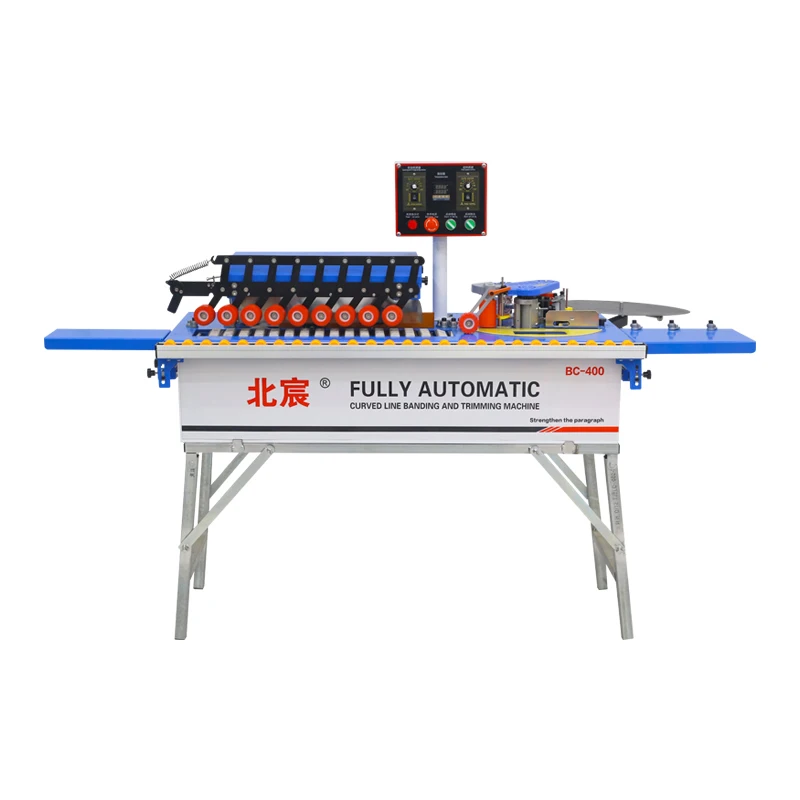
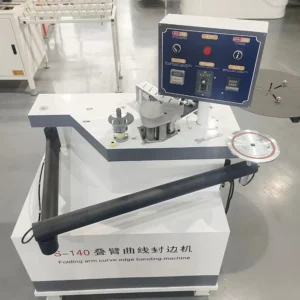
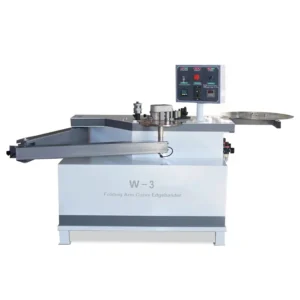
Precision-built DW400 edge bander — every unit ships with confirmed electrical schematics matching your facility’s voltage, eliminating on-site rewiring delays.
Technical Specifications
| Parameter |
Value |
| Model |
DW400 |
| Product Type |
Semi-Automatic Edge Banding Machine |
| Total Power |
3800W |
| Voltage Options |
220V / 380V / customization available |
| Trimming Power |
650W × 2 |
| Polishing Power |
180W × 2 |
| Vacuum Power |
1200W |
| Edge Power |
20W |
| Transmission Power |
60W |
| Air Source Pressure |
0.5–0.8 MPa |
| Glue Pot Capacity |
1000 ml |
| Edge Banding Height |
0–50 mm |
| Edge Banding Thickness |
0.3–3 mm |
| Minimum Sheet Length |
25 cm |
| Minimum Sheet Width |
10 cm |
| Product Size |
116 × 47 × 69 cm |
| Product Weight |
70 kg |
| Control Language |
Chinese and English standard; other languages customizable |
| Plug Options |
EU, USA, AU, UK |
| Assembly State |
Fully assembled, wooden case packed |
| Feed Speed |
(basis to be confirmed) |
| Panel Thickness Range |
(basis to be confirmed) |
Application Suitability
| Application |
Material or Output |
| Cabinet door edge finishing |
MDF and particleboard panels with PVC edge banding |
| Furniture straight-edge trimming |
Plywood and blockboard with veneer or melamine strips |
| Polymer door panel processing |
Polymer composite boards requiring adhesive tape banding |
| Workshop-scale production runs |
Medium-volume straight edge banding for custom furniture makers |
Why the Voltage Question Should Come Before the Price on Any Semi-Automatic Edge Banding Machine
Confirming your facility’s voltage and frequency before production starts prevents weeks of on-site electrical rework.
I spent years on the assembly floor before moving to the export side, and one incident stuck with me. A semi-automatic edge bander shipped to South Asia arrived with a motor configuration that did not match the local grid frequency. The motor would not start, and rewiring the entire cabinet took three weeks on-site. That is not a problem you fix with a phone call. Every DW400 now goes through a mandatory voltage confirmation step before production begins, with a signed electrical schematic matching your exact supply [NEED_CITE: voltage and frequency standards by export market]. Skipping this conversation at the inquiry stage costs far more than addressing it up front.

Component Sourcing and Assembly Depth
The DW400 semi-automatic edge banding machine is built from the frame up in a single facility, not assembled from third-party sub-kits. Trimming motors rated at 650W each and polishing units at 180W are sourced, inspected, and matched during incoming material QC before they reach the assembly bench. This matters for OEM partners who need to verify manufacturing depth before committing to a private-label program. When a distributor can trace every critical component back to its incoming inspection record, resale confidence in the regional market improves.
Four-Stage QC From Raw Steel to Crate
Every unit moves through incoming material inspection, in-process assembly checks, finished-product functional testing, and pre-shipment verification. The glue pot is run at operating temperature to confirm stable adhesive flow across the full 1000 ml capacity. Trimming and polishing heads are tested on actual MDF and plywood samples to confirm edge finish quality before the machine is cleared for packing [NEED_CITE: CE machinery directive requirements for industrial equipment]. For OEM orders, logo placement, nameplate branding, and control panel graphics are verified at this final stage against the agreed artwork.
Reading the Specs That Actually Matter
Edge banding thickness range from 0.3 to 3 mm means this machine handles everything from thin PVC foil to solid wood veneer strips, covering the majority of materials a cabinet shop encounters. The 650W × 2 trimming motors provide enough torque to cut cleanly through thicker banding without stalling, while the dual 180W polishing units remove residual adhesive and leave a smooth finish. The integrated 1200W vacuum system pulls dust directly at the trimming and polishing stations, keeping the work area clear and preventing adhesive buildup on downstream components. Air source pressure between 0.5 and 0.8 MPa drives the pneumatic clamping and feed mechanisms — confirming your workshop compressor meets this requirement avoids feed inconsistencies that show up as uneven glue lines.
The Hidden Cost of Wrong Configuration Choices
When a buyer selects an entry-level edge bander for a production volume it was never designed to handle, the first symptom is inconsistent trimming quality after several hours of continuous operation. Thermal buildup in undersized motors causes the cut to wander, and operators compensate by slowing the feed — which then creates a bottleneck at the polishing stage [NEED_CITE: thermal derating in continuous-duty woodworking motors]. Similarly, ordering a machine without confirming plug type or control panel language means the first day on your floor is spent on electrical adapters and operator confusion rather than production. These are not warranty issues; they are configuration failures that could have been resolved during the quotation phase.
Why Procure This Machine Here
Every DW400 carries a confirmed electrical schematic before the first component is cut, so your grid match is documented, not assumed. OEM partners receive full private-label scope covering panel printing, nameplate, control panel branding, and packaging — verified during pre-shipment inspection. The four-stage QC process means incoming material, in-process assembly, finished testing, and dispatch verification are all recorded and available for review. Engineers provide a formal configuration proposal within 24 hours of receiving your production requirements, not a generic catalogue quote. Factory visits are open for buyers who want to witness assembly and testing firsthand [NEED_CITE: ISO 9001 quality management system requirements for manufacturing audits].
Documentation & Verification
- Electrical schematic and voltage confirmation document signed before production
- Factory test record showing edge finish on your specified panel material
- Machine specification sheet matching final as-built configuration
- Operation and maintenance manual in your agreed language
- Spare parts list with part numbers for trimming blades and polishing wheels
- Packing photographs documenting condition before crate closure
Installation, Commissioning & Support
- Requires a dedicated circuit matching confirmed 220V or 380V supply with appropriate breaker rating
- Compact 116 × 47 × 69 cm footprint fits standard workshop layouts without floor reinforcement
- Ships fully assembled; connect air supply at 0.5–0.8 MPa and power to begin commissioning
- Glue pot temperature calibration performed on your specific banding material during first run
- Trimming and polishing parameters set to match your 0.3–3 mm edge banding thickness range
- Recommended spare blades and polishing pads included for initial production period
What to Include in Your Inquiry
Share your panel material types and typical edge banding thickness so we can confirm the DW400 configuration matches your production mix. Specify your facility voltage, frequency, and preferred plug type to ensure the electrical system is built correctly from the start. If you are evaluating this unit for OEM or private-label distribution, indicate your branding scope requirements — panel artwork, nameplate design, and control panel language — so we can include these in the initial proposal.
Frequently Asked Questions
Q: What OEM customization is available for the DW400?
A: Private-label options cover logo application on the machine panel, custom nameplate, control panel branding, and packaging design. Artwork is confirmed and signed off before production begins. Each customization element is verified during the pre-shipment inspection stage against your approved drawings, ensuring brand consistency across your regional market.
Q: How is voltage and plug configuration confirmed before production?
A: During the quotation phase, you provide your facility voltage, frequency, and plug type. Our engineering team issues a formal electrical schematic for your approval before any component is manufactured. This prevents on-site motor failures and cabinet rewiring that occur when machines ship with assumed rather than confirmed electrical specifications.
Q: What inspections does each DW400 go through before dispatch?
A: Each machine passes through incoming material inspection, in-process assembly checks, finished-product functional testing, and pre-shipment verification. The glue pot is tested at operating temperature, and trimming and polishing stations run actual panel samples. Documentation of every stage is compiled and ships with the machine or is provided digitally on request.
Q: Can you modify the DW400 to custom specifications?
A: Specification adjustments such as voltage range, control panel language, and plug type are handled as standard configuration options. For deeper engineering modifications, submit your drawings or requirements during the inquiry stage. Our engineers review feasibility and respond with a formal proposal outlining what can be adapted and any implications for lead time.
Q: What documentation ships with each machine?
A: Standard documentation includes the CE declaration of conformity, ISO 9001 certificate, machine specification sheet, electrical schematic with voltage confirmation, operation manual in the agreed language, spare parts list, and packing photographs. Additional customs documentation support is available based on your destination country’s import requirements.