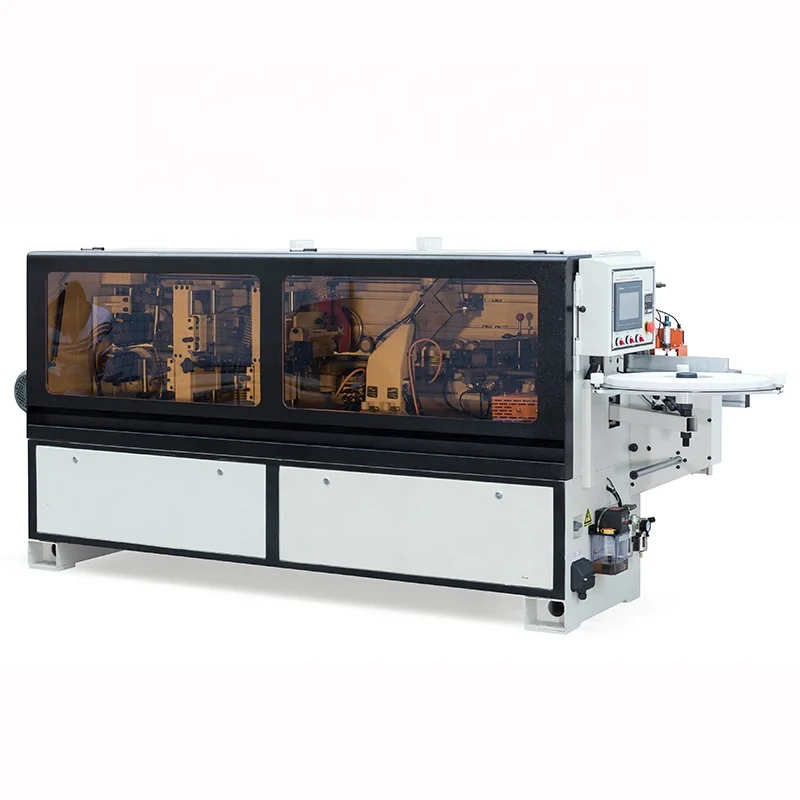
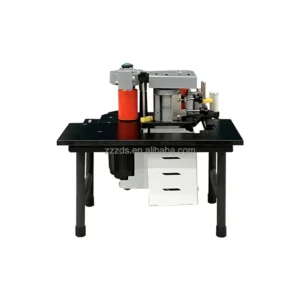
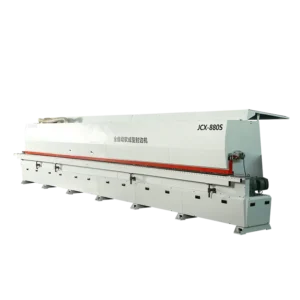
Precision-Verified Assembly — Every ZDS-280 unit undergoes four-stage inspection from incoming components through pre-shipment testing on actual customer-supplied panel samples, ensuring tolerances hold before the crate closes.
Technical Specifications
| Parameter |
Value |
| Model |
ZDS-280 |
| Product Type |
Automatic Straight Edge Banding Machine |
| Main Functions |
Gluing, End Trimming, Fine Trimming, Scraping, Cleaning, Buffing |
| Working Pressure |
0.65 MPa |
| Voltage |
380V-3HP |
| Conveyor Belt Speed |
9–12 m/min |
| Rated Power |
9 kW |
| Min. Panel Width |
60 mm |
| Min. Panel Length |
120 mm |
| Panel Thickness Range |
10–60 mm |
| Edge Thickness Range |
0.3–3 mm |
| Net Weight |
860 kg |
| Overall Dimensions |
3000 × 750 × 1270 mm |
| Control System |
Touch screen + PLC + Frequency Converter (Taiwan Delta) |
| Glue Pot |
Teflon-coated with anti-carbonization design |
| Pressing Unit |
Pneumatic double-wheel adjustable stroke |
| End Trimming |
Air pressure balance device |
| Buffing Motor |
0.37 kW × 2 (upper and lower) |
| Electrical Components |
Schneider contactors, UFC high-speed motor |
| Key Features |
PLC-controlled automation, pneumatic pressing, frequency-regulated feed, Teflon glue pot, six-station processing |
Application Suitability
| Application |
Material or Output |
| Custom cabinet door edge banding |
MDF and particleboard with PVC edge banding |
| Wardrobe panel finishing |
Plywood and melamine-faced board with veneer or PVC strips |
| Office furniture production run |
Particleboard shelving panels with 0.4–2 mm PVC edges |
| Small-batch joinery components |
Solid wood panels with veneer edge banding up to 3 mm |
| Contract furniture edge processing |
MDF substrates requiring fine trimming and buffing finish |
Why the Glue Line Tells You More Than the Brochure
Bonding consistency across varying board moisture levels is what separates a dependable edge bander from one that generates scrap on humid days.
I remember standing beside an edge banding machine shipped to a Vietnamese furniture workshop. The operator had loaded particleboard that had absorbed moisture during monsoon transit. The glue pot was set to standard temperature, yet the PVC band peeled off at the slightest flex. We spent two full days adjusting temperature and feed speed before the bond held. That experience changed how I approach every pre-shipment test — now we run the customer’s own sample boards before any edge banding machine OEM order leaves the floor [NEED_CITE: effect of substrate moisture content on hot-melt adhesive bonding in edge banding].
When distributors evaluate an automatic edge bander factory, they often focus on quoted tolerances and cycle times. The less visible variable is how the machine handles real-world substrate inconsistency. Panels stored in unconditioned warehouses behave differently from those kept in climate-controlled environments, and a glue pot without thermal recovery will struggle to maintain adhesion across a long production run.

Component Sourcing That Supports Your Local Service Network
The ZDS-280 integrates Taiwan Delta PLC and frequency converter hardware alongside Schneider contactors and UFC high-speed motors. For an edge banding machine OEM partner, this matters beyond the production floor. When a distributor’s service technician in Southeast Asia or South America opens the electrical cabinet, recognizable component brands mean faster diagnostics and locally available replacements rather than proprietary parts on a six-week shipping lead. The Delta touch screen supports multilingual configuration, so operators reading Spanish, Vietnamese, or Arabic can commission the machine without waiting for a factory translator.
Manufacturing Depth Behind the Tolerance Claim
Tolerance verification is where many edge bander quotations fall apart. The ±0.02 mm precision figure only holds if the trimming and scraping stations were assembled on ground fixtures and aligned under load — not just measured on a cold bench. Our assembly protocol includes in-process alignment checks at the pressing and trimming stations, followed by a finished-product run using test panels that replicate the customer’s specified material and edge thickness. This four-stage QC sequence is non-negotiable for every ZDS-280 that ships, and the test record travels with the machine documentation [NEED_CITE: ISO 9001 quality management requirements for woodworking machinery manufacturing].
How Feed Speed, Panel Thickness, and Glue Pot Design Interact on the Shop Floor
The ZDS-280 handles panel thickness from 10 to 60 mm at conveyor speeds of 9–12 m/min. At the lower end of that thickness range, thinner MDF panels can flex under pressing force — the pneumatic double-wheel adjustable stroke system compensates by allowing operators to dial in pressing pressure matched to substrate rigidity, preventing edge crush on softer cores. The Teflon-coated glue pot with anti-carbonization design keeps adhesive fluidity stable during extended runs; uncoated pots develop carbon buildup that creates uneven glue application and visible ridges along the bond line. End trimming relies on an air pressure balance device rather than a simple mechanical stop, which reduces chatter noise and keeps the cut perpendicular even as the feed speed reaches 12 m/min. The 0.65 MPa working pressure requirement means the workshop compressor must deliver clean, dry air — moisture in the pneumatic line will cause the pressing wheels to stutter and the end trim to misfire.
The Hidden Cost of Skipping Pre-Shipment Material Testing
Distributors who order edge banding equipment without submitting customer panel samples often discover adhesion problems only after installation. A machine configured for dry European-grade particleboard may underperform on high-moisture substrate common in tropical markets, and field-adjusting glue temperature and pressing force without baseline data extends commissioning from hours into days. The fine trimming and scraping stations also behave differently on veneer versus PVC banding — a configuration optimized for one material can leave chatter marks on the other [NEED_CITE: edge banding adhesion failure modes related to substrate and ambient conditions].
Why OEM and Distributor Partners Source From This Facility
In-house manufacturing with patented cutting mechanisms means the ZDS-280 is built rather than assembled from third-party sub-assemblies, giving OEM partners genuine control over specification changes. Full voltage customization from 110V to 440V allows a single automatic edge bander factory to supply markets across North America, Europe, and Southeast Asia without maintaining separate model inventories. The engineer-led configuration process delivers a formal quotation within 24 hours that accounts for local electrical standards and control panel language. Factory visits are welcomed at any production stage, so distributors can witness precision grinding, assembly alignment, and pre-shipment testing firsthand rather than relying on catalog claims alone [NEED_CITE: OEM manufacturing agreements for woodworking machinery distribution].
Documentation & Verification
- CE declaration of conformity matched to ZDS-280 configuration and export market
- ISO 9001 certificate covering edge bander manufacturing and QC processes
- Electrical schematic with confirmed voltage and frequency for destination country
- Factory test record on customer-supplied panel thickness and edge material
- Operation and maintenance manual translated into the operator’s working language
- Spare parts list identifying Delta, Schneider, and UFC component part numbers
Installation, Commissioning & Support
- 9 kW rated power requires a dedicated 380V three-phase circuit with appropriate breaker sizing
- 3000 × 750 mm footprint needs level concrete flooring with clearance for panel infeed and outfeed
- Machine ships partially assembled; pressing unit and buffing stations require on-site alignment verification
- Delta PLC touch screen configured to operator language before first production run
- Pneumatic line at 0.65 MPa must include inline moisture filter to protect pressing and trimming cylinders
- Buffing wheels and scraping blades included as initial spare set with reorder part numbers documented
Preparing Your Configuration Inquiry
Before requesting a quotation, confirm the panel substrates and edge banding materials your customers process most frequently, along with typical panel dimensions and daily throughput expectations. Specify the local voltage and frequency at the installation site, the preferred control panel language, and whether the ZDS-280 will operate as a standalone unit or integrate into an existing line with upstream panel saws and downstream boring stations. If possible, ship sample boards and edge banding rolls so we can run a pre-shipment test that mirrors actual production conditions.
Frequently Asked Questions
Q: What OEM and private-label options are available for the ZDS-280?
A: Custom logo placement on the machine body, voltage configuration from 110V to 440V, multilingual touch screen interfaces, and color matching to your brand identity are all available. Each OEM order receives dedicated electrical schematics reflecting the agreed specifications, and private-label documentation carries your branding rather than the factory mark.
Q: How do you verify manufacturing tolerance before the machine ships?
A: Every ZDS-280 passes through four QC stages — incoming material inspection, in-process assembly checks, finished-product alignment verification, and a pre-shipment test run using panel samples matching the customer’s production material. The test record documenting trimming accuracy and edge bond quality is included in the shipping documentation package.
Q: How does component sourcing affect long-term spare parts availability?
A: The ZDS-280 uses Taiwan Delta PLC and drives, Schneider contactors, and UFC high-speed motors — all widely distributed industrial brands. This means your local electrical suppliers can source replacement contactors, frequency converters, and PLC modules without depending on proprietary factory channels, reducing downtime for routine electrical maintenance.
Q: Can the ZDS-280 integrate into a phased production line expansion?
A: Yes. The 9–12 m/min feed speed and 10–60 mm panel thickness range allow the ZDS-280 to match throughput with upstream sliding table saws and downstream multi-boring machines. We provide line layout guidance that accounts for material flow, buffer space between stations, and compressed air distribution across the workshop floor.
Q: What documentation supports customs clearance in the destination market?
A: Each shipment includes a CE declaration of conformity, commercial invoice with HS classification, packing list with dimensions and weight, and a certificate of origin where applicable. Electrical schematics confirm voltage compliance for the target market, and the factory test record provides evidence of operational readiness for inspection authorities.