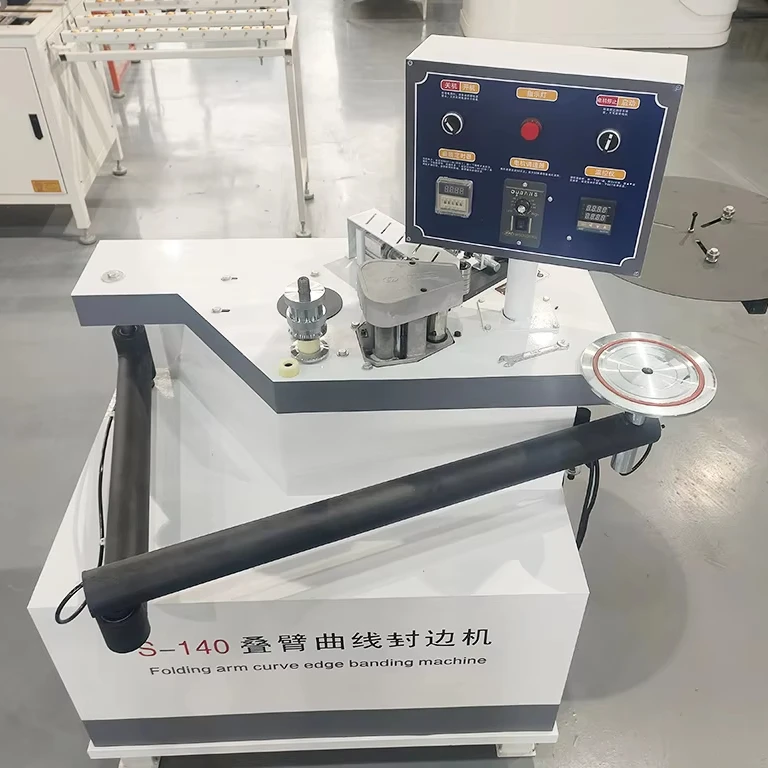
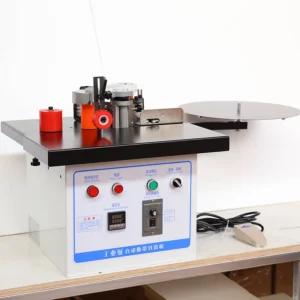
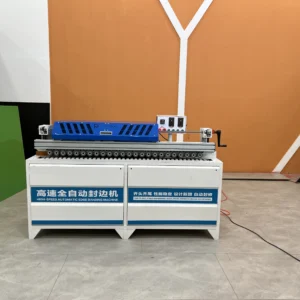
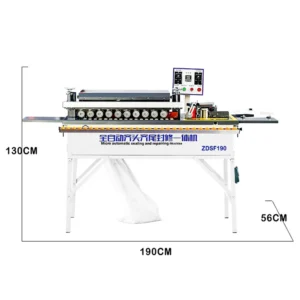
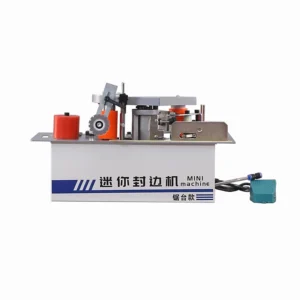
Precision-ground assembly with four-stage QC — every curve edge banding machine OEM order runs through incoming material, in-process, finished product, and pre-shipment verification before the crate closes, with a factory test record signed off on your specified edge band thickness range.
Technical Specifications
| Parameter |
Value |
| Model |
S-140 / W-2 / W-3 |
| Product Type |
Curve Edge Banding Machine |
| Voltage |
220V (S-140); 220V 50Hz (W-2, W-3) |
| Total Power |
1.4 kW (S-140, W-2); 3.4 kW (W-3) |
| Air Pressure Requirement |
0.5–0.8 MPa |
| Edge Banding Speed |
0–180 mm/s |
| Edge Band Thickness Range |
0.4–2 mm |
| Edge Band Width Range |
8–50 mm |
| Glue Pot Capacity |
1000 ml (S-140) |
| Gluing Method |
Double-sided gluing |
| Breaking Method |
Automatic tape break, double cylinder controlled |
| Standard Suction Cup |
200×26 mm (S-140); 300×26 mm (W-2, W-3) |
| Hot Air Device |
Bottom-up hot air heating |
| Edge Banding Wheel |
Adjustable +0.5 mm to edge strip width |
| Motor Type |
Pure copper motor |
| Control Panel Features |
Intelligent temperature control, speed adjustment, timer |
| Function |
Straight and curved dual purpose |
| Overall Size |
96×62×88 cm (S-140); 1200×800×1220 mm (W-2); 1210×1100×970 mm (W-3) |
| Weight |
88 kg (S-140); 152 kg (W-2, W-3) |
Application Suitability
| Application |
Material or Output |
| Custom cabinet door edge finishing |
MDF and particleboard with PVC edge banding |
| Curved wardrobe panel profiling |
Plywood and melamine-faced board with veneer strips |
| Office desk and study table edging |
Particleboard panels with 0.4–2 mm PVC bands |
| Solid wood furniture contour banding |
Solid wood panels with veneer edge material |
| Window and door component finishing |
Plywood profiles with narrow 8 mm banding |
| Small-batch decoration industry work |
Mixed substrate panels on curved and straight profiles |
Why the Voltage Question Should Come Before the Price on a Curve Edge Banding Machine OEM Order
A machine wired for the wrong grid is a crate that never opens.
I learned this the hard way when a South American distributor took delivery of an automatic edge bander specified at 380 V, only to find the workshop ran 220 V at 60 Hz. The unit sat on the dock while a step-up transformer was sourced locally — three weeks of dead time, freight damage risk, and a customer relationship under strain [NEED_CITE: voltage and frequency standards by export market]. Since then, every curve edge banding machine OEM build I oversee starts with a confirmed electrical schematic matched to the destination grid before a single component is pulled from stock.
Component Sourcing and Assembly Depth
Manufacturing depth matters when you are putting your own label on the machine. The S-140, W-2, and W-3 series are assembled on our floor from precision-ground components, with proprietary cutting mechanisms that hold tolerance across both straight runs and curved profiles. For OEM partners, this means the curve edge banding machine OEM nameplate carries a build history you can trace back through our in-process inspection records — not a rebranded unit from a third-party line with unknown provenance.
Private-Label Configuration as Standard Practice
Logo placement, control panel language, and color matching are not afterthoughts bolted on at the packing stage. Each curve edge banding machine OEM order receives a configuration sheet covering branding position, panel text in the operator’s working language, and voltage confirmation documented on the electrical schematic. Distributors reselling into markets where operators may not read English or Chinese need this alignment before the control panel powers on for the first time [NEED_CITE: CE machinery directive requirements for industrial equipment].
How Spec Choices Translate on the Shop Floor
The double-sided gluing system with bottom-up hot air heating addresses a problem every edge banding operator recognizes: cold substrates in winter or humid workshops where glue adhesion drops unpredictably. Heating the bond line from below keeps the adhesive at working temperature across MDF, particleboard, and plywood without requiring the operator to slow the feed rate manually. The automatic tape break, controlled by a double-cylinder mechanism, terminates the strip consistently whether the profile is a tight inside curve or a long straight run, reducing the hand-trimming work downstream. An adjustable banding wheel set +0.5 mm wider than the strip prevents lateral drift during the feed cycle — a small detail that keeps the edge band centered on 8 mm narrow stock and 50 mm wide material alike. The pure copper motor delivers stable torque across the 0–180 mm/s speed range without the thermal drop-off common in aluminum-wound alternatives at sustained duty.

What Happens When the Specification Step Gets Skipped
Distributors who select a model tier based on price alone often discover the mismatch at the worst possible moment. An entry-level S-140 placed in a high-volume cabinet shop will run beyond its intended duty cycle, accelerating wear on the glue pot and feed mechanism. A W-3 with 3.4 kW total power sent to a small joinery workshop with limited electrical capacity may trip breakers during startup. Panels banded on a machine with unverified tolerance fail at the assembly bench, not on the edge bander — and by then the distributor has already invoiced the end customer [NEED_CITE: tolerance verification practices in panel processing machinery].
Why Distributors and OEM Partners Source Here
In-house manufacturing means every curve edge banding machine OEM build is traceable from incoming material inspection through pre-shipment verification, with a documented quality pass rate backed by our four-stage QC protocol. Voltage customization from 110 V to 440 V is confirmed on the electrical schematic before production starts, not discovered at the destination port. Patented cutting mechanisms and precision-ground components are built on our floor, not subcontracted. The full model range — S-140 through W-3 — lets a distributor stock a tiered lineup for different workshop sizes without managing multiple suppliers. Factory visits for first-article inspection and sample processing tests are welcomed before any order commitment.
Documentation & Verification
- CE declaration of conformity matching the exported model configuration
- ISO 9001 certificate covering the manufacturing process for your unit
- Electrical schematic with confirmed voltage and frequency for your grid
- Factory test record on your specified edge band thickness and substrate
- Operation and maintenance manual in the operator’s working language
- Packing photographs taken before crate closure for shipment verification
Installation, Commissioning & Support
- 0.5–0.8 MPa air source with dedicated regulator for the double-cylinder tape break
- 220 V circuit with appropriate breaker sizing for 1.4 kW or 3.4 kW total power draw
- Compact footprint allows bench or floor placement in workshops with limited space
- Intelligent temperature control calibrated during commissioning for your local ambient conditions
- Pure copper motor inspection and lubrication schedule included in the maintenance manual
- Spare suction cups (200×26 mm or 300×26 mm) and glue pot seals in the initial parts kit
Before You Request a Quote
Tell us the destination market’s voltage and frequency so we can confirm the electrical schematic matches your grid standard. Share the edge banding materials and panel substrates your customers typically process — PVC, veneer, MDF, plywood — so we can recommend the right model tier. If you are building territory stock, let us know the workshop size range you serve so we can align S-140, W-2, and W-3 availability to your market mix.
Frequently Asked Questions
Q: What OEM and private-label customization is available for the curve edge banding machine?
A: Logo placement, control panel language, machine color, and voltage configuration from 110 V to 440 V are all configurable. Each customization is documented on the configuration sheet and electrical schematic before production begins, so the machine arrives ready for your market without field modifications.
Q: How is tolerance verified before a curve edge banding machine OEM unit ships?
A: Every unit goes through a four-stage QC process ending with a pre-shipment factory test. We run your specified edge band thickness and substrate through the machine and document the results. The signed test record ships with the unit so you can review actual performance data before the container is sealed.
Q: What documentation is included for customs clearance and local compliance?
A: Each shipment includes the CE declaration of conformity, ISO 9001 certificate, machine specification sheet, electrical schematic with voltage confirmation, factory test record, operation manual in the agreed language, spare parts list, and packing photographs for condition verification.
Q: How do I choose between S-140, W-2, and W-3 for my regional market?
A: The S-140 suits small workshops and light-duty custom furniture. The W-2 handles moderate production volumes with a larger suction cup. The W-3 at 3.4 kW supports higher-duty applications. Share your customer profile and we will map the right tier to your territory mix.
Q: What spare parts and training support is available for distributor service teams?
A: Initial spare parts kits include suction cups, glue pot seals, and wear items specific to your model. Technical training covers assembly-level diagnostics, parameter calibration on the intelligent control panel, and maintenance intervals so your team can support end users without factory callbacks.