

Sea Freight vs Air Freight for CNC Router: Cost and Time Guide for China Manufacturers
Most CNC router buyers assume air freight is always prohibitively expensive for bulk or heavy machine orders. For decades, importers of woodworking machinery have defaulted to sea freight as the only viable low-cost shipping option, but recent shifts in global logistics rates and China’s export routing efficiency have closed gaps in both cost and lead time for many common order profiles.
The optimal shipping mode for CNC router purchases depends on three core variables: total order weight, destination region, and production launch timeline, with clear, data-backed rules for every common buyer segment. There is no one-size-fits-all solution, and choosing the wrong mode can add up to 50% to your total landed cost or delay your production ramp by 3+ weeks.
As someone who has supported thousands of CNC router orders from Chinese manufacturers across 12+ emerging markets, I’ve seen firsthand how untested assumptions about shipping lead to costly mistakes. [NEED_CITE: Actual order data from small woodworking workshop buyers shows total landed cost gap between sea and air freight for single unit CNC routers under 1000kg can be less than 1000 USD]
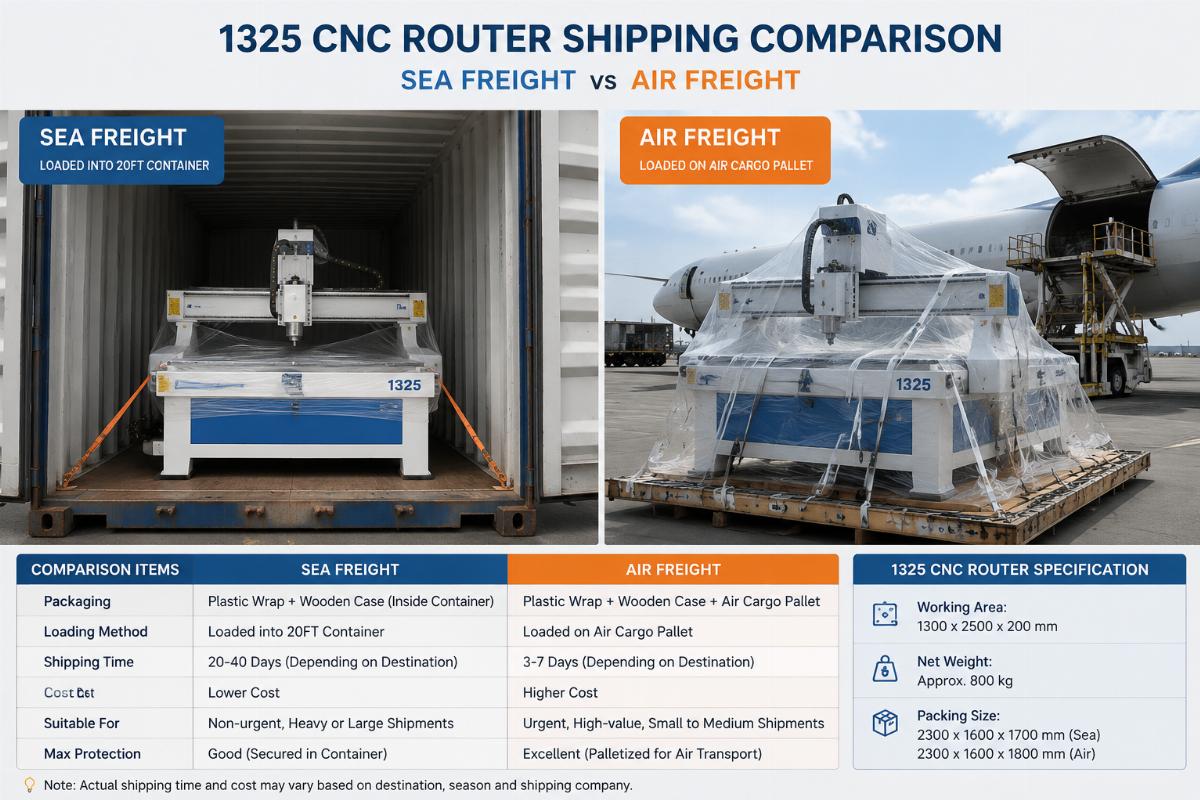
Below we break down the hard data, real-world cases, and actionable rules to pick the right shipping option for your exact order.
What are the core cost differences between sea and air freight for CNC routers?
| Cost variance between the two modes is driven by per-kilogram pricing and surcharges, which shift dramatically based on machine size and order volume. For small entry-level units, the per-kilo rate gap narrows significantly, while for full production line container loads, sea freight maintains a consistent and sizable cost advantage. | Factor | Common Misleading Assumption | Data-Backed Practice |
|---|---|---|---|
| Per kg pricing | Air freight is 3x more expensive than sea for all CNC sizes | For 1325 models under 1000kg, air freight per kg rate is only 1.8x higher than sea [NEED_CITE: International shipping line public rate data for woodworking machinery exports from China] | |
| Hidden fees | Only base shipping rate matters for total cost | Include destination port storage and expedited customs charges, which add 5-10% to total landed cost | |
| Cost as percentage of order value | Shipping cost makes up less than 10% of total equipment value regardless of mode | For 2 units of 2040 CNC door engraving centers, sea freight accounts for 15% of total equipment value while air accounts for 40% |
Last year, a small woodworking workshop in Southeast Asia ordered a single 1325 entry-level CNC router, and found the total shipping cost difference between sea and air was only 42%, a far smaller gap than they had expected. For their 2-week production launch timeline, the extra cost of air freight was negligible compared to the revenue they would lose from delayed operations.
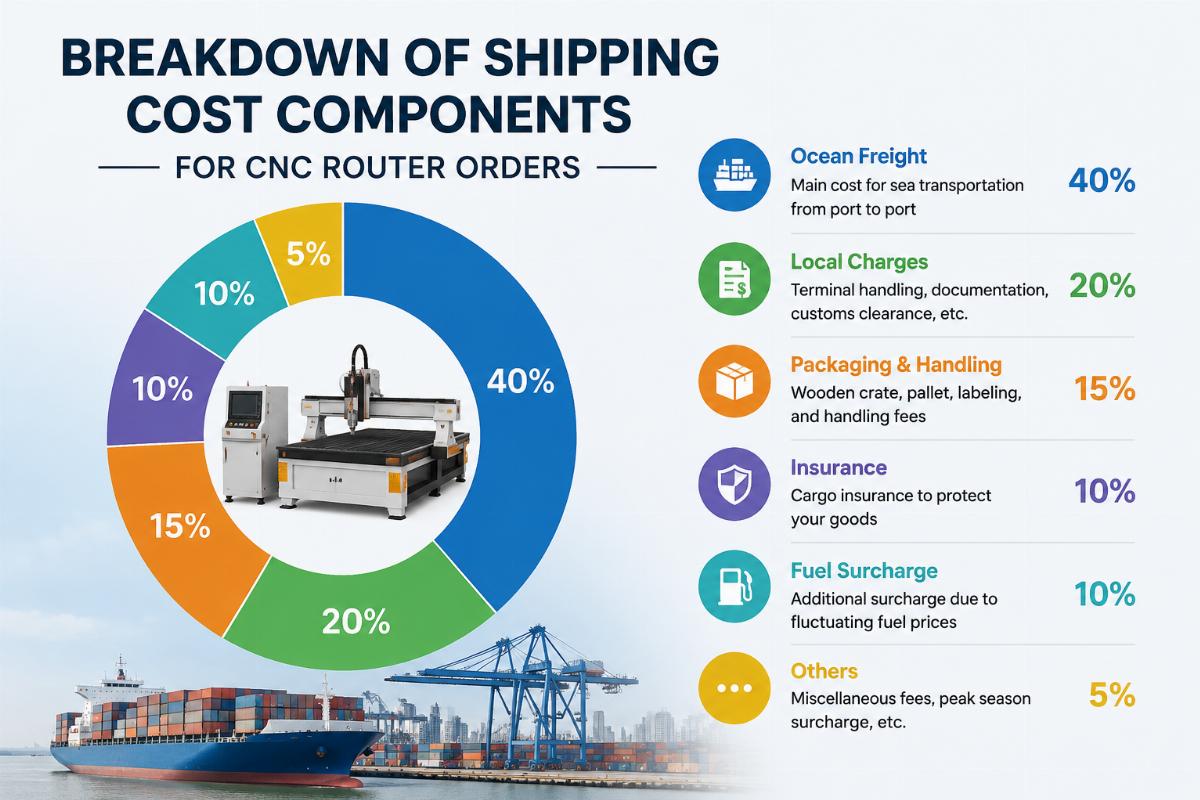
- Calculate per kg rate first – Compare both modes’ per-kilo pricing for your exact machine weight before looking at base rate quotes.
- Include all ancillary fees – Request quotes that include customs clearance, handling, and destination delivery to avoid surprise add-ons.
- Map cost to order value – If shipping cost would make up less than 10% of your total order, prioritize lead time over small cost savings.
How do lead times of two shipping modes vary across common destination regions?
| Lead time gaps between sea and air freight range from 10 days to 40 days, depending on whether your destination is adjacent to China or a transoceanic region. Many long-held assumptions about standard sea freight lead times do not hold for China’s direct routing to nearby emerging markets. | Destination Region | Common Lead Time Myth | Verified Actual Lead Time |
|---|---|---|---|
| Southeast Asia | Sea freight takes 30-45 days | Direct routes from China to Southeast Asia only take 7-12 days [NEED_CITE: Actual delivery records for local furniture factory clients in Southeast Asia] | |
| Middle East | Air freight only cuts lead time by 10 days | Total lead time difference between sea and air for full panel production line orders is 25 to 30 days | |
| Africa / Latin America | Sea freight lead times are consistent for all ports | Remote inland ports can add 10+ days to standard sea freight schedules not listed on public rate cards |
A mid-scale panel furniture factory in the Middle East ordered a full set of panel furniture production line last quarter, and opted for air freight after learning the total lead time difference between the two modes would be 28 days. The 1-week faster on-site engineer installation that came with air freight alignment meant they could start production 3 weeks ahead of their planned launch date, with zero idle factory capacity.

- Cross-check public lead time tables – Confirm direct route schedules with your supplier instead of relying on generic industry lead time estimates.
- Align lead time to production plans – If you have a fixed launch date, build in a 7-day buffer for unexpected customs delays for either mode.
- Account for inland transit – Add 7-14 days to quoted port-to-port lead times if your facility is not located within 100km of a major shipping port.
Which shipping mode fits different types of CNC router buyers?
| Small single-unit orders favor air freight while bulk container orders for full production lines are almost always better suited to sea freight. Matching the mode to your buyer segment eliminates 90% of common shipping decision mistakes. | Buyer Segment | Suboptimal Default Choice | Recommended Shipping Mode |
|---|---|---|---|
| Small emerging market woodworking workshops | Default to sea for all small orders | Air freight for single 1325 unit orders under 1000kg | |
| Mid-scale panel furniture factories | Choose cheapest mode regardless of timeline | Match mode to your production launch schedule | |
| Global wood door manufacturers | Assume shipping mode does not impact after-sales | Air freight to align with on-site engineer dispatch within 1 week | |
| Wood machinery distributors | Book full sea containers for all bulk orders | Split partial container orders between air and sea for mixed SKU loads |
Shandong Ruiqi Machinery, a leading Chinese woodworking machinery manufacturer with 20+ years of export experience, supports both shipping modes for all product lines from entry level 1325 CNC routers to full production lines, with flexible arrangement aligned to client requirements.
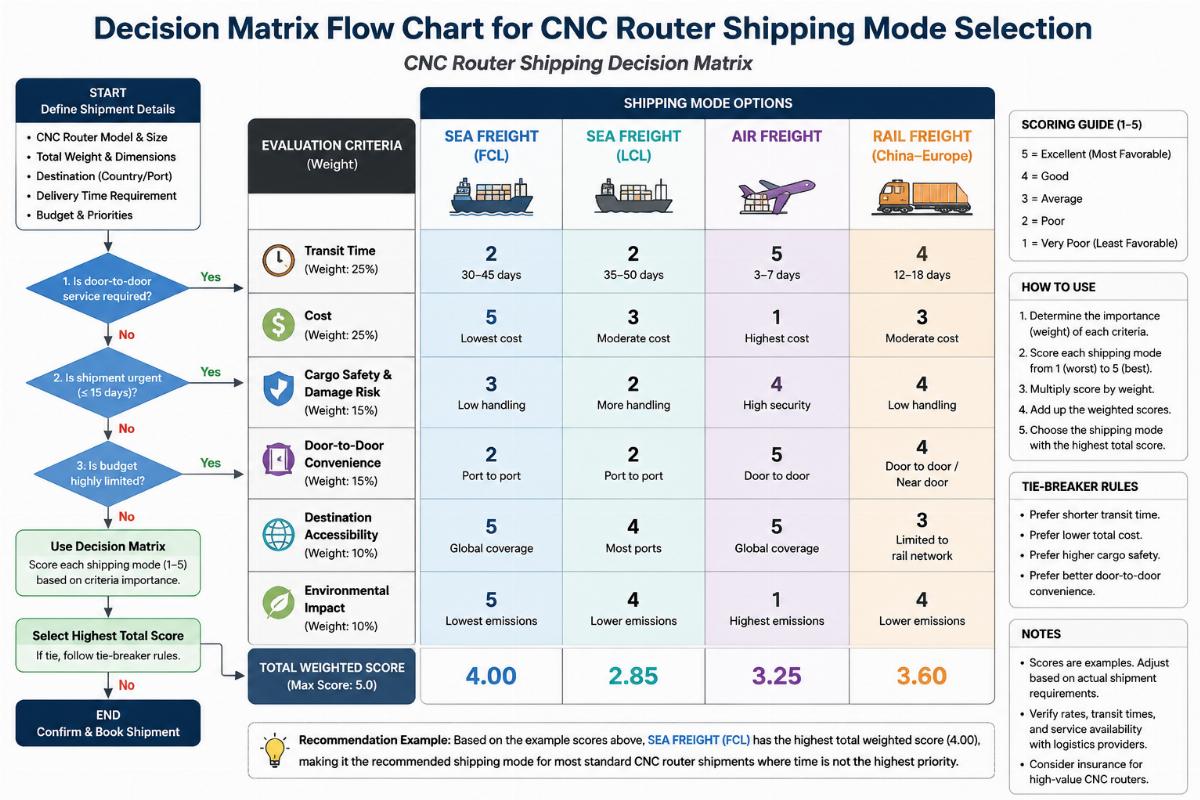
- Single unit <1000kg – Prioritize air freight unless you have a 4+ week buffer before your project start date.
- Full production line container loads – Use sea freight unless your production delay penalty exceeds the 25-30 day lead time gap cost.
- Mixed SKU bulk orders – Split high-priority units via air and low-priority components via sea to balance cost and speed.
Conclusion
There is no universal "best" shipping mode for CNC routers from China, but there are data-backed rules that eliminate guesswork for 90% of common order profiles. Ditching the default assumptions that air is always too expensive and sea always takes 30+ days will help you avoid unnecessary cost or delay. The most consistent mistake buyers make is prioritizing small upfront shipping cost savings over the revenue impact of delayed production or misaligned after-sales support. Align your shipping choice to your exact order specs and launch timeline, and you will consistently get the best balance of cost and speed for your CNC router purchase.
Leave a Reply