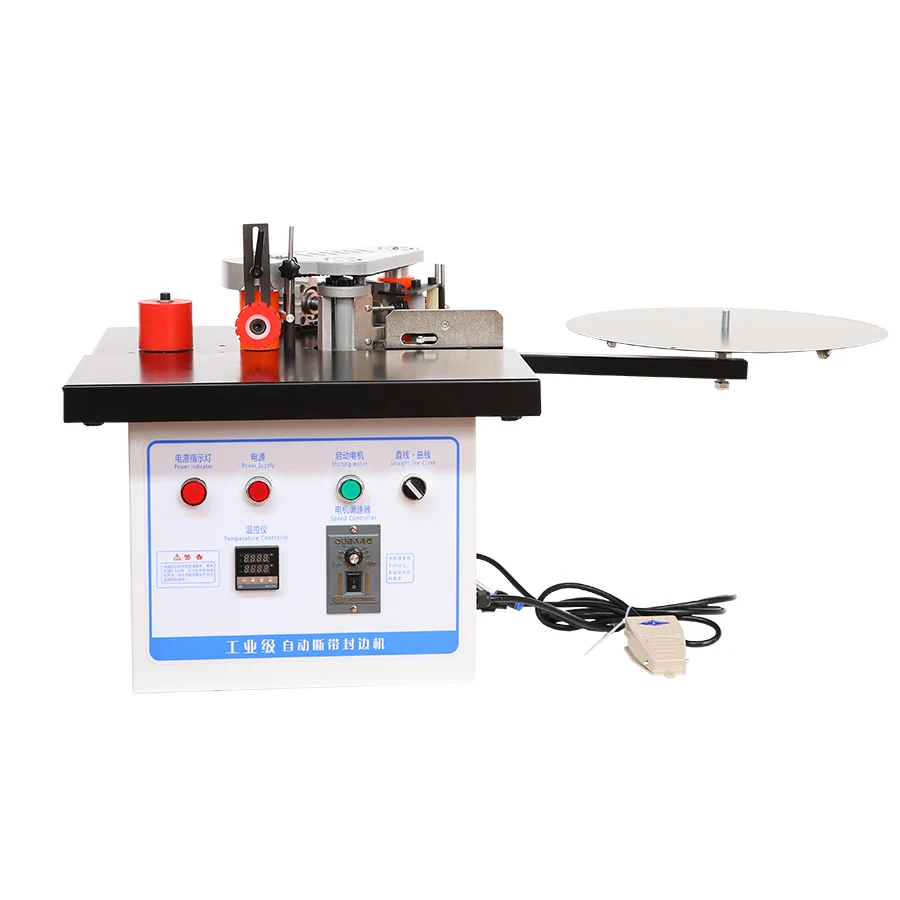
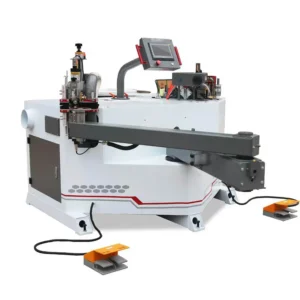
OEM Precision Build — In-house manufactured ZDSF50 mini portable edge banding machine with patented cutting mechanisms, verified tolerance, and four-stage QC before dispatch to distributors and private-label partners.
Technical Specifications
| Parameter |
Value |
| Model |
ZDSF50 |
| Product Type |
Mini Portable Edge Banding Machine |
| Rated Power |
1.2 kW |
| Voltage |
220V (50Hz/60Hz confirmation required per market) |
| Control System |
Manual with pneumatic assist and foot switch |
| Overall Dimensions (L×W×H) |
54 × 54 × 56 cm |
| Net Weight |
26 kg |
| Edge Banding Speed |
0–6 m/min |
| Strip Thickness Range |
0.5–1.5 mm |
| Panel Thickness Range |
10–60 mm |
| Glue Pot Capacity |
1000 ml |
| Glue Pot Heating Time |
5–10 min |
| Gluing Method |
Double-sided glue application via coated rollers |
| Edge Type Supported |
Straight, Curved, Shaped |
| Air Supply Requirement |
0.4–0.6 MPa |
| Belt Breaking |
Pneumatically controlled with travel switch and foot switch |
| Pressure Rollers |
Adjustable, rubber construction |
| Edge Strip Transport |
Adjustable bayonet for strip height |
Application Suitability
| Application |
Material or Output |
| Small workshop edge finishing |
MDF and particleboard panels with PVC edge strips |
| Custom furniture on-site banding |
Plywood panels with veneer edge strips |
| Curved and shaped panel edges |
MDF and plywood with 0.5–1.5 mm PVC or veneer |
| Low-volume production runs |
Straight and curved panel components for cabinet making |
Why the Voltage Question Comes Before the Quotation on a Mini Portable Edge Banding Machine
Locking electrical parameters at order stage prevents a machine from sitting idle on the workshop floor.
I have seen portable edge banders arrive in Eastern Europe with the wrong voltage configuration because the frequency was never confirmed line by line against the local grid standard. The customer’s entire cabinet line stopped while they waited for a step-down transformer to arrive. That kind of delay is entirely preventable when the OEM process requires voltage, frequency, and plug type to be documented before the machine enters assembly [NEED_CITE: voltage and frequency standards by export market].
For distributors and importers sourcing a mini portable edge banding machine from a factory, the electrical specification conversation must happen before pricing, not after. A 220V unit wired for 50Hz running on a 60Hz supply will show subtle speed drift in the feed mechanism that only reveals itself after weeks of operation. The cost of a field rewind dwarfs the five minutes it takes to confirm the destination grid.

Component Sourcing and Assembly Integrity
Every ZDSF50 mini portable edge banding machine leaves the factory with precision-ground pressure rollers and an adjustable bayonet system for edge strip transport. The rubber roller compound is selected for consistent grip across PVC and veneer materials, and each roller is checked for concentricity before installation on the shaft. Pneumatic fittings are rated for the 0.4–0.6 MPa supply range typical in small workshop compressors.
The frame welding is completed in a dedicated fixture to maintain the 54×54×56 cm footprint within tolerance, ensuring the 26 kg unit sits level on any flat workshop bench without shimming. Assembly jigs are recalibrated at intervals defined by the production engineering team, so the geometry of one unit matches the next across a distributor’s bulk order.
Private-Label and OEM Configuration Process
Distributors building a regional product line can specify their own logo placement, control panel language, and packaging artwork on the ZDSF50 platform. The manual control system with pneumatic assist allows the operator interface to be customized without redesigning the electronics — the foot switch layout and travel switch positions remain standardized for reliability, while external branding elements are adapted to the importer’s market identity [NEED_CITE: CE machinery directive requirements for industrial equipment].
OEM partners integrating this unit into a broader furniture-making equipment bundle benefit from a documented configuration sheet that travels with each order. Voltage, frequency, plug standard, and language are recorded against the purchase order number, so repeat orders from the same distributor ship with identical specifications without re-confirmation. The factory test record is branded with the distributor’s logo when requested, maintaining a consistent end-user experience.
How the Specifications Translate on the Workshop Floor
The 0–6 m/min banding speed range gives operators control over feed rate when switching between straight runs and curved sections, where slower feed prevents strip lifting at tight radii. The 10–60 mm panel thickness range covers standard MDF shelving through thicker particleboard carcass panels without requiring roller repositioning between jobs.
Double-sided glue application via coated rollers ensures adhesive reaches both the panel edge and the back of the strip simultaneously, which matters when working with porous MDF that absorbs glue quickly. The 1000 ml glue pot with 5–10 minute heat-up time supports continuous use across a batch of panels without frequent refilling interruptions.
Pneumatically controlled belt breaking with the travel switch handling straight-line cuts and the foot switch managing curved sections means the operator keeps both hands on the panel during shaping work. The 0.4–0.6 MPa air supply requirement aligns with standard workshop compressors, so no dedicated high-pressure line is needed [NEED_CITE: typical workshop compressed air system specifications].
The Cost of Skipping Specification Alignment
Importers who order portable edge banders without confirming the destination workshop’s air supply capacity often discover on commissioning day that the existing compressor cannot maintain 0.4 MPa under continuous cycling. The pneumatic belt breaking then stutters, leaving uneven strip ends that require manual trimming. This is not a machine fault — it is a specification gap that a pre-shipment checklist would have caught [NEED_CITE: pneumatic system sizing for woodworking machinery].
Similarly, machines shipped with control panel labels in a language the local operators cannot read sit unconfigured until the distributor arranges translation and relabeling. The ZDSF50 OEM process addresses this by confirming panel language at order stage, not at packing stage.
Why Distributors Source This Platform Here
The ZDSF50 is manufactured in-house with proprietary cutting mechanism patents, giving OEM partners a product built on verifiable engineering rather than assembled from bought-in sub-assemblies. The four-stage QC process — incoming material, in-process, finished product, and pre-shipment verification — generates a test record that ships with every unit, providing distributors with documentation their own customers can inspect.
Voltage customization from 110V to 440V is available as standard, not as a special order, which means a single distributor can serve multiple regional markets from one platform. CE declaration of conformity and ISO 9001 certification are available to support market entry in regulated territories. Factory visits are welcomed for distributors who want to audit the production line before committing to a bulk order.
Documentation & Verification
- Factory test record covering glue pot heating cycle and pneumatic pressure verification before dispatch
- CE declaration of conformity documentation for market entry in regulated territories
- Electrical schematic confirming voltage, frequency, and plug type per destination market
- Operation and maintenance manual in the agreed language for operator training
- Spare parts list with part numbers matching the as-built configuration
- Packing photographs documenting machine condition at point of dispatch
Installation, Commissioning & Support
- Bench space of approximately 54×54 cm required with clearance for panel overhang on the infeed side
- Dedicated 220V circuit rated for 1.2 kW continuous draw with appropriate breaker sizing
- Partial assembly required on arrival; pneumatic lines and pressure roller alignment to be verified
- Compressed air connection at 0.4–0.6 MPa with inline filter and regulator recommended
- Glue pot first heat-up monitored for full melt cycle before production banding begins
- Spare wear parts including replacement rubber rollers and bayonet guides shipped with initial order
What to Include in Your Inquiry
Distributors and OEM partners should provide the destination market’s standard voltage and frequency, preferred control panel language, and estimated annual volume so the factory can recommend neutral or branded packaging configuration. If the ZDSF50 will be sold alongside other machinery in a bundled line, sharing the upstream and downstream equipment helps the engineering team verify throughput compatibility. Sample processing tests with your specified panel material and edge strip type can be arranged before bulk production begins.
Frequently Asked Questions
Q: What OEM and private-label options are available for the ZDSF50?
A: Distributors can specify custom logo placement on the machine body, branded packaging artwork, and control panel language. The factory test record can carry the distributor’s branding. Electrical specifications are locked per order to match the destination market. Minimum quantities for branded versus neutral packaging vary — confirm at inquiry stage.
Q: How is voltage and frequency confirmed before production to match the destination market?
A: The OEM process requires the destination country, grid voltage, and frequency (50Hz or 60Hz) to be recorded on the configuration sheet before assembly begins. Each unit is tested at the confirmed voltage during pre-shipment QC, and the electrical schematic shipped with the machine reflects the as-built specification.
Q: What does the four-stage QC process cover and what test records ship with the machine?
A: The four stages cover incoming material inspection, in-process assembly checks, finished product functional testing, and pre-shipment verification. Each ZDSF50 ships with a factory test record documenting glue pot heat-up, pneumatic system pressure hold, roller alignment, and banding test results on the specified panel thickness.
Q: Can the factory arrange a sample processing test before bulk order?
A: Yes. Distributors can send their specified panel material and edge strip samples to the factory for a processing test on the ZDSF50. The test verifies glue adhesion, strip alignment, and belt breaking performance on the actual materials the distributor’s customers will use. Test results are documented and shared before order confirmation.