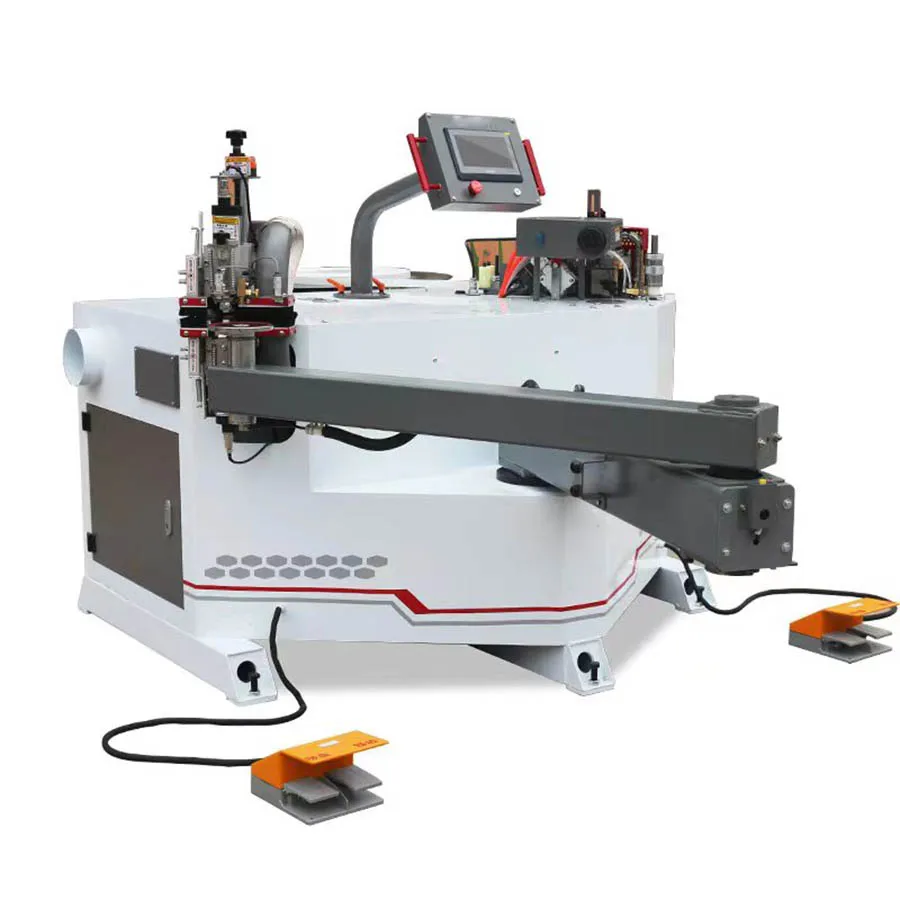
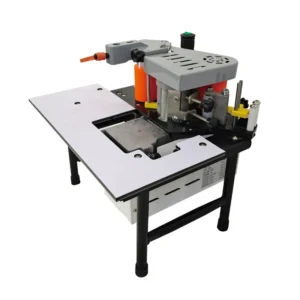
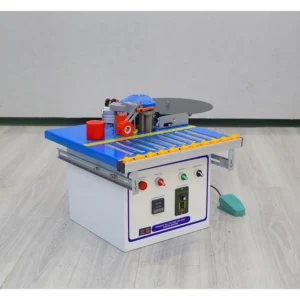
Four-Stage Quality Control — every ZDS-700 curve edge bander ships with a documented factory test record verifying ±0.3mm docking accuracy on your specified panel material before the crate is sealed.
Technical Specifications
| Parameter |
Value |
| Model |
ZDS-700 |
| Product Type |
Automatic Curve Edge Banding Machine |
| Rated Power |
6 kW |
| Voltage & Frequency |
380V / 50Hz (configurable from 110V to 440V) |
| Control System |
PLC HIU-XP with IT7000 touch screen |
| Edge Banding Speed |
0–22 m/min |
| Feeding Speed |
0–30 cm/s |
| Strip Thickness Range |
0.5–3 mm |
| Strip Width Range |
14–70 mm |
| Glue Pot Volume |
2600 ml |
| Glue Pot Operating Temperature |
110–210℃ |
| Glue Type Compatibility |
PUR and EVA |
| Edge Banding Motor |
220V 400W servo motor |
| Trimming Profiling Motor |
220V 60W single-phase motor |
| Trimming High-Speed Motor |
220V 400Hz 24000 rpm |
| Frequency Transformer |
MD200 2.2 kW |
| Laser Displacement Sensor |
1030 series |
| Docking Accuracy |
±0.3 mm |
| Touch Screen Data Storage |
20 form data sets |
| Cleaning Devices |
4 stations with automatic cleaning liquid spray |
| Hot Air Device |
1 heating unit for strip-plate bonding reinforcement |
| Air Pressure Requirement |
0.6–0.8 MPa |
| Air Storage Tank Volume |
2 L |
| Length of Stacking Arm |
2270 mm |
| Overall Dimensions (L×W×H) |
1550 × 1440 × 1350 mm |
| Net Weight |
451 kg |
Application Suitability
| Application |
Material or Output |
| Curved cabinet door edge finishing |
MDF and plywood panels with PVC or veneer strips 0.5–3 mm |
| Rounded furniture component banding |
Particleboard shaped panels with melamine edge banding |
| Custom-shaped shelving and countertop edges |
Solid wood panels with veneer or PVC strips |
| Prototype and short-run curved parts |
Mixed substrate batches in job-shop environments |
Why Claimed Tolerance Fails on the First Curved Panel
A tolerance figure is meaningless without a documented test on the actual strip and substrate combination you will run in production.
I have seen distributors receive curve edge banders with spec sheets stating tight docking accuracy, only to find visible gaps when running 3mm PVC on a 25mm MDF radius. The issue was never the machine’s mechanical capability — it was that the pre-shipment test had been done on a flat panel with thin veneer, not the buyer’s actual material profile. Curved edge banding introduces variables that flat-edge machines never encounter: strip tension shifts around radii, glue flow dynamics change with centrifugal force, and the trimming head must follow a continuously varying contour. Without testing on your specific material stack, those variables remain unknown until the container arrives at your warehouse [NEED_CITE: ISO test procedures for edge banding tolerance verification on curved substrates].
When sourcing an automatic curve edge banding machine OEM factory should produce a test record on your exact material before dispatch, not after complaints arrive.

Servo-Driven Feeding for Contour Consistency
The ZDS-700 uses a 220V 400W servo motor for the edge banding drive rather than a standard induction motor. On curved profiles, the strip must accelerate and decelerate slightly as it wraps around varying radii — a servo responds to these micro-adjustments in real time, keeping strip tension consistent from the first millimeter to the last. This is the difference between a clean bonded edge on a 100mm radius and a strip that lifts at the apex because the feed rate could not adapt. For an automatic curve edge banding machine OEM factory building units for diverse markets, the servo platform means one machine architecture handles everything from tight-radius cabinet pulls to sweeping countertop curves without hardware swaps.
Laser Displacement and Docking Control
A 1030-series laser displacement sensor monitors strip position continuously during the banding cycle. The system reads the strip-to-panel gap and commands trimming adjustments to hold ±0.3mm docking accuracy. On curved edges, this matters more than on straight runs because any deviation compounds along the contour — a small misalignment at the start of a radius becomes a visible overhang by the midpoint. The laser closes that loop without operator intervention, which is critical when a distributor ships an automatic curve edge banding machine OEM factory produced to an end user who has never set up a curve bander before [NEED_CITE: laser displacement sensor application standards in woodworking machinery].
Reading the Specs That Matter for Curved Work
The 2600ml one-time molded glue pot with heat preservation maintains stable adhesive viscosity across the entire banding cycle, which is especially important on curved profiles where the strip spends more time in contact with the pot’s delivery zone due to slower effective feed rates around tight radii. PUR and EVA compatibility means a distributor can configure the machine for their market’s dominant adhesive chemistry — PUR for moisture-critical applications like bathroom cabinetry, EVA for cost-sensitive general furniture. The IT7000 touch screen stores 20 form data sets, so a workshop running multiple curved panel profiles can recall feed speed, glue temperature, and trimming offsets without manual re-entry. The 24000 rpm trimming high-speed motor ensures a clean cut on the strip end even when the contour demands frequent direction changes. Four automatic cleaning stations with liquid spray prevent adhesive buildup that would otherwise degrade strip bonding on subsequent panels.
The Cost of Skipping Configuration Verification
I once had a customer in South America buy a curve edge bander that arrived with a 380V/50Hz electrical configuration — their workshop ran on 220V/60Hz. The machine sat crated for three weeks while a local electrician jury-rigged a transformer that was never rated for the servo motor’s starting load. The control board burned out within a month. This is not an isolated case [NEED_CITE: electrical mismatch failure rates in exported woodworking machinery]. When an importer evaluates an automatic curve edge banding machine OEM factory without locking voltage, frequency, and control panel language in writing before production, the financial exposure extends well beyond the machine’s cost — it includes downtime on the furniture line that depends on it.
How This Factory Builds for OEM Requirements
In-house manufacturing means the entire assembly — from precision-ground feeding components to the laser sensor integration — is controlled under one roof rather than outsourced to a patchwork of subcontractors. Four-stage QC covers incoming material inspection, in-process checks during assembly, finished product functional testing, and pre-shipment verification with photographic documentation at each gate. OEM scope includes logo placement on the machine body, custom nameplate design, color matching to the distributor’s brand identity, and packaging artwork prepared to the buyer’s template. Operation and maintenance manuals are produced in the target market language, so the distributor’s service team can train end users without translation delays. Voltage and frequency customization from 110V to 440V is handled as a standard production variation, not a special request.
Documentation & Verification
- Factory test record documenting ±0.3mm docking accuracy on your specified panel and strip combination before dispatch
- Electrical schematic with confirmed voltage and frequency matching your local grid standard
- Operation and maintenance manual in the agreed language covering PLC touch screen data set programming
- Packing photographs showing crating method and component securing for ocean freight
- CE declaration of conformity and ISO 9001 certificate for customs and regulatory compliance
Installation, Commissioning & Support
- Requires a dedicated 380V circuit with appropriate breaker sizing for the 6 kW rated power draw
- Floor space of approximately 1550 × 1440 mm with additional clearance for the 2270 mm stacking arm operation
- Compressed air supply delivering 0.6–0.8 MPa connected to the integrated 2L air storage tank
- First-cycle commissioning includes glue pot temperature calibration across the 110–210℃ range for your adhesive type
- Operator training covers IT7000 touch screen navigation, form data set recall, and servo motor parameter adjustment
- Spare parts package includes replacement trimming blades and cleaning spray nozzles sized for the four-station system
What to Include in Your Inquiry
Provide the specific panel substrates and edge banding strip materials you intend to run, including thickness ranges and the minimum curve radius your production requires. Confirm your workshop’s voltage and frequency standard along with the preferred control panel language for your operators. If you are evaluating as a distributor, specify the OEM branding requirements — logo, nameplate, color, and manual language — so the formal quotation covers the full scope.
Frequently Asked Questions
Q: What OEM customization is available for branding and electrical configuration?
A: The factory supports custom logo application, nameplate design, machine color, and packaging artwork under your brand. Voltage is configurable from 110V to 440V, and the control panel language is set to your market’s requirement. All OEM specifications are confirmed in writing before production begins, and the operation manual is produced in your chosen language.
Q: How is the ±0.3mm docking tolerance verified before the machine ships?
A: Each ZDS-700 undergoes a pre-shipment test using the buyer’s specified panel material and strip thickness. The factory test record documents measured docking accuracy on curved profiles, and inspection photographs are provided at all four QC stages — incoming material, in-process, finished product, and pre-shipment verification.
Q: What is the typical lead time for an OEM batch order?
A: OEM batch orders follow a production schedule that accounts for custom electrical configuration, branding application, and language-specific documentation preparation. Lead times are confirmed at the quotation stage and typically extend beyond standard models due to the additional customization and verification steps involved.
Q: Can the glue system be configured exclusively for PUR or EVA based on market needs?
A: Yes. The 2600ml glue pot with heat preservation is compatible with both PUR and EVA adhesives. The factory can configure seals, temperature profiles, and cleaning intervals optimized for your selected adhesive type during production, ensuring the system arrives tuned for your market’s dominant chemistry.
Q: What spare parts and technical support are provided to OEM distributors?
A: Each machine ships with a spare parts list covering high-wear items such as trimming blades and cleaning nozzles. Distributors receive technical documentation including electrical schematics and the PLC system manual. The factory provides remote guidance for installation and can arrange training for the distributor’s local service team on commissioning and routine maintenance procedures.