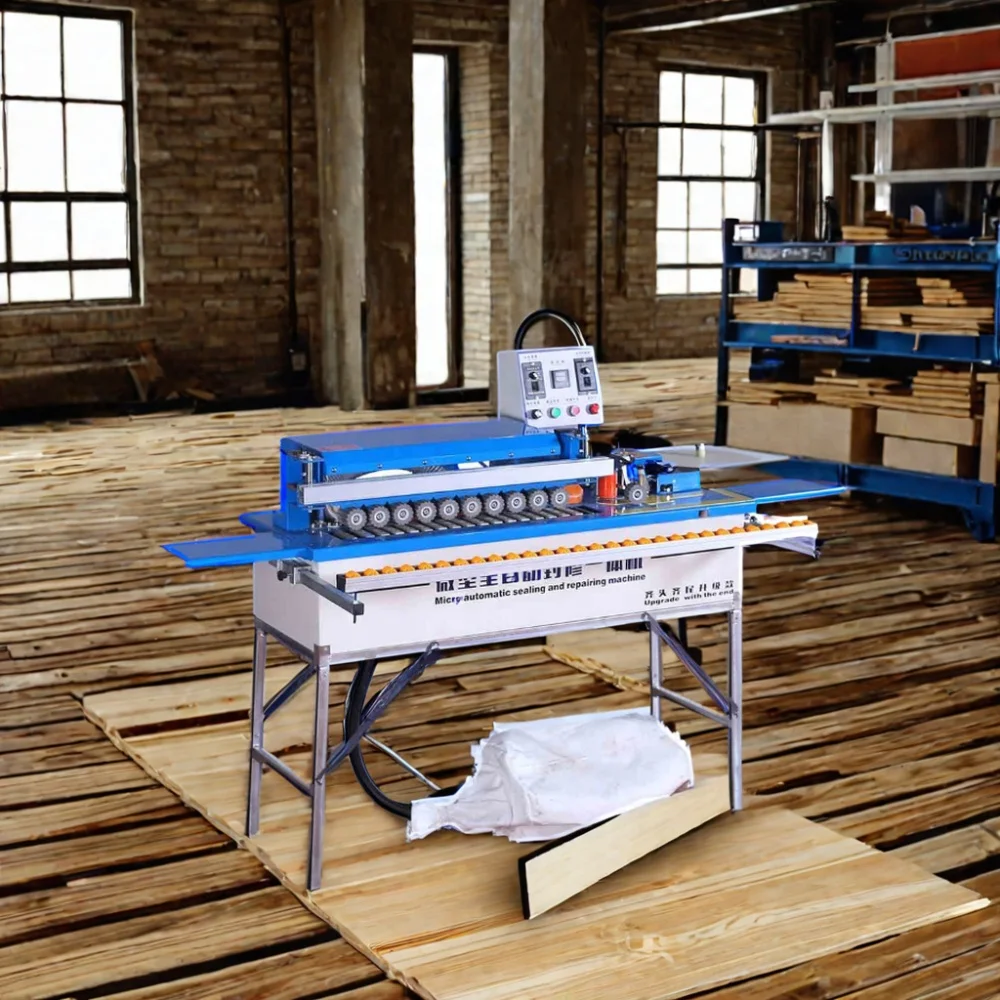
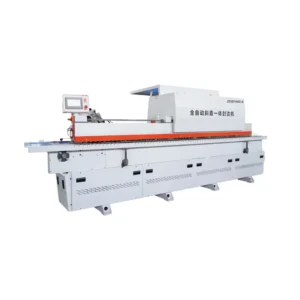
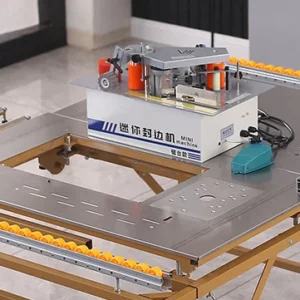
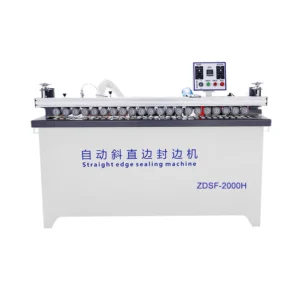
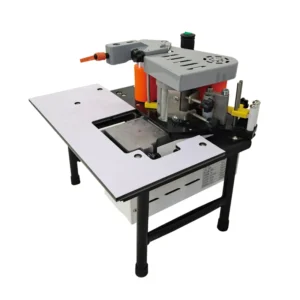
Factory-verified compact edge bander — every unit undergoes a four-stage quality control process before dispatch, ensuring tolerance claims match actual production output for small workshops scaling from manual to machine-based edge banding.
Technical Specifications
| Parameter |
Value |
| Product Type |
Automatic Edge Banding Machine |
| Voltage |
220V (configurable from 110V to 440V) |
| Total Suction Power |
1200W |
| Belt Drive Power |
25W |
| Transmission Power |
60W |
| Polishing Power |
180W × 2 |
| Trimming Power |
800W × 2 |
| Conveying Speed |
0–15 m/min |
| Edging Speed |
0–6 m/min |
| Edge Height Range |
10–60 mm |
| Edge Thickness Range |
0.3–3 mm |
| Overall Dimensions (L×W×H) |
120 × 54 × 72 cm |
| Glue Application Method |
Double-sided adhesive |
| Gluing Device Rotation |
180 degrees |
| Control System |
Individual function control panel |
| Feed Mechanism |
Double-row rubber pressure wheels |
| Dust Extraction |
Integrated vacuuming system |
| Trimming Stations |
Up and down motors with dust suction |
| Polishing Stations |
Cross polishing, up and down |
| Assembly State |
Partial assembly required on site |
| Warranty |
1 year factory defect coverage |
Application Suitability
| Application |
Material or Output |
| Small-scale cabinet production |
Melamine-faced particleboard with PVC edge banding |
| Custom furniture workshop |
MDF panels with 0.4–2 mm veneer or PVC edges |
| Curved profile edge finishing |
Plywood and solid wood panels with shaped contours |
| Joinery startup operations |
Straight and curved edge banding on boards up to 60 mm thick |
| Compact workshop environments |
Panel processing where floor space is limited to roughly 1.2 × 0.5 m |
Why Voltage Compatibility Matters Before You Compare Automatic Edge Banding Machine Factory Quotes
Specifying local voltage and frequency at the inquiry stage prevents a machine from arriving dead on the shop floor.
I once watched a joinery shop in Southeast Asia take delivery of a compact edge bander wired for a different frequency standard than their local grid. The trimming motors overheated within the first week, and the polishing station never reached consistent speed. By the time the correct transformer arrived, the shop had lost production time they could not recover. This is not an isolated case — voltage and frequency mismatches remain one of the most common commissioning failures across export markets [NEED_CITE: voltage and frequency standards by export market]. An automatic edge banding machine factory that does not confirm your electrical infrastructure before quoting is leaving this risk entirely on your side.

How the 180-Degree Rotating Glue Unit Expands What a Small Footprint Can Do
Most compact edge banders in this class handle only straight profiles, forcing workshops to maintain a separate manual station for curved components. The rotating gluing device on this Automatic Edge Banding Machine factory unit turns the edge application head through a full 180 degrees, allowing the same machine to band both straight cabinet sides and curved shelf fronts without repositioning the workpiece on a secondary fixture. For a small custom furniture shop running mixed geometries, this eliminates a bottleneck that typically requires twice the floor space.
Double-Sided Adhesive Application and What It Means for Substrate Versatility
Hot-melt glue pots require warm-up time, temperature monitoring, and regular cleaning — overhead that small workshops often underestimate. This unit uses double-sided adhesive application instead, which removes the glue pot entirely from the maintenance schedule. The trade-off is that adhesive tape must be matched to the edge banding material and substrate, but for shops running PVC and melamine edges on particleboard or MDF, this simplification reduces daily setup steps and removes one common source of edge adhesion failure [NEED_CITE: edge banding adhesion methods for panel substrates].
Reading the Specs That Actually Determine Edge Quality
The 800W × 2 trimming motors are the station that most directly determines whether a finished edge looks factory-grade or hand-applied. At the edging speed range of 0–6 m/min, these motors have sufficient power to make clean flush cuts on PVC banding up to 3 mm thick without chatter marks. The cross-polishing system at 180W × 2 then removes any micro-scratches left by trimming, which matters when melamine surfaces show every imperfection under workshop lighting. The integrated dust extraction at 1200W total suction keeps trimming debris away from the polishing wheels — a detail that directly affects surface finish consistency over a full production run. Edge height coverage from 10 to 60 mm means standard cabinet panels and thicker shelving stock can run on the same machine without fixture changes.
The Cost of Skipping Configuration Verification at the Quotation Stage
When a compact edge bander arrives with a control panel in a language the operator cannot read, commissioning stalls until someone can translate each station label. When the feed mechanism does not match the panel thickness range the shop actually processes, material jams become a daily occurrence. These are not defects — they are configuration oversights that happen when an order is placed without a detailed specification review. For a small workshop, each day of stalled commissioning represents a proportionally larger share of monthly output than it would for a high-volume factory [NEED_CITE: common commissioning delays in imported woodworking machinery]. Verifying control language, panel thickness compatibility, and spare parts availability before production begins is the difference between a machine that runs on arrival and one that sits idle waiting for corrections.
Why Sourcing This Machine Through the Factory Channel Matters
Every unit is built on the same production line that supplies larger models, meaning the precision-ground components and proprietary cutting mechanisms are not downgraded for the compact range. The four-stage quality control process — incoming material inspection, in-process checks, finished product testing, and pre-shipment verification — applies identically regardless of machine size. Voltage customization from 110V to 440V with frequency matching is configured at the factory rather than adapted in the field. An engineer reviews your production requirements before the quotation is issued, so the configuration reflects your actual panel materials and throughput expectations rather than a generic default build.
Documentation & Verification
- CE declaration of conformity confirming machinery directive compliance for this model
- Electrical schematic with voltage and frequency confirmed against your local grid specification
- Factory test record run on your specified panel thickness and edge banding material
- Operation and maintenance manual translated into your operator’s working language
- Spare parts list with part numbers for trimming motors, polishing wheels, and feed components
Installation, Commissioning & Support
- Requires a dedicated 220V circuit rated for the combined 1200W suction and motor loads
- Partial assembly on site — small components ship separately and must be fitted before first run
- Overall 120 × 54 cm footprint fits standard workshop aisles without special floor preparation
- Individual function control panel allows station-by-station testing during commissioning
- Double-row rubber pressure wheels should be inspected and aligned before processing production panels
- Trimming and polishing stations require initial speed calibration against your specific edge material
What to Include in Your Inquiry
To receive a configuration recommendation and formal quotation, share your primary panel material and thickness range, the edge banding type and thickness you run most often, and your local voltage and frequency standard. If you are replacing a manual edge banding process, note your current daily panel count so the throughput expectations can be assessed against the 0–6 m/min edging speed range. Specify your preferred control panel language and whether you need curved profile capability for your product mix.
Frequently Asked Questions
Q: Can this machine be configured for voltage standards outside 220V?
A: Yes. The factory configures voltage anywhere from 110V to 440V with the correct frequency for your market. This is confirmed at the quotation stage and documented in the electrical schematic before production begins, so the machine arrives wired correctly for your workshop’s grid without requiring field transformers or rewiring.
Q: What is the realistic daily output on 18mm melamine board with PVC edging?
A: The edging speed range is 0–6 m/min, and actual throughput depends on panel length, operator feed rhythm, and trimming complexity. For standard cabinet components, this unit is positioned for small workshops where batch sizes and variety matter more than continuous high-volume line speed.
Q: What OEM and private label options are available?
A: Custom logo placement, control panel language, and specification modifications are available as standard factory options. Private label packaging and documentation can be arranged for distributors. All customization is confirmed during the engineering review before the order enters production.
Q: Can I send my own board and edge material for a processing trial?
A: Yes. The factory accepts sample substrates and edge banding materials for test runs before you commit to an order. The test record documents edge quality, trimming finish, and adhesion results on your specific material combination and ships with the machine if you proceed.
Q: How are spare parts handled after the machine is installed?
A: A spare parts list with numbered components is included in the documentation package. Trimming motors, polishing wheels, and feed mechanism parts are standard inventory items at the factory. The recommended practice is to order a first-year consumables kit before shipment so critical spares arrive with the machine rather than waiting for international freight after a failure.