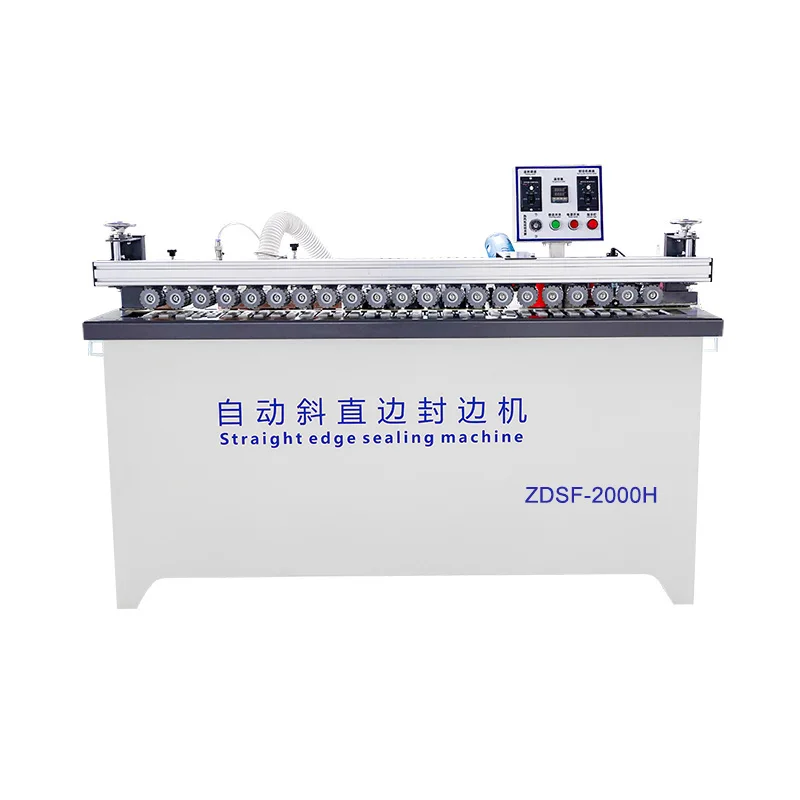
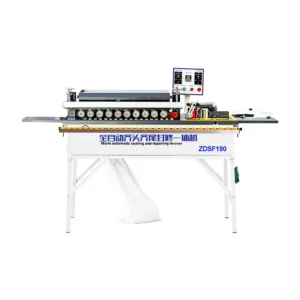
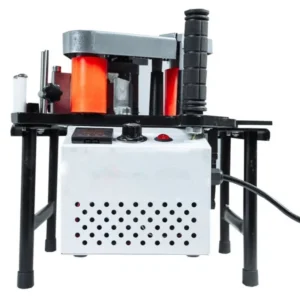
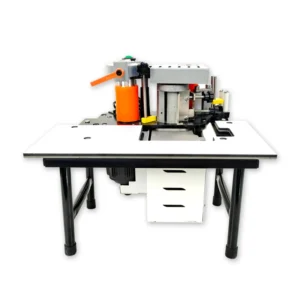
Manufacturing Depth Verified — Every WF-2000 unit undergoes four-stage QC including pre-shipment testing with your actual panel substrate before factory release.
Technical Specifications
| Parameter |
Value |
| Model |
WF-2000 / WF-2000H |
| Product Type |
Automatic Edge Banding Machine |
| Overall Dimensions |
2100×600×630mm (WF-2000) / 2100×600×1100mm (WF-2000H) |
| Net Weight |
137kg (WF-2000) / 149kg (WF-2000H) |
| Panel Thickness Range |
18-25mm |
| Strip Thickness |
1.2mm |
| Rated Voltage |
220V (configurable from 110V to 440V) |
| Rated Power |
6.17KW |
| Rated Air Pressure |
0.4-0.6MPa |
| Feed Speed |
0-14m/min |
| Control System |
Control Panel |
| Pressing System |
8 pressing rollers |
| Vacuum Device |
Self-contained vacuum device |
| Pressure Beam |
Aluminum alloy, manually adjustable |
| Edge Banding Functions |
Slotted edge banding, elastic profiling trimming, hot air heating for edge sealing |
| Belt Breaking |
Automatic belt breaking |
Application Suitability
| Application |
Material or Output |
| Custom cabinet door edge sealing |
MDF and particleboard with PVC edge banding up to 1.2mm |
| Workshop-scale furniture production |
Plywood panels requiring 45-degree oblique and straight edge profiling |
| Joinery startup automation transition |
Solid wood panels and veneer edge banding in compact footprint operations |
| Portable edge banding for on-site work |
Panel processing plants needing relocatable edge sealing equipment |
What "Factory-Direct" Means When Tolerances Are on the Line
An Edge Banding Machine factory must prove tolerance claims on your substrate, not just on showroom samples.
Distributors and OEM partners routinely receive demonstration units that perform flawlessly on the manufacturer’s chosen MDF, only to discover that edge adhesion degrades when local particleboard with higher moisture content enters the feed [NEED_CITE: substrate moisture variation and edge banding adhesion failure rates]. The gap between a controlled demo and actual production conditions is where most edge quality disputes originate. I have seen edge banders of this class fail in humid workshops where the board swelled just enough to throw off the pressing roller contact pressure, resulting in visible glue lines across an entire batch.

Component Sourcing and Assembly Transparency
An Edge Banding Machine factory that controls its own assembly line can trace each pressing roller, heating element, and vacuum motor back to its source batch. The WF-2000 series integrates 8 pressing rollers and a self-contained vacuum device into a single chassis weighing between 137kg and 149kg depending on variant, meaning the manufacturing process must account for precise weight distribution and alignment during final assembly. OEM partners evaluating this equipment need visibility into how these components are seated and calibrated before the housing is closed.
Private Label Capability Without Engineering Compromise
White-label arrangements only hold value when the underlying machine specification remains intact after branding modifications. The WF-2000 and WF-2000H variants share identical functional configurations while differing in overall height, giving OEM partners two form-factor options under their own marque without requiring separate engineering validation [NEED_CITE: OEM machinery private label configuration standards]. Custom voltage winding from 110V to 440V and multilingual control panel overlays are applied during the manufacturing stage, not retrofitted after standard production.
How the Pressing System and Heat Profile Shape Edge Quality
The 8 pressing rollers work against the aluminum alloy pressure beam to maintain uniform contact across the 18-25mm panel thickness range. At feed speeds approaching 14m/min, roller spacing and individual spring tension determine whether the edge banding seats fully before the adhesive begins to set. Hot air heating applied throughout the edge sealing process keeps the glue workable across varying ambient temperatures — a factor that becomes critical when machines ship to regions with workshop conditions far from the factory floor where they were tested. The slotted edge banding function and elastic profiling trimming together address both the initial adhesion and the final contour, reducing the need for secondary hand-finishing on shaped panel edges. The self-contained vacuum device eliminates dependency on external dust extraction infrastructure, which simplifies installation in smaller workshops where ductwork is impractical.
The Cost of Skipping Substrate-Specific Testing Before Shipment
When an edge banding machine arrives configured for one material but the buyer runs another, the failure mode is rarely immediate — it shows up as intermittent delamination after the furniture reaches the end customer [NEED_CITE: field failure patterns in edge banding on mismatched substrates]. For distributors holding inventory, this translates into warranty claims that trace back to the factory’s pre-shipment verification gap rather than operator error. Machines quoted without confirming the buyer’s actual panel moisture content and density create downstream liability that no amount of post-sale technical support can fully resolve.
Why Manufacturing Partners Choose This Production Line
In-house manufacturing with patented cutting mechanisms means tolerance claims on the WF-2000 are verifiable through factory test records, not marketing literature. The four-stage QC process — incoming material, in-process, finished product, and pre-shipment — is documented per unit and available for audit by OEM partners and their technical teams. Voltage, language, and specification customization are applied as standard manufacturing steps, not handled as exceptions. The WF-2000 product family offers both entry-level and full-function configurations, allowing distributors to serve market segments from startup joinery shops to established panel processors without switching equipment sources.
Documentation & Verification
- CE declaration of conformity covering the WF-2000 electrical and mechanical safety envelope
- ISO 9001 certificate applicable to the manufacturing and QC process
- Machine specification sheet with verified panel thickness and feed speed parameters
- Electrical schematic confirming voltage configuration matches your target market infrastructure
- Factory test record run on your specified panel material and edge banding strip thickness
- Operation and maintenance manual in the agreed language for your service team
Installation, Commissioning & Support
- 220V rated power circuit with dedicated breaker sized for the 6.17KW load requirement
- Partially assembled delivery with user manual and video teaching for final assembly steps
- Manual pressure beam height adjustment across the 18-25mm range before first production run
- 0.4-0.6MPa air supply connection verified before activating the 8 pressing rollers
- Self-contained vacuum device tested independently before introducing panel stock into the feed
- Spare parts list covering wear items for the elastic profiling trimming and belt breaking mechanisms
What We Need to Prepare Your Quotation
Provide your target panel material, typical board dimensions, and the edge banding strip thickness you plan to run so we can configure the WF-2000 with the correct roller pressure and heating profile. Confirm your local voltage and frequency along with the control panel language required for your operators. If you are evaluating this unit for OEM or distribution purposes, indicate your branding requirements and the order volume range you anticipate.
Frequently Asked Questions
Q: What is the manufacturing lead time for OEM orders and can custom branding be applied?
A: Typical lead times depend on order volume and the extent of branding customization required. Custom logo application to the machine housing, control panel overlays in your language, and voltage winding to your market standard are all integrated during the manufacturing stage. We confirm the branding specification sheet and voltage configuration before production begins, and provide pre-shipment photographs showing your branding applied to the finished unit.
Q: How do you verify feed speed consistency across different panel materials?
A: Each WF-2000 undergoes pre-shipment testing using the panel material specified in your order documentation. We run the machine across the 0-14m/min feed speed range and document edge adhesion quality at multiple speed points. The factory test record includes photographs of the edge finish on your substrate, confirming that the 8 pressing rollers and hot air heating system produce consistent results on your actual material.
Q: What documentation is provided for customs clearance and regulated market entry?
A: The WF-2000 ships with a CE declaration of conformity, ISO 9001 certificate reference, electrical schematic, and packing photographs for customs inspection support. For markets requiring additional compliance documentation, confirm the specific regulatory requirements at the inquiry stage so we can prepare the necessary certificates before dispatch.
Q: Can the electrical system be customized for different regional voltage standards?
A: The WF-2000 rated voltage of 220V is the standard configuration, but the motor and control system can be wound and configured for 110V, 380V, or 440V to match your local infrastructure. Voltage and frequency confirmation is a mandatory step in our order process to prevent machines arriving unusable at the destination. The electrical schematic provided with each unit reflects the exact configuration built.
Q: What spare parts are included and what should distributor service teams stock?
A: Each shipment includes a baseline spare parts list covering common wear items from the elastic profiling trimming assembly and belt breaking mechanism. For distributors building a regional service capability, we recommend an expanded inventory of pressing roller springs, heating elements, and vacuum device filters based on your projected installed base and service territory coverage.