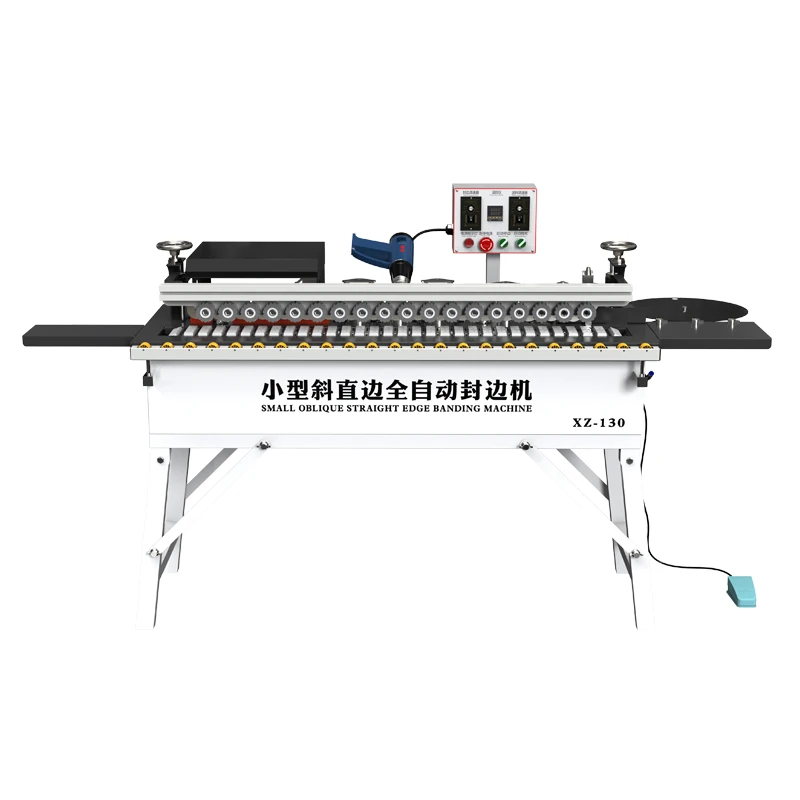
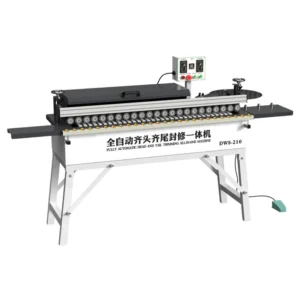
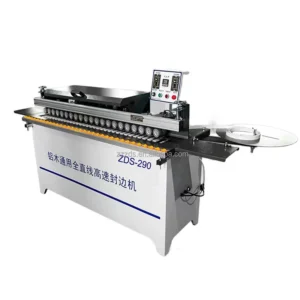
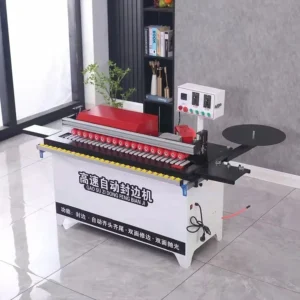
Precision Assembly — Each DW130 unit is built on a dedicated line with four-stage QC checkpoints, ensuring private-label distributors receive factory-verified equipment with full traceability.
Technical Specifications
| Parameter |
Value |
| Model |
DW130 |
| Product Type |
Fully Automatic Multifunctional Edge Banding Machine |
| Overall Dimensions (L×W×H) |
139×52×61 cm |
| Glue Pot Capacity |
2000 ml |
| Voltage |
220V (configurable per market requirement) |
| Heating Time |
5–10 min |
| Control Panel Language Options |
Chinese / English (source value — verify against manufacturer catalog) |
| Plug Options |
EU / USA / AU / UK (source value — verify against manufacturer catalog) |
| Edge Type |
Oblique and straight edge |
| Assembly State |
Fully assembled |
| Standards |
CE |
Application Suitability
| Application |
Material or Output |
| Cabinet Door Production |
MDF and particleboard with PVC or veneer edge banding |
| Small-Batch Custom Furniture |
Plywood panels and solid wood boards for residential cabinetry |
| Joinery Workshop Operations |
Straight and oblique edge profiles on panel substrates up to standard thickness |
| Entry-Level Panel Processing |
Low-volume edge finishing for startup furniture makers |
Why the Voltage Question Must Come Before the Production Schedule
A machine wired for the wrong grid is dead weight on the workshop floor until an electrician rewires it.
I have watched importers take delivery of an edge bander only to discover the motor was wound for 380V three-phase while their facility runs single-phase 220V. The DW130 Edge Banding Machine OEM factory approach locks the voltage and plug standard during the order confirmation stage, not after the crate is built. Regional distributors placing container orders need every unit matched to the destination market’s electrical code before the first weld is laid [NEED_CITE: voltage and frequency standards by export market]. Sending a machine with a mismatched motor means weeks of downtime and customs complications that no amount of post-sale support can recover.

Component Sourcing and Assembly Integrity
The DW130 is manufactured in-house within a facility that maintains direct sourcing relationships for critical drive and heating components. Private-label partners evaluating the DW130 Edge Banding Machine OEM factory need visibility into where bearings, motors, and glue pot heating elements originate. Our engineering team provides a component breakdown document so distributors can verify supply chain depth before committing to a private-label agreement.
Four-Stage QC for Every Private-Label Unit
Incoming materials are inspected before they reach the assembly bench. In-process checks verify alignment of the feed chain and trimming stations. Finished units undergo a full functional run with test panels, and pre-shipment verification includes a dimensional audit against the specification sheet. Each stage generates a signed record that ships with the machine [NEED_CITE: ISO 9001 quality management documentation requirements].
Reading the Numbers That Matter
The 2000 ml glue pot capacity supports sustained small-batch production without requiring mid-shift refills that interrupt workflow. A 5–10 minute heating window means operators can power on at the start of a shift and begin feeding panels quickly. The compact 139×52×61 cm footprint allows installation against a wall or between existing machines in constrained workshops where floor space dictates production layout. Oblique and straight edge capability in a single frame eliminates the need for a second dedicated machine when handling beveled panel profiles common in custom cabinet doors.
The Hidden Cost of Skipping Configuration Confirmation
Distributors who order a standard specification without confirming their market’s plug type and control panel language end up absorbing the cost of field modifications. Operators who cannot read the control display make setup errors that damage panels and waste edge banding material. A machine configured for one frequency standard but operated on another will experience premature motor wear [NEED_CITE: effects of frequency mismatch on induction motor lifespan]. These failures surface after the warranty clock has started, eroding the distributor’s reputation locally.
Manufacturing Depth Behind the Private Label
The facility operates a 10,000 ㎡ production floor with 60 engineers overseeing design and process control. Patented cutting mechanisms are developed and tested in-house rather than sourced externally. Custom logo application, packaging design, and control panel language configuration are handled as standard line items, not special requests. The four-stage QC protocol applies identically to branded and white-label units, ensuring a distributor’s brand reputation is protected by the same verification standards [NEED_CITE: CE machinery directive requirements for industrial equipment].
Documentation & Verification
- Factory test record showing edge banding quality on distributor-supplied sample panels before dispatch
- Electrical schematic and voltage confirmation document matching the destination market’s power standard
- CE declaration of conformity for customs clearance in regulated markets
- Operation and maintenance manual translated into the agreed language for local operator training
- Spare parts list with OEM part numbers for distributor inventory planning
Installation, Commissioning & Support
- Compact 139×52×61 cm footprint requires only a level concrete floor without special foundation work
- 220V single-phase connection via specified plug type eliminates the need for transformer installation
- Fully assembled delivery means the machine is operational once unpacked and connected to power and dust extraction
- Initial parameter setup for glue temperature and feed speed is calibrated during the factory test based on buyer-supplied materials
- Oblique and straight edge switching procedure is documented in the multilingual operation manual
Starting the Configuration Conversation
To prepare a formal quotation with accurate private-label specifications, we need your target market’s voltage and frequency standard, preferred plug type, and the control panel language your end users require. Share the edge banding material types and panel substrates common in your region so our engineers can run a compatibility test before production. If you are evaluating a container-load order, specify the logo and packaging requirements so we can include tooling setup in the manufacturing schedule.
Frequently Asked Questions
Q: What OEM customization is available for the DW130?
A: Logo placement on the machine body, custom paint color, control panel language configuration, and branded packaging are all standard OEM options. Voltage and plug type are configured per order. Distributors can also request specific documentation formatting to match their resale requirements.
Q: How is voltage and plug standard confirmed before production?
A: The buyer provides the destination market’s electrical specification during the inquiry stage. Our engineering team issues an electrical schematic and voltage confirmation document for approval before manufacturing begins, ensuring the motor, heater, and control system match the local grid.
Q: What does the four-stage QC process cover?
A: Incoming material inspection, in-process assembly checks, finished product functional testing with sample panels, and pre-shipment dimensional verification. Each stage produces a signed record that accompanies the machine to the buyer.
Q: Can I visit the factory to audit manufacturing capability?
A: Factory visits are welcomed at any production stage. Distributors can inspect assembly lines, review QC records, and witness test runs on their specified panel materials and edge banding types before placing a container order.