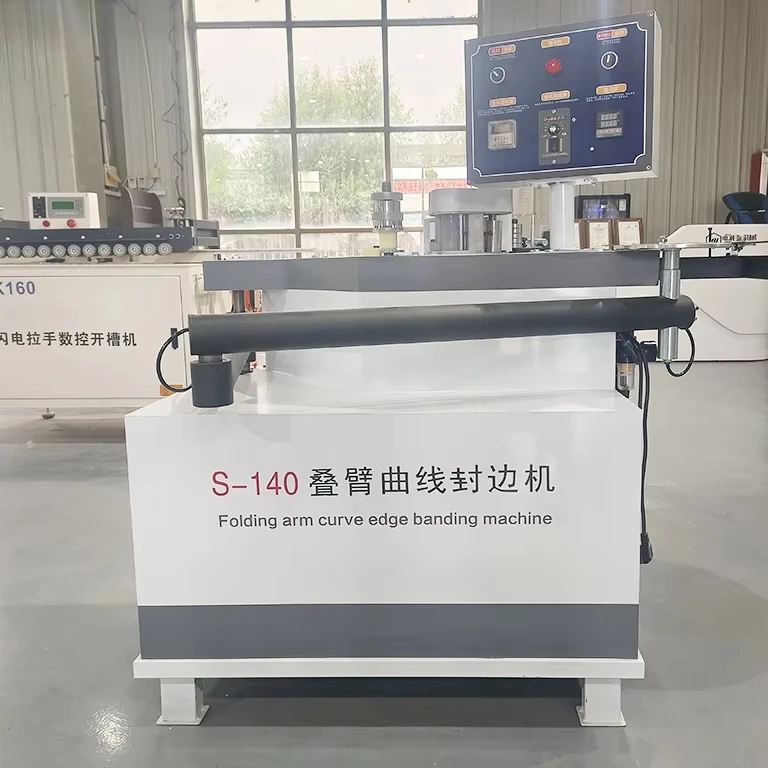
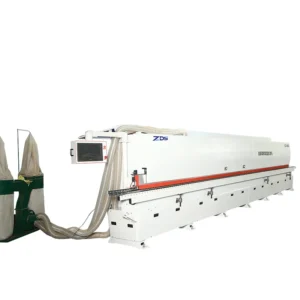
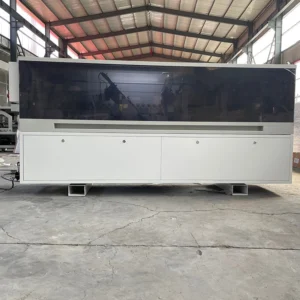
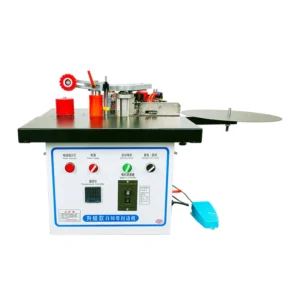
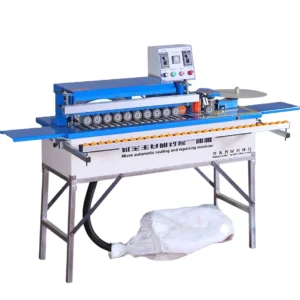
Precision-Verified Manufacturing — Four-stage quality control covering incoming material through pre-shipment verification ensures every curved edge banding machine OEM order leaves the factory with documented test records, not just a packing list.
Technical Specifications
| Parameter |
Value |
| Model |
S-140 |
| Product Type |
Manual / Semi-Automatic Curved Edge Banding Machine |
| Voltage & Frequency |
220V / 50Hz |
| Rated Power |
1.4 kW |
| Air Supply Requirement |
0.5–0.8 MPa |
| Edge Banding Speed |
0–180 mm/s |
| Edge Band Thickness Range |
0.4–2 mm |
| Edge Band Width Range |
8–50 mm |
| Glue Pot Capacity |
1000 ml |
| Breaking Method |
Automatic tape break (double-cylinder controlled) |
| Suction Cup Size |
200×26 mm |
| Gluing Type |
Double-sided gluing |
| Heating System |
Hot air device (bottom-up heating) |
| Control Features |
Intelligent temperature control, speed adjustment, timer |
| Overall Dimensions (L×W×H) |
960×620×880 mm |
| Net Weight |
88 kg |
| Assembly State |
Fully assembled |
Application Suitability
| Application |
Material or Output |
| Custom cabinet and wardrobe production |
MDF and particleboard with PVC or veneer edge banding |
| Curved panel furniture components |
Plywood and shaped MDF profiles requiring manual feed control |
| Office furniture manufacturing |
Study tables, desks, and worktops with straight or curved edges |
| Door and window frame finishing |
Solid wood panels and composite substrates up to 2 mm band thickness |
| Small-batch decoration industry work |
Mixed substrate runs where quick changeover between band materials is required |
Why Adhesion Failures Trace Back to the Gluing Method
Visible glue lines and banding lift-off on curved profiles often originate from uneven adhesive distribution, not operator error.
When a curved edge banding machine factory ships a unit with single-sided gluing, the adhesive must transfer from the substrate to the band during manual feeding — a process that leaves starved zones on tight radii. I have watched workshops blame the glue, then the operator, then the humidity, before realizing the machine itself was applying adhesive to only one surface. Double-sided gluing eliminates that variable by coating both the panel edge and the banding material before they meet. [NEED_CITE: edge banding adhesion failure root causes in furniture manufacturing]
The S-140 addresses this with a 1000 ml glue pot and a bottom-up hot air heating device that maintains consistent adhesive viscosity across the entire contact zone. For distributors evaluating a curved edge banding machine OEM partnership, this distinction matters because warranty claims on adhesion failures generate the most field service calls in the first six months of operation.

How Component Sourcing Defines Long-Term Reliability
Every curved edge banding machine OEM order depends on component consistency across production batches. The suction cups, pneumatic cylinders, and heating elements in the S-140 are sourced from verified suppliers with documented batch traceability. When a distributor commits to stocking machines for regional resale, the failure of a single proprietary component can strand an end-user without local spare parts. This machine uses standardized pneumatic fittings and commercially available suction cups sized at 200×26 mm, meaning replacement parts do not require a dedicated supply chain from the factory. [NEED_CITE: component standardization in woodworking machinery for aftermarket support]
What Four-Stage QC Actually Catches Before Shipment
Incoming material inspection verifies that pneumatic cylinders hold rated pressure and that heating elements reach target temperature within specified ramp-up time. In-process checks confirm that the double-cylinder tape breaking mechanism triggers consistently at the end of each feed cycle. Finished product testing runs actual edge banding material through straight and curved profiles, documenting adhesion quality and edge termination. Pre-shipment verification repeats the functional test on the specific voltage configuration ordered — a step that prevents the all-too-common scenario where a machine arrives at a port wired for 220V 50Hz but was tested only on the factory’s domestic supply.
Reading the Specs That Matter for Curved Edge Work
The 0–180 mm/s feed speed range on the S-140 reflects the reality that curved profiles demand operator-controlled pacing; a fixed high-speed feed would cause the banding to bridge across concave curves rather than conform to the substrate. The 0.4–2 mm band thickness range covers both thin PVC for cabinet carcasses and thicker veneer for visible furniture edges, but attempting to run 3 mm solid wood edging on this class of machine would overload the glue pot and compromise adhesion. The intelligent temperature control maintains hot melt adhesive within a narrow operating window — too cool and the glue skins over before contact, too hot and it degrades into a brittle film. The 88 kg net weight and 960×620 mm footprint place this machine firmly in the small-workshop category where floor space is limited but curved edge capability is required alongside straight-edge production.
The Cost of Skipping Voltage Confirmation Before Production
I once traced a burned-out heating element on a newly installed edge bander back to a 60Hz supply running a machine wound for 50Hz — the element overheated because the fan motor spun faster than designed, disrupting the airflow balance in the hot air device. Machines quoted without confirming local voltage and frequency arrive unusable, and the distributor absorbs the shipping cost both ways. For a curved edge banding machine OEM buyer placing a container order, a single voltage mismatch across the shipment can wipe out the margin on the entire lot. The S-140 is configurable from 110V to 440V, but only if the target market’s electrical standard is confirmed before the production run begins. [NEED_CITE: voltage and frequency standards by export market]
What Separates Factory-Direct from Trading-Company Supply
In-house manufacturing means the cutting and gluing mechanisms on the S-140 are built on the same floor where final assembly and testing occur — there is no third-party integrator obscuring the component origin. Full OEM branding extends beyond logo placement to include custom control panel language, voltage-specific wiring diagrams, and private-label packaging that matches the distributor’s existing product line. The four-stage QC documentation travels with every machine, giving the importer verifiable records to present to their own customers. Engineer-led configuration ensures that a distributor ordering for a market with predominantly 220V 60Hz supply does not receive machines tested only on 50Hz. Factory visits are welcomed so that buyers can inspect precision-ground components and verify tolerance claims against test panels before committing to volume.
Documentation & Verification
- CE declaration of conformity covering the S-140 for European market entry
- Electrical schematic matched to your confirmed voltage and frequency before production
- Factory test record on your specified edge band material and panel substrate
- Operation and maintenance manual translated into your operator’s working language
- Spare parts list with standardized component identifiers for local sourcing
Installation, Commissioning & Support
- 220V dedicated circuit required; confirm amperage capacity exceeds the 1.4 kW rated draw
- Fully assembled on arrival — no foundation bolts required given the 88 kg net weight
- Pneumatic supply must deliver 0.5–0.8 MPa clean dry air via standard industrial fitting
- First-run commissioning includes glue pot temperature calibration for your specific hot melt adhesive
- Extra set of suction cups and heating element included as standard consumable spare parts
- Daily maintenance limited to glue pot cleaning and suction cup surface inspection
What We Need to Configure Your Shipment
Provide the edge banding materials you intend to stock — PVC, ABS, melamine, or veneer — along with the panel substrates your customers process most frequently. Confirm the local voltage and frequency standard for your target market so that every unit in the order is wound and tested to match. If you require OEM branding, share your logo files, preferred control panel language, and packaging specifications so that the first production sample reflects your final configuration.
Frequently Asked Questions
Q: What OEM customization options are available for the S-140?
A: Logo placement, machine color, voltage from 110V to 440V, control panel language, and private-label packaging are all configurable. Each OEM variation is documented in the production order so that repeat shipments remain identical. We provide a pre-production sample photo set for your approval before the full run begins.
Q: Can I receive factory test records and sample panels before committing to a full order?
A: Yes. We run your specified edge band material and panel substrate through the S-140 and document adhesion quality, edge termination, and surface finish. The test panels and written record ship with the sample machine or separately by courier, so you can evaluate output quality before releasing a container order.
Q: How do you ensure component consistency across production batches?
A: Pneumatic cylinders, heating elements, and suction cups are sourced from verified suppliers with batch traceability. Incoming material inspection checks each component against rated specifications before it enters assembly. We do not substitute unapproved alternatives between orders, and your spare parts list reflects the exact components installed in your machines.
Q: How is after-sales spare part supply handled for overseas distributors?
A: The S-140 uses standardized pneumatic fittings and commercially available suction cups, reducing dependence on proprietary parts. We include a recommended spare parts list with every shipment and maintain stock of wear items for dispatch by air freight. Your local service team can source common consumables independently while we supply specialized components on request.