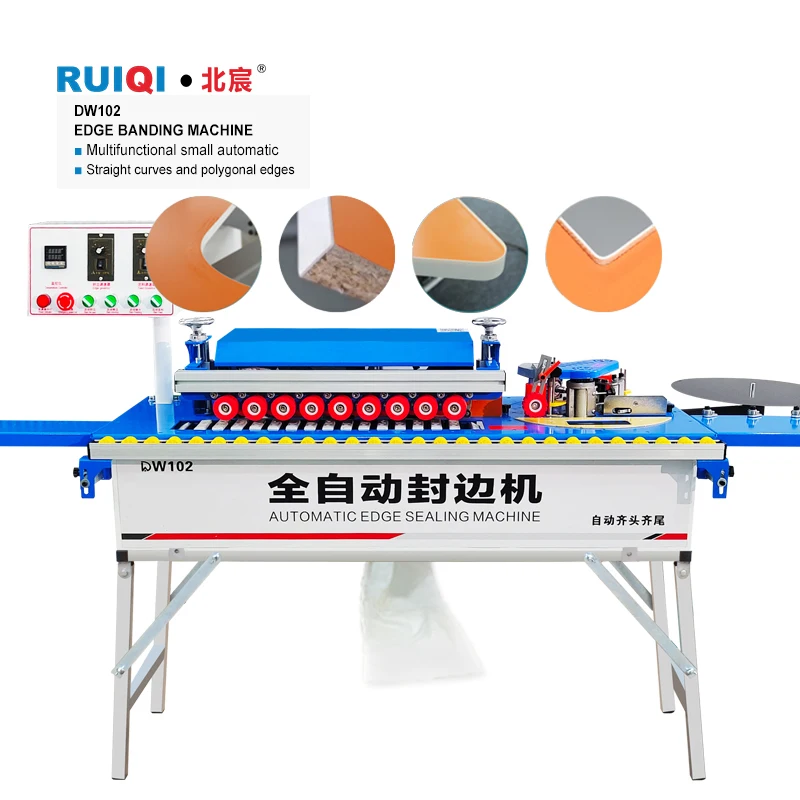
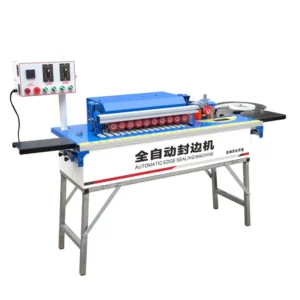
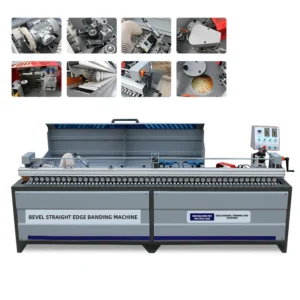
Precision Manufacturing Depth — Proprietary cutting mechanisms and four-stage QC verify every tolerance claim before the DW102 leaves the assembly floor.
Technical Specifications
| Parameter |
Value |
| Model |
DW102 |
| Product Type |
Automatic Edge Banding Machine |
| Total Power |
3800W |
| Voltage |
220V/380V/customization available |
| Air Source Pressure |
0.5-0.8 MPa |
| Glue Pot Capacity |
1000 ml |
| Edge Banding Height |
0-50 mm |
| Edge Banding Thickness |
0.3-3 mm |
| Minimum Sheet Length |
25 cm |
| Minimum Sheet Width |
5 cm |
| Trimming Power |
650W × 2 |
| Polishing Power |
180W × 2 |
| Vacuum Power |
1200W |
| Transmission Power |
60W |
| Edge Power |
20W |
| Product Size |
128 × 47 × 69 cm |
| Product Weight |
75 kg |
| Assembly State |
Fully assembled |
| Language Options |
Chinese, English (customizable to other languages) |
| Key Features |
Curved and straight edge banding, edge trimming, polishing, automatic head and tail cutting, vacuum hold-down |
Application Suitability
| Application |
Material or Output |
| Cabinet door production |
Medium density fiberboard with PVC or melamine edge banding |
| Custom furniture panels |
Particleboard and plywood with 0.3-3 mm veneer or polymer strips |
| Polymer door fabrication |
Polymer composite substrates requiring curved and straight edge profiles |
| Workshop-scale joinery |
Blockboard and solid wood panels in small-batch processing |
| Panel edge finishing |
MDF shelving and wardrobe components with visible-edge requirements |
Why Voltage Confirmation Must Precede the Edge banding machine OEM Agreement
Matching electrical specifications to the destination grid prevents costly commissioning failures and protects motor windings from premature burnout.
Distributors who skip voltage verification during the quotation stage often discover the mismatch only when the container arrives at the port. A machine wound for 380V/50Hz running on a 220V/60Hz supply will overheat the trimming motors within the first production shift. I have watched importers absorb return freight and rewinding costs because the electrical schematic was never reviewed before production started [NEED_CITE: voltage and frequency standards by export market]. Confirming local supply characteristics during the Edge banding machine OEM specification phase eliminates this entirely.

Component Sourcing Transparency for Distributor Confidence
Every grinding spindle, pneumatic cylinder, and heating element in the DW102 traces back to a documented supplier batch. When a regional distributor evaluates an Edge banding machine OEM partnership, the first question is always whether components can be sourced locally for warranty repairs. We provide a full bill of materials with part numbers so that your service team can stock critical spares without depending on overseas shipments for every minor replacement.
Private Label Build Process and Design Confirmation
The private label workflow begins with your logo artwork, color specification, and control panel language requirements confirmed in writing before the frame enters the paint booth. Each customization point — from the badge on the glue pot housing to the translated HMI strings on the control display — goes through a formal design proof that your team signs off on. This prevents the situation where a container-load of machines arrives with the wrong branding or an operator interface your customers cannot read [NEED_CITE: CE machinery directive requirements for industrial equipment].
How Board Thickness Range and Trimming Stations Shape Output Quality
The DW102 handles edge banding thickness from 0.3 mm to 3 mm across a 0-50 mm height range, which covers the full spectrum from thin PVC foil on MDF cabinet parts to thick solid-wood lipping on blockboard shelving. The dual 650W trimming motors provide independent rough and finish trimming passes — the first removes bulk overhang while the second cleans the radius to match the panel face. When trimming power is insufficient for the banding thickness, operators see chatter marks on the cut surface that require hand-scraping downstream. The 180W × 2 polishing wheels then burnish the trimmed edge to a consistent sheen, and the 1200W vacuum unit captures dust and offcuts before they contaminate the glue pot or settle on freshly bonded surfaces. Maintaining air pressure between 0.5 and 0.8 MPa ensures the pneumatic feed rollers grip consistently across the 25 cm minimum sheet length, preventing the slip-and-jerk feed pattern that causes uneven glue application on narrow stock.
The Cost of Skipping Pre-Shipment Panel Testing
A distributor once ordered a batch of compact edge banders without submitting sample panels for a factory run-off. The machines performed well on the MDF we used in-house, but the customer’s local particleboard had a rougher surface texture that caused the 0.4 mm PVC banding to lift at the leading edge after trimming. Catching this at our factory with a sample run would have flagged the need for a pre-milling adjustment before the machines shipped [NEED_CITE: substrate surface roughness and edge adhesion failure modes]. Instead, the distributor absorbed technician travel costs and production downtime while the fix was diagnosed remotely.
What Manufacturing Depth Means for Your Territory
In-house precision grinding of feed rollers and trimming spindles means the DW102 does not depend on third-party machined parts that vary between batches. Our four-stage QC protocol checks incoming raw material hardness, in-process assembly alignment, finished-product run-off on actual panel stock, and pre-shipment verification with packing photographs — so what arrives at your warehouse matches what was tested. Voltage customization from 220V to 380V is configured at the winding stage, not adapted with external transformers. The control panel language is set during HMI programming, supporting English as standard and expandable to your local market language. CE and ISO 9001 certifications cover the manufacturing facility and process, not just a paper declaration. And every OEM order ships with the documentation package your customs broker and end-users actually need.
Documentation & Verification
- CE declaration of conformity covering the DW102 electrical and mechanical safety scope
- ISO 9001 certificate for the manufacturing facility producing your private label units
- Electrical schematic with confirmed voltage and frequency matching your destination market
- Factory test record run on your specified panel material and edge banding thickness
- Machine specification sheet detailing all configurable parameters at time of order
- Packing photographs documenting condition and configuration before container loading
Installation, Commissioning & Support
- The fully assembled 128 × 47 × 69 cm footprint requires a level floor with clearance for sheet infeed and outfeed on both sides
- A dedicated circuit matching the confirmed 220V or 380V supply must be installed before uncrating, rated for the 3800W total draw
- The 0.5-0.8 MPa air supply needs a clean, filtered line with a shut-off valve within reach of the operator station
- First commissioning includes glue pot temperature calibration matched to your specific hot-melt adhesive and banding material combination
- Operator training covers the English or customized-language control panel, including feed speed adjustment and trimming depth setting
- Spare parts list identifies wear items — trimming blades, polishing wheels, vacuum filters — with reorder part numbers
Before You Request a Quotation
To configure the DW102 for your market, we need your destination country’s standard voltage and frequency, the edge banding materials and thicknesses your customers primarily run, and the control panel language your operators require. If you are evaluating this model for private label distribution, share your logo artwork and any color or branding guidelines so we can include design proofs with the formal quotation.
Frequently Asked Questions
Q: How do you verify manufacturing tolerances on each DW102 before it ships?
A: Every unit goes through a four-stage QC process. We check incoming component dimensions, inspect assembly alignment during build, run a finished-product test using actual panel stock and edge banding, and perform a final pre-shipment verification with documented results. You receive the factory test record with your shipment, so tolerance claims are backed by measured data from your specific machine.
Q: What can be customized under the OEM and private label program?
A: The scope covers your logo placement, machine color scheme, control panel language, and confirmed voltage and frequency for your market. We also accommodate tailored specifications such as custom safety guarding or specific component brand preferences. Each customization point is confirmed through a written design proof before production begins, so there are no surprises when the machines arrive.
Q: Can you provide transparency on component sourcing for spare part planning?
A: Yes. We supply a complete bill of materials listing critical components with supplier part numbers. This allows your service team to identify wear parts — trimming blades, polishing wheels, pneumatic seals — and source or stock them independently. We also include a recommended spare parts list calibrated to typical distributor service intervals and regional availability.
Q: What documentation ships with a private label order for customs clearance?
A: Each machine ships with the CE declaration of conformity, commercial invoice, packing list, and certificate of origin as required by your import regulations. The electrical schematic confirms the voltage and frequency configuration. We also provide customs documentation support tailored to your destination country, including HS code guidance and any labeling requirements your freight forwarder specifies.
Q: How is territory support handled for regional distributors?
A: Territory arrangements are discussed during the initial partnership evaluation, including model mix recommendations suited to your market’s typical workshop sizes and panel processing volumes. We provide technical training for your service team covering commissioning, common fault diagnosis, and routine maintenance procedures, so your customers receive local support without waiting for overseas engineer dispatch.