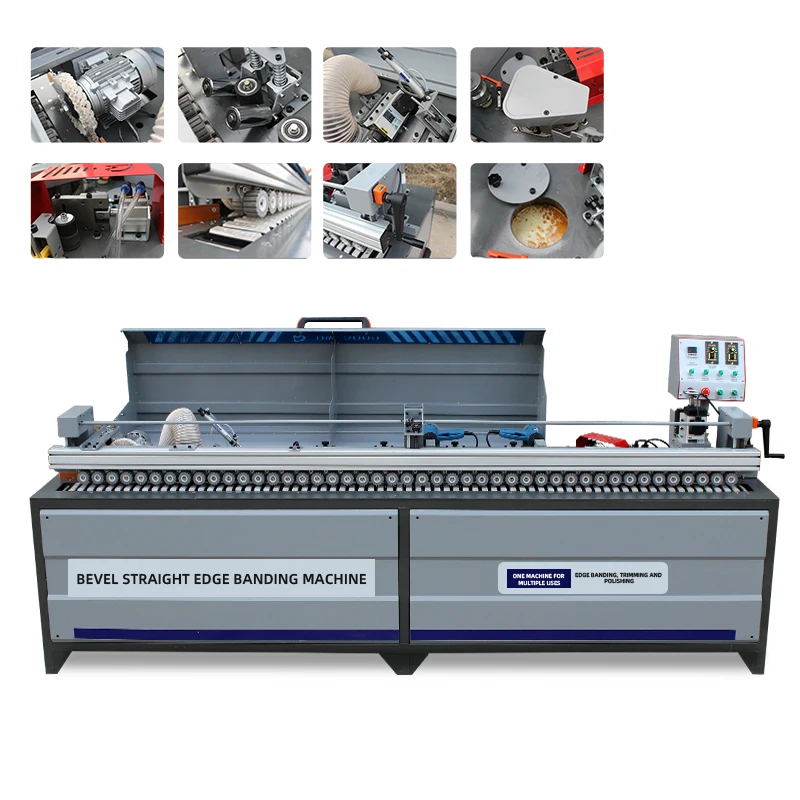
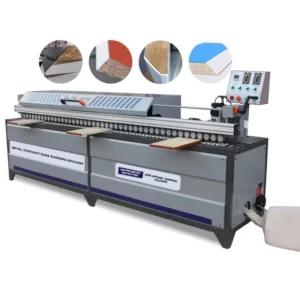
Precision-Ground Manufacturing — every DW3000 unit undergoes four-stage quality control before leaving our Ningjin facility, ensuring OEM partners receive edge banding machines that meet declared tolerances without post-delivery rework.
Technical Specifications
| Parameter |
Value |
| Model |
DW3000 |
| Product Type |
Automatic Edge Banding Machine with Bevel and Straight Edge Capability |
| Rated Power |
11 kW (total) |
| Voltage & Frequency |
380V/415V, 50Hz or 60Hz (to be confirmed per destination market) |
| Overall Dimensions (L×W×H) |
299 × 65 × 130 cm |
| Net Weight |
430 kg |
| Feed Speed |
0–12 m/min |
| Edge Banding Height |
0–50 mm |
| Edge Banding Thickness |
0.3–3 mm |
| Minimum Sheet Length |
30 cm |
| Minimum Sheet Width |
15 cm |
| Pre-milling Motor |
2.2 kW |
| Trimming Motor |
2.2 kW × 2 (spindle type) |
| Polishing Motor |
0.4 kW × 2 |
| Heating Power |
2.2 kW × 2 (dual heat gun design) |
| Vacuum Power |
550 W |
| Glue Pot Capacity |
4000 ml |
| Air Source Pressure |
0.5–0.7 MPa |
| Bevel Angle Range |
30–90° (8 adjustable oblique pressure wheel groups) |
| Standard Stations |
Pre-milling, bevel/straight edge banding, end trimming, edge trimming, scraping, polishing, high-power vacuuming |
| Control Panel Language |
Chinese and English standard; other languages available on request |
| Certification |
CE and ISO 9001 (verify applicability to this specific model) |
Application Suitability
| Application |
Material or Output |
| Custom cabinet panel edge banding |
MDF and particleboard with PVC or melamine edge band |
| Bevel-edge furniture components |
Plywood and MDF panels requiring 30–90° angled edge profiles |
| Mid-volume batch production |
Solid wood panels and veneer edge banding on straight edges |
| Panel processing plant integration |
Pre-milled boards entering trimming and polishing in a single pass |
Why Voltage Confirmation Must Precede the Purchase Order
An edge bander wired for the wrong frequency will not start, regardless of how well it was built.
I learned this the hard way when a German client received an Automatic Edge Banding Machine factory configured for 380V/50Hz while his workshop ran on 400V/60Hz. The motor refused to engage, and a three-week wait for a variable frequency drive retrofit followed. His showroom demonstration schedule collapsed, and the relationship nearly did too. [NEED_CITE: voltage and frequency standards by export market]
That incident changed how I handle every subsequent order. Now, before any DW3000 enters production, we request a copy of the buyer’s electrical installation certificate or utility supply letter. The destination market’s power grid specifications dictate the build, not the other way around. This applies equally to OEM partners who resell under their own brand — their end users expect the machine to work the day it is uncrated. [NEED_CITE: CE machinery directive requirements for industrial equipment]

Manufacturing Depth Behind the DW3000 Platform
OEM partners evaluating an OEM Edge Banding Machine need to look past the brochure and into the production floor. The DW3000 is assembled from precision-ground components sourced and machined in-house, with proprietary cutting mechanisms covered by utility patents. This means when a distributor requests a tolerance verification, we can trace it back to the grinding log rather than a supplier’s declaration.
The four-stage quality control protocol — incoming material inspection, in-process checks, finished product testing, and pre-shipment verification — runs on every unit. For private-label buyers, this manufacturing depth provides the confidence to stand behind the machines they resell in their home markets without maintaining a large local engineering team.
What Private-Label Buyers Should Verify Before Committing
When a regional distributor stamps their logo on an Automatic Edge Banding Machine factory unit, they inherit every warranty claim and service call. That is why our OEM process begins with a factory audit visit — or a live video walkthrough — where buyers inspect the component sourcing, assembly jigs, and QC checkpoints firsthand. [NEED_CITE: typical OEM quality audit procedures for woodworking machinery imports]
We configure each OEM batch to the partner’s specification: control panel language matching their operator base, voltage matching their regional grid, and exterior color or branding aligned to their product family. The DW3000’s modular station layout — pre-milling through polishing — means a distributor can offer multiple trim levels from one platform without carrying separate inventories.
Reading the Specification Sheet Against Real Production Needs
The 0–12 m/min feed speed range on the DW3000 matters most when matched to panel thickness and edge band material. Thicker PVC banding at 3 mm requires slower feed rates to allow the dual 2.2 kW heat guns sufficient dwell time for full adhesive activation. Rushing the feed on heavy-gauge material produces cold glue joints that delaminate during assembly.
The eight adjustable oblique pressure wheel groups covering 30–90° are what distinguish this Automatic Edge Banding Machine from straight-only models. A workshop producing both standard cabinet carcasses and angled display shelving can switch between bevel and straight profiles without moving panels to a secondary station. The 4000 ml glue pot capacity supports sustained production runs, reducing the frequency of mid-batch refill stops.
The spindle-type trimming motors at 2.2 kW each provide the torque needed for clean end cuts on dense particleboard, while the 0.4 kW polishing motors deliver a finished edge surface that requires no secondary sanding. Pairing these stations in one pass eliminates the handling damage that occurs when panels move between separate machines.
The Hidden Cost of Skipping Pre-Shipment Verification
Importers who accept a container without requesting factory test records often discover tolerance drift only when panels fail to fit during cabinet assembly. A gap that measures within spec at the factory can shift during ocean transit if the machine was not secured and tested in its shipping configuration. [NEED_CITE: common causes of tolerance deviation in edge banding machines after international shipping]
Buyers who skip the voltage confirmation step face a worse outcome: a machine that physically cannot energize. The cost of a retrofit transformer or VFD, combined with delayed production schedules and lost customer confidence, far exceeds the time required to exchange a single utility document before the order enters production.
Sourcing Directly from the Production Floor
The DW3000 is manufactured entirely within our own facility, meaning OEM partners negotiate with the engineers who built the machine rather than a trading company adding a margin layer. Private-label customization — logo placement, panel color, control interface language — is handled on the same production line, not outsourced to a third-party decorator.
Every unit ships with an electrical schematic matched to the confirmed voltage specification, a factory test record documenting performance on the buyer’s specified panel material, and a spare parts list with OEM part numbers that remain valid for future reorders. Our engineer-led configuration process delivers a formal quotation within 24 hours of receiving the buyer’s production requirements and site conditions.
Documentation & Verification
- Factory test record confirming edge quality on your specified MDF, plywood, or particleboard substrate
- Electrical schematic and voltage confirmation document matching your destination grid frequency and phase
- Operation and maintenance manual translated into your operator’s working language
- CE declaration of conformity and ISO 9001 certificate for import compliance verification
- Spare parts list with part numbers valid for direct reorder from our facility
- Packing photographs documenting crating condition for customs and freight insurance claims
Installation, Commissioning & Support
- Requires a level concrete floor pad supporting the 430 kg net weight across the 299 cm footprint
- Dedicated 380V/415V three-phase circuit with breaker rated above the 11 kW total draw
- 0.5–0.7 MPa compressed air supply with inline moisture separator plumbed to the machine inlet
- Initial commissioning includes feed speed calibration and bevel wheel angle setup for your panel range
- Operator training covers glue pot refill procedure on the 4000 ml capacity unit and daily vacuum cleaning
- Wear parts inventory starts with replacement trimming blades and polishing wheels matched to your edge material
What We Need to Configure Your DW3000
Send us your primary panel material type, typical thickness range, and the edge banding material you run most often. Include your workshop’s supply voltage and frequency so we can build the correct electrical configuration from the start. If you are an OEM partner, let us know your branding requirements and the languages your end-user operators will need on the control panel.
Frequently Asked Questions
Q: What OEM and private-label customization is available for the DW3000?
A: We configure logo placement, exterior color, control panel language, and voltage to match your regional market requirements. Each OEM batch is built on the same production line as our standard units, with private-label branding applied during assembly rather than as an afterthought. Minimum order quantities vary by configuration depth.
Q: Can I visit the factory to audit manufacturing and QC before ordering?
A: Factory visits are welcomed and encouraged for OEM partners evaluating our manufacturing depth. You can inspect component sourcing, precision grinding stations, and the four-stage QC process in person. For buyers unable to travel, we arrange live video walkthroughs covering the same checkpoints.
Q: What documentation ships with each machine for import compliance?
A: Every DW3000 ships with a CE declaration of conformity, ISO 9001 certificate, electrical schematic matched to your confirmed voltage, factory test record, multilingual operation manual, spare parts list, and packing photographs. This documentation package supports customs clearance and distributor resale in regulated markets.
Q: How are spare parts and technical training structured for distributors?
A: Spare parts lists include OEM part numbers for direct reorder from our facility. We provide technical training materials that distributor service teams can use for their own operator instruction. Wear parts such as trimming blades and polishing wheels are matched to the edge banding materials common in your territory.