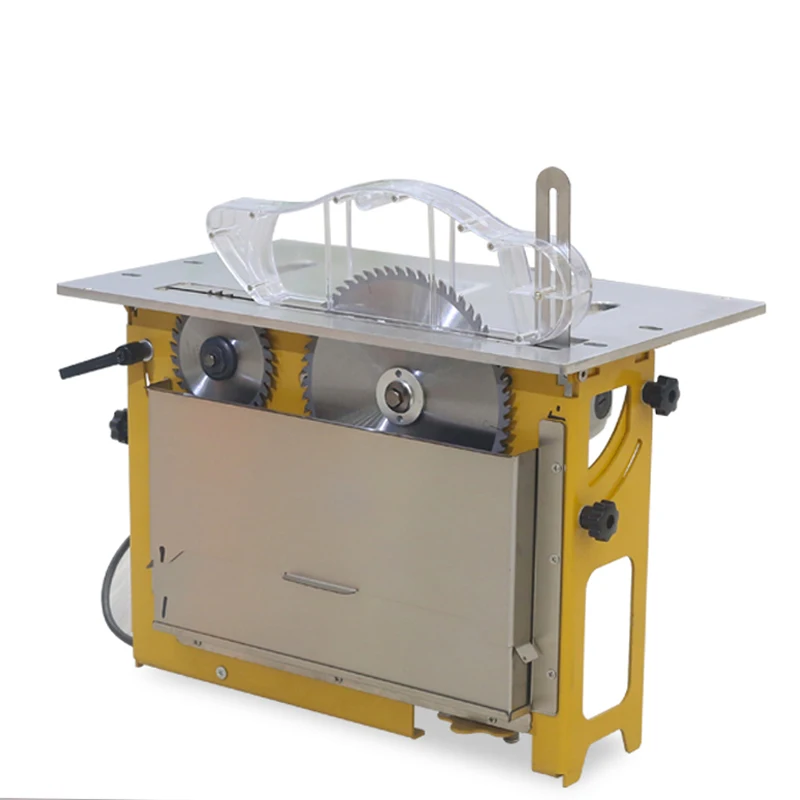
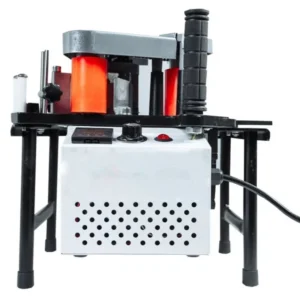
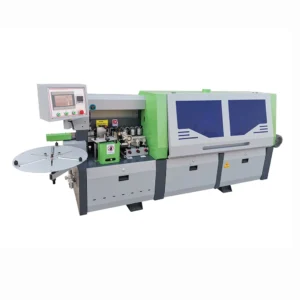
Precision Ground Components — Every cutting mechanism is verified on actual panel stock before crating, ensuring the portable panel saw arrives ready for immediate OEM branding and local market deployment.
Technical Specifications
| Parameter |
Value |
| Product Type |
Portable Sliding Panel Saw |
| Total Power |
6200W |
| Main Saw Motor |
3000W |
| Main Saw Speed |
3800 r/min |
| Main Saw Blade Diameter |
200mm |
| Sub Saw Motor |
2000W |
| Sub Saw Speed |
13000 r/min |
| Vacuum Cleaner Power |
1200W |
| Maximum Cutting Length |
2.44m |
| Maximum Cutting Thickness |
40mm |
| Net Weight |
22kg |
| Machine Dimensions |
500 × 300 × 380mm |
| Voltage & Frequency |
Configurable from 110V to 440V (basis to be confirmed) |
| Control System |
Manual or electronic options available |
| Language Options |
Chinese / English standard; other languages customizable |
| Plug Options |
EU / USA / AU / UK |
| Certification |
CE (basis to be confirmed) |
Application Suitability
| Application |
Material or Output |
| On-site panel cutting |
MDF, particleboard, plywood sheets up to 2.44m |
| Small joinery workshop sizing |
Solid wood panels and laminated boards up to 40mm thick |
| Renovation and interior fit-out |
PVC-edged panels and veneer-faced substrates on job sites |
| Start-up workshop production |
Custom furniture components cut from standard sheet stock |
Why the Voltage Question Must Come Before the Quotation
Confirm local grid specifications before discussing price, not after the machine arrives.
I once watched a sliding table saw motor burn out within minutes of commissioning because the factory shipped a 380V unit to a facility running 415V three-phase. The client lost nearly a month of production waiting for replacement windings to arrive overseas. That single oversight wiped out any margin the buyer had negotiated [NEED_CITE: voltage and frequency standards by export market]. When sourcing a Portable Panel Saw OEM partner, the first engineering question should always be the destination grid — everything else follows from that answer.

Component Sourcing and Patented Cutting Mechanisms
The main and sub saw motors are matched to the proprietary cutting mechanism we developed in-house, holding tolerances that keep edge chipping within acceptable limits across both melamine-faced and raw MDF surfaces. Each Portable Panel Saw OEM order begins with a bill of materials locked to your specification sheet, so motor winding gauge, bearing grade, and switchgear rating all align with the target market’s electrical environment rather than a generic export default.
Four-Stage Quality Control Across the Build Cycle
Incoming materials are inspected before entering the assembly line, in-process checks verify alignment at each sub-assembly station, finished units undergo full-load cutting tests on actual panel stock, and a pre-shipment verification confirms voltage output, plug configuration, and language settings on the control interface. This sequential filtering catches deviations that a single final inspection would miss [NEED_CITE: CE machinery directive requirements for industrial equipment]. Every test is documented per unit, and records travel with the shipment.
Spec Interpretation: What Dual Motors and 2.44m Reach Mean on the Shop Floor
The 3000W main saw at 3800 r/min handles the primary kerf through boards up to 40mm thick, while the 2000W sub saw spinning at 13000 r/min scores the bottom face before the main blade exits — this two-stage cut prevents tear-out on laminated and veneered panels where a single blade would splinter the underside. A 2.44m maximum cutting length covers full standard sheets of plywood and particleboard without requiring a secondary cross-cut station, reducing handling steps in compact workshops. The 22kg net weight and 500 × 300 × 380mm footprint allow one operator to reposition the unit between job sites or store it against a wall when floor space is needed for assembly work. Integrated vacuum extraction at 1200W captures dust at the blade guard, keeping the work surface clear and reducing airborne particulate in enclosed fit-out environments.
The Hidden Cost of Skipping Configuration Verification
Machines quoted without confirming local voltage and frequency arrive unusable, sitting in customs or on the shop floor while transformers are sourced locally. Control panels printed in a language the operator cannot read stall commissioning indefinitely, forcing the distributor to arrange aftermarket labeling or send a technician at their own expense. Entry-level saws pushed into production volumes they were never rated for develop premature bearing wear and motor overheating — failures that surface months after the warranty discussion has ended [NEED_CITE: industrial equipment warranty dispute patterns]. These costs compound quietly and erode the distributor relationship long after the initial sale.
Why Source This Sliding Table Saw Factory Direct
In-house manufacturing with patented cutting mechanisms means design changes for OEM branding do not require negotiating with a third-party engineering house. Voltage, plug type, and control panel language are configured as standard options rather than treated as special requests, so a Sliding Table Saw factory order ships matched to the destination market from day one. The four-stage QC process with pre-shipment verification produces a test record specific to your panel thickness range, not a generic pass certificate. Engineer-led configuration recommendations arrive as a formal quotation within 24 hours, reducing the back-and-forth that delays container bookings. Factory visits are welcomed at any production stage, letting you witness assembly, testing, and crating before the unit leaves the floor.
Documentation & Verification
- CE declaration of conformity matched to the specific portable panel saw configuration shipped
- ISO 9001 certificate covering the manufacturing and QC process for your order batch
- Electrical schematic confirming voltage, frequency, and plug type for your destination market
- Factory test record documenting cut accuracy on your specified panel material and thickness
- Operation and maintenance manual produced in the language agreed at order confirmation
- Packing photographs showing crating, bracing, and container loading before dispatch
Installation, Commissioning & Support
- Confirm dedicated circuit capacity for the 6200W total draw before uncrating the unit
- Verify local voltage and frequency against the electrical schematic before first power-on
- Mount on a level surface; the 22kg frame requires no anchor bolts for standard operation
- Run initial calibration cuts on scrap panels to confirm 2.44m guide alignment before production use
- Replace the 200mm main blade and sub saw blade as a matched set to maintain scoring quality
- Clean vacuum ducting and dust collection bag after every operating shift to sustain 1200W suction
Starting a Manufacturing Partnership Inquiry
Provide the panel materials you intend to cut, the thickness range most common in your production, and the destination country’s voltage and frequency so we can configure the motor windings and plug accordingly. Let us know whether you require OEM branding on the machine housing, custom packaging artwork, or a specific control panel language for your end users. If you are evaluating multiple suppliers, we can arrange a sample cutting test on your own board stock or schedule a factory visit to walk through the assembly and QC process in person.
Frequently Asked Questions
Q: What can be customized under an OEM arrangement for this portable panel saw?
A: Logo placement, machine color, voltage from 110V to 440V, plug type, control panel language, and packaging artwork are all configurable. We adjust the motor winding and switchgear at the factory so the unit arrives ready for the target market. Private label documentation and manuals are produced in your brand identity.
Q: How do you verify cutting accuracy before the machine ships?
A: Each unit runs a cutting test on actual panel stock at the thickness specified in your order. We measure kerf straightness and edge chipping on both faces, record the results, and include the test report with the shipment. Sample cut pieces can be mailed to your office for independent inspection before crating.
Q: What does the four-stage QC process actually inspect?
A: Incoming material inspection checks motor windings and bearing tolerances. In-process QC verifies sub-assembly alignment. Finished product testing runs full-load cuts on panel stock. Pre-shipment verification confirms voltage output, plug configuration, and language settings. Each stage generates a signed record attached to your unit’s documentation pack.
Q: How are spare parts and technical training handled for distributor partners?
A: We supply a recommended spare parts list matched to your order volume, including blades, bearings, and switchgear. Technical training covers assembly, common fault diagnosis, and calibration procedures for your local service team. Parts ship from our Ningjin facility with standard export documentation.
Q: Can you develop a custom variant based on our drawings or market-specific requirements?
A: Yes, we review engineering drawings or physical samples to assess feasibility. Minimum order quantities depend on the extent of tooling changes required — a color and logo swap may need only a small batch, while a modified frame or motor mount involves a larger commitment. We provide a development timeline and cost breakdown before tooling begins.