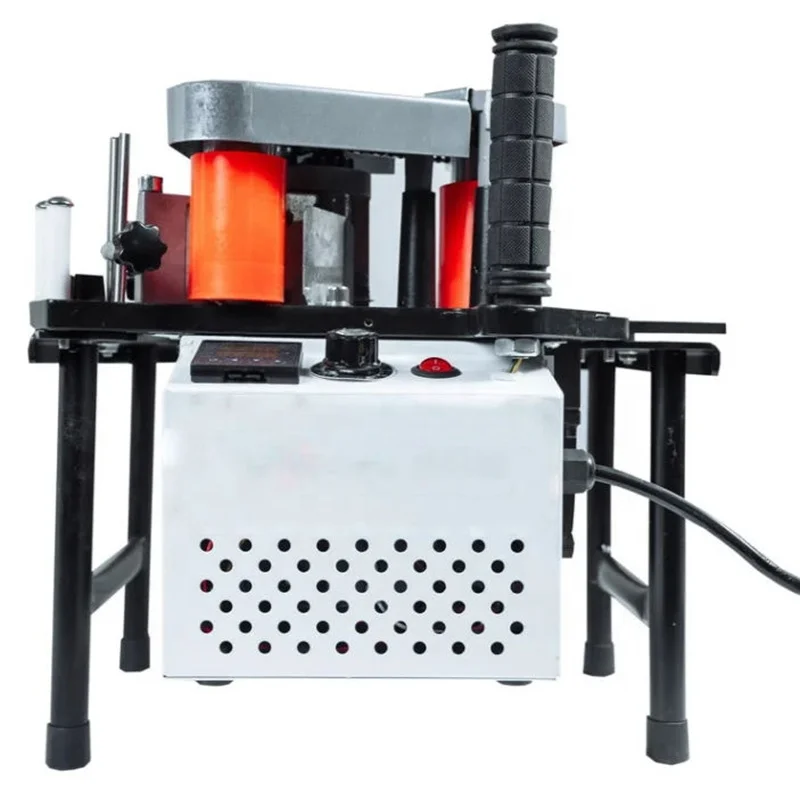
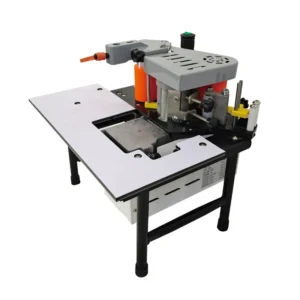
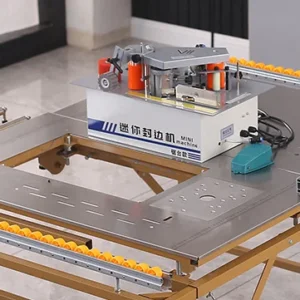
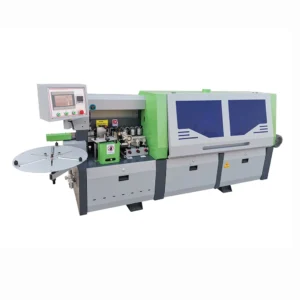
Precision-Built Portable Edge Banding — Double-sided gluing mechanism assembled under four-stage quality control, with every portable edge banding machine verified on sample panels before crate release.
Technical Specifications
| Parameter |
Value |
| Product Type |
Portable Manual Edge Banding Machine |
| Edge Banding Shape Capability |
Curved, Straight and Special-shaped Sheet |
| Edge Thickness Range |
0.3–3mm |
| Edge Sealing Speed |
0–6 m/min |
| Edge Sealing Height (Panel Thickness) |
7–60mm |
| Gluing Method |
Double-sided gluing |
| Glue Pot Volume |
1000ml |
| Net Weight |
14kg |
| Control System |
Manual operation |
| Plug Options |
EU / AU / UK / USA / CN plug available |
| Voltage & Frequency |
Basis not stated in source — confirm local voltage and frequency |
| Rated Power |
Basis not stated in source — confirm motor power rating |
| Overall Dimensions |
Basis not stated in source — confirm machine body dimensions |
Application Suitability
| Application |
Material or Output |
| Small workshop edge finishing |
MDF, particleboard and plywood with PVC or melamine banding |
| On-site joinery and custom furniture repair |
Solid wood panels with veneer edge banding |
| Prototyping and short-run custom pieces |
Curved and special-shaped panel edges |
| Cabinet maker site installations |
Straight and contoured edge sealing at the job location |
Why the Voltage Question Must Come Before the Quote
A portable edge banding machine that arrives with the wrong plug or incompatible motor winding sits dead on the workshop floor until rewound or returned.
I once watched a Lagos furniture factory hold an edge bander in its crate for three weeks because the motor was wound for 380V while the site ran 415V three-phase. The unit had been quoted, paid for and shipped without anyone confirming the destination supply. When the buyer finally powered it, the winding burned within seconds. That machine cost the factory weeks of lost production and a full motor rewind before it ever sealed a single panel edge [NEED_CITE: voltage and frequency standards by export market].
A Portable Edge Banding Machine OEM factory that skips the electrical confirmation step is not saving time — it is shifting the risk entirely onto the buyer. Every schematic should be cross-referenced against the destination market’s supply before production release.

Component Sourcing and Assembly Depth
The gluing mechanism on this portable edge banding unit uses a double-sided application head fed from a 1000ml pot. Both the workpiece edge and the banding strip receive adhesive simultaneously, which keeps coverage even when the operator guides the machine around curved or special-shaped contours. The feed rollers and glue delivery channel are assembled from precision-ground parts, each inspected at incoming material stage before entering the line.
Manufacturing depth matters at this scale because a portable machine has no heavy cast-iron bed to absorb vibration — tolerances depend entirely on component fit. The assembly team aligns the feed chain and glue pot on every unit, checking that the banding tracks flat against the panel edge without drift.
OEM and Private-Label Manufacturing Scope
This portable edge banding platform supports full private-label customization for distributors and brand partners. Logo placement, machine color, plug configuration and packaging format are all configurable at the production stage rather than applied after the fact. Control labeling and operation manuals are produced in the language agreed with the buyer, so the operator reads instructions in their own working language on day one.
For regional importers building a catalogue, the OEM capability extends to documentation branding — CE declaration, specification sheets and packing photographs all carry the distributor’s identity [NEED_CITE: CE machinery directive requirements for industrial equipment]. The factory produces single units for sample evaluation and scales through to container-load runs without shifting the production line.
How Thickness Range and Glue Volume Shape Output Quality
The 0.3–3mm edge thickness range covers standard PVC, melamine and veneer banding stock used across furniture and joinery work. Thin 0.3mm PVC requires lower clamping pressure and careful heat management to avoid blistering, while 3mm solid banding demands firm feed pressure and adequate adhesive volume. The 1000ml glue pot provides enough reserve for extended runs on thicker stock without frequent refills, which matters when an operator is guiding the machine by hand along a long curved panel.
The 7–60mm panel thickness range accommodates everything from slim cabinet shelving to thick worktops and solid-wood bench tops. Operating outside this range risks incomplete adhesion on thin stock or insufficient clamp reach on thick panels. The 0–6 m/min sealing speed lets the operator match feed rate to curve complexity — slower on tight radii, faster on long straight runs.
What Happens When Specification Confirmation Is Skipped
Buyers who purchase a portable edge bander without confirming plug type, voltage or control language often discover the mismatch only after the crate is opened. A UK-plug unit delivered to a site with Australian outlets requires an adapter that may not handle the motor’s startup current. An operator who cannot read the control panel will guess at temperature and speed settings, producing inconsistent glue lines that only surface during final assembly. Panels that fail at the joinery stage expose the entire batch to rework [NEED_CITE: CE machinery directive requirements for industrial equipment].
Why Sourcing Directly From This Production Line
Every unit passes through four-stage quality control — incoming material inspection, in-process assembly checks, finished-product verification and pre-shipment audit — before release. Patented cutting and gluing mechanisms are built in-house rather than sourced as third-party kits. Voltage and plug configuration are confirmed against the buyer’s site supply before the motor is wound. Factory test records are generated on the buyer’s specified panel thickness and banding material. OEM branding and packaging are integrated into production, not applied as afterthoughts.
Documentation & Verification
- Factory test record run on your specified panel thickness and banding type
- Electrical schematic matched to destination voltage and frequency before build
- CE declaration of conformity covering portable edge banding equipment scope
- Operation and maintenance manual in the operator’s agreed language
- Spare parts list with part numbers for glue pot, feed rollers and heating element
Installation, Commissioning & Support
- Confirm single-phase supply matches the motor nameplate before first connection
- Allow bench space for the 14kg unit with clear access on all sides for curved work
- Run a test piece on scrap panel stock to set glue temperature and feed speed
- Clean the 1000ml glue pot after each session to prevent adhesive carbon buildup
- Inspect feed rollers and banding guide weekly for wear on abrasive PVC stock
Before You Send the Inquiry
Share your typical panel materials, the edge banding types you run most often, and the curvature range of your workpieces. Confirm your workshop voltage, frequency and plug standard so the electrical package is matched before production starts. If you are evaluating for distributor branding, outline your packaging format, logo placement preference and target manual language.
Frequently Asked Questions
Q: What OEM customization is available for this portable edge banding machine?
A: Logo, machine color, plug type, packaging format and manual language are all configurable during production. Single-unit sample orders and full container runs both support private-label branding, with documentation carrying your company identity from the factory gate.
Q: How does the factory verify edge banding tolerance before shipment?
A: Each unit is tested on sample panels matching the buyer’s specified thickness and banding material. A factory test record documents glue adhesion results, edge alignment and finish quality. This record ships with the machine and is available for review before dispatch.
Q: Can I visit the production line to see this machine being assembled?
A: Factory visits are welcomed at any production stage. Buyers can witness component assembly, precision grinding checks and sample processing on the portable edge banding machine in person, confirming build quality before placing larger orders.
Q: What precision processes are used for the gluing and feeding components?
A: Critical gluing channels and feed rollers are precision-ground and inspected at incoming material stage. Assembly alignment is verified in-process, and each unit undergoes finished-product testing to confirm consistent double-sided adhesive coverage across the full edge thickness range.
Q: What is the minimum order quantity for private-label manufacturing?
A: Single units can be produced with full OEM branding for evaluation purposes. Lead times scale with volume, and the factory provides a formal quotation with timeline within 24 hours of receiving your specification and branding requirements.