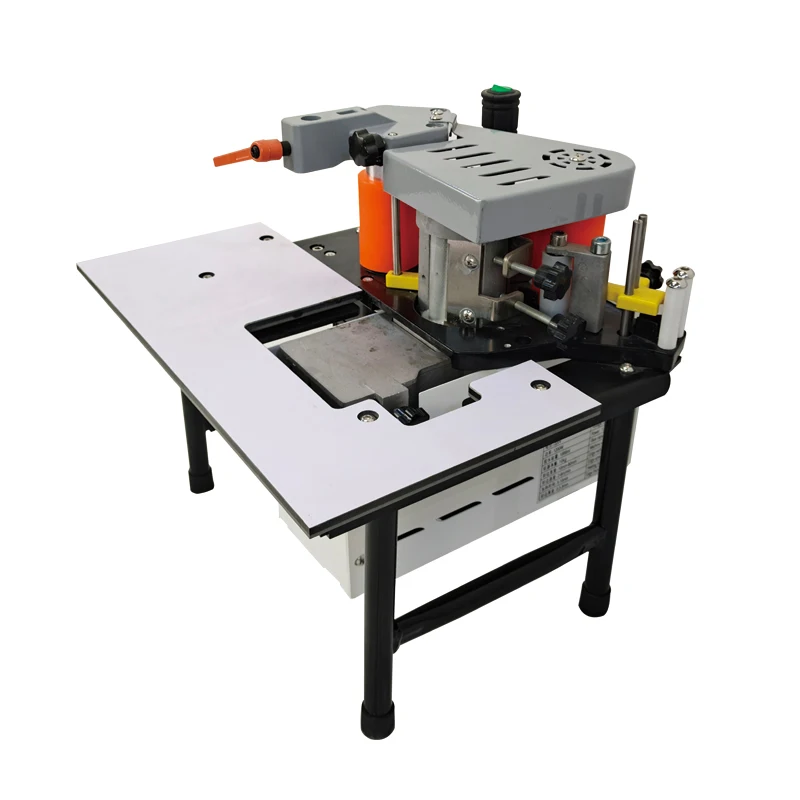
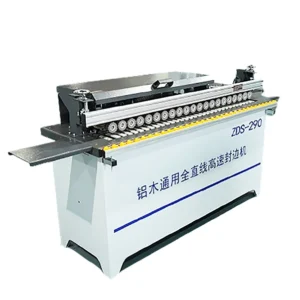
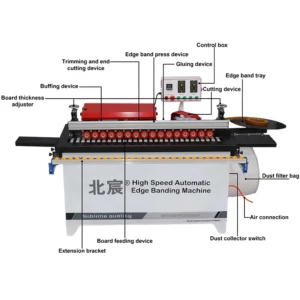
Voltage Verified Before Assembly — every ST-30 portable edge banding machine leaves our Shandong facility with a signed electrical schematic matching the destination country’s frequency and plug standard, a discipline enforced after early field failures.
Technical Specifications
| Parameter |
Value |
| Model |
ST-30 |
| Product Type |
Portable Edge Banding Machine |
| Total Power |
1000W |
| Voltage |
220V / 380V / customization |
| Edge Banding Height |
0–50 mm |
| Edge Banding Thickness |
0.3–3 mm |
| Suitable Edge Banding Tape |
ABS, PVC, Melamine, Veneer |
| Edge Type |
Straight and Curve |
| Minimum Sheet Length |
25 cm |
| Minimum Sheet Width |
3 cm |
| Air Source Pressure |
0.5–0.8 MPa |
| Glue Pot Capacity |
1000 ml |
| Product Size |
38 × 35 × 35 cm |
| Product Weight |
12 kg |
| Language Options |
Chinese, English (customizable to Spanish or other languages) |
| Plug Options |
EU, USA, AU, UK |
| Standards |
ISO 9001, CE |
Application Suitability
| Application |
Material or Output |
| Small custom furniture workshops |
Curved cabinet doors and straight shelving panels in MDF and plywood |
| On-site furniture installation and repair |
ABS and PVC edge finishing on particleboard at the job site |
| Joinery shops transitioning from manual banding |
Melamine and veneer tape on both straight and curved workpiece edges |
| Regional distributor showroom demonstrations |
Lightweight portable unit for live edge banding trials on plywood samples |
Why the Voltage Question Must Come Before the Quotation
A portable edge banding machine that cannot be plugged in is a 12-kilogram paperweight sitting on your workshop floor.
I spent my early years on the assembly floor in Shandong before moving into technical sales, and one incident stuck with me. A buyer in Southeast Asia received an edge bander that matched every mechanical specification he requested — except the voltage. The local supply was 220V single-phase, and the machine had been wound for 380V three-phase. It sat idle for three weeks while we shipped a replacement motor and transformer. That delay nearly cost us the account. [NEED_CITE: voltage and frequency standards by export market]
Since then, I personally review the electrical data sheet for every unit before it enters final assembly. With the ST-30, this discipline is straightforward because the machine supports 220V and 380V configurations and ships with EU, USA, AU, or UK plug types. Confirming these details during the quotation stage eliminates the most common cause of commissioning failure for imported woodworking equipment.

Dual Edge Geometry in a Single Portable Chassis
Most entry-level portable edge banders handle only straight edges, forcing a workshop to invest in a second unit or revert to hand trimming for curved components. The ST-30 addresses both profiles within one frame, making it practical for a small furniture maker producing rounded cabinet fronts alongside standard rectangular shelving. This dual capability reduces the capital outlay for a joinery shop moving from manual banding to mechanized finishing.
The minimum workpiece dimensions — 25 cm length and 3 cm width — allow the machine to process narrow drawer sides and small offcuts that larger automatic feeders cannot grip. For an OEM partner evaluating this model as a volume entry in a product catalog, that versatility simplifies the value proposition to end users who work with varied panel sizes.
Glue Pot Capacity and Sustained Operation Cycles
A 1000 ml glue pot may seem like a minor specification until you are mid-run on a batch of forty cabinet panels and the adhesive reservoir runs dry. Larger stationary edge banders typically hold several liters, but portable units often compromise at half that volume to save weight. The ST-30 maintains a full liter, supporting continuous banding sessions without interrupting workflow to refill hot melt adhesive.
Temperature stability inside the pot directly affects bond quality, particularly when switching between PVC and veneer tapes that require different melting points. [NEED_CITE: hot melt adhesive temperature ranges for wood edge banding materials] The operator must allow the glue to reach the appropriate working temperature before feeding the first panel, a step documented in the operation manual provided in the buyer’s chosen language.
How Core Parameters Translate to Workshop Output
The 0.3–3 mm edge banding thickness range covers the majority of tapes used in custom furniture production. Thin 0.3 mm melamine suits budget-conscious cabinet carcasses, while 3 mm ABS provides impact resistance for workbench tops and commercial shelving. Selecting tape thickness outside this range risks poor adhesion or trimming difficulties that compromise the finished edge.
Air source pressure between 0.5 and 0.8 MPa drives the pneumatic feed mechanism that presses the tape against the panel edge. Insufficient pressure produces visible glue lines and weak bonds, while excessive pressure can crush softer veneer tapes. A small workshop should verify their compressor output before commissioning the ST-30 to avoid inconsistent results on the first production run.
The 1000W total power rating keeps the machine compatible with standard single-phase workshop circuits in most markets, eliminating the need for dedicated three-phase wiring. This characteristic matters for garage-based joinery startups and mobile installers who rely on portable generators or domestic power outlets at the job site.
The Hidden Cost of Skipping Electrical Verification
Every year, workshops receive imported machinery that sits unpowered because the frequency mismatch — 50 Hz versus 60 Hz — was never discussed during the ordering process. Motors designed for one frequency run hotter and draw more current on the other, leading to thermal overload trips within the first hour of operation. [NEED_CITE: CE machinery directive requirements for industrial equipment]
When the ST-30 is configured for a 60 Hz market but ships with a 50 Hz motor winding, the glue pot heater element may underperform, causing adhesive to cool prematurely on the panel edge. This manifests as tape lifting at the corners days after installation, a defect the end user blames on the machine rather than the specification gap. Requesting the electrical schematic before production begins prevents this class of failure entirely.
Manufacturing Depth Behind a Portable Unit
In-house assembly of the ST-30 means the same technicians who grind the feed rollers also run the pre-shipment edge banding test on your specified substrate. There is no third-party trading company interpreting your requirements through a second language.
Voltage and plug customization is handled on the production line rather than outsourced after the fact, so the machine leaves the factory with the correct wiring already installed. The four-stage quality control process — incoming material inspection, in-process checks, finished product verification, and pre-shipment testing — applies to this 12 kg unit with the same rigor as a full-size automatic edge bander.
OEM partners can specify private label logos, custom color panels, and documentation in the target market language without minimum order quantities that strain a new distribution relationship. The engineering team provides a formal configuration proposal within 24 hours of receiving the buyer’s processing requirements and budget parameters.
Documentation & Verification
- Factory test record showing edge banding results on your specified MDF or plywood thickness
- Electrical schematic confirming voltage, frequency, and plug type matched to destination country
- Operation and maintenance manual written in the agreed language without Chinese-only sections
- CE declaration of conformity covering portable woodworking machinery safety requirements
- Spare parts list identifying wear components with part numbers for reorder accuracy
Installation, Commissioning & Support
- Connect to a dedicated 1000W circuit matching the confirmed 220V or 380V supply before first use
- Verify compressor output falls within 0.5–0.8 MPa range to ensure consistent pneumatic tape feed pressure
- Allow the 1000 ml glue pot to reach full operating temperature before feeding the first panel edge
- Run test pieces on both straight and curved profiles using your actual ABS or PVC tape stock
- Calibrate feed speed on sample offcuts to match the 0.3–3 mm thickness of your chosen banding material
- Clean glue residue from the pot and feed rollers after each session to prevent adhesive buildup
Requesting a Configuration Proposal
To move from inquiry to quotation, share the panel materials you process most frequently — MDF, plywood, or particleboard — along with the edge tape types and thicknesses in your current product range. Specify the local voltage and frequency at the installation site, and indicate whether the control panel should display instructions in English, Spanish, or another language. If you are evaluating this unit as an OEM partner, include your branding requirements and target documentation language so the engineering team can prepare a complete proposal.
Frequently Asked Questions
Q: How is voltage and plug type confirmed before shipment to match local electrical standards?
A: During the quotation stage, we request your local supply voltage, frequency, and preferred plug standard. The electrical schematic is then prepared and shared for your approval before assembly begins. The ST-30 supports 220V and 380V configurations with EU, USA, AU, and UK plug options, and each unit ships with a signed voltage confirmation document.
Q: Can the control panel be supplied in a single language without Chinese characters?
A: Yes. The ST-30 control interface can be configured in English, Spanish, or other languages upon request. We confirm the language during the specification review stage and reflect it on the formal quotation. The operation manual matches the panel language so your operators have consistent reference material during commissioning.
Q: What substrates and edge banding materials can be tested in a pre-shipment sample run?
A: We conduct pre-shipment tests using MDF, plywood, or particleboard with ABS, PVC, melamine, or veneer tape based on your production mix. You may send sample panels and tape to our factory, or we source equivalent materials locally. The test results are photographed and documented in the factory test record included with your shipment.
Q: What is included in the OEM logo and private label customization process?
A: OEM customization covers logo placement on the machine housing, custom packaging artwork, and private label documentation. We provide digital proofs for your approval before printing or engraving begins. There is no minimum order quantity for branding modifications on the ST-30, making it accessible for distributors establishing a new product line.
Q: How are spare parts and glue pot components supplied for after-sales maintenance?
A: Each ST-30 ships with a spare parts list identifying wear items such as feed rollers, trimming blades, and glue pot seals with corresponding part numbers. Replacement components are available for individual shipment, and we recommend stocking consumables based on your expected monthly operating hours to minimize downtime.