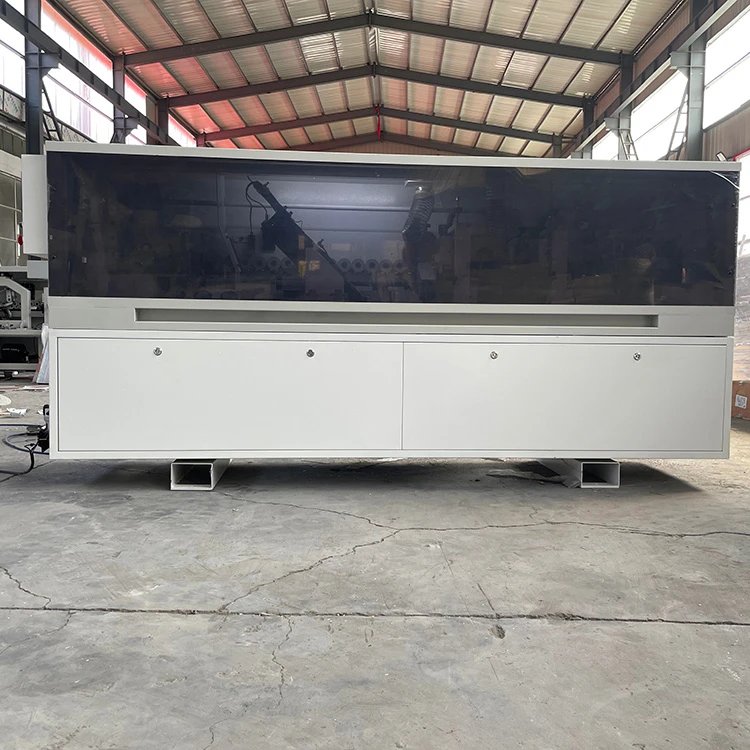
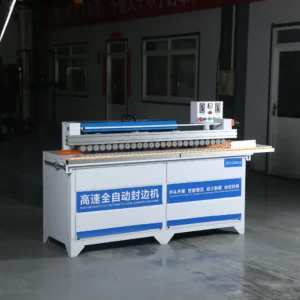
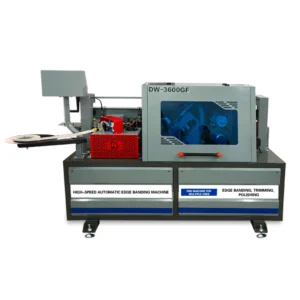
Manufacturing depth with full OEM scope — ZDS280B and ZDS280C edge banding machines are built on a 14 mm steel frame with component-level sourcing transparency, allowing distributors and private-label partners to audit every stage from raw plate to pre-shipment test.
Technical Specifications
| Parameter |
Value |
| Model |
ZDS280B / ZDS280C |
| Product Type |
Automatic Edge Banding Machine |
| Main Functions (ZDS280B) |
Gluing, End trimming, Fine trimming, Buffing |
| Main Functions (ZDS280C) |
Gluing, End trimming, Fine trimming, Scraping, Buffing |
| Panel Thickness Range |
10–55 mm |
| Edge Thickness Range |
0.4–3 mm |
| Min. Panel Width |
45 mm |
| Min. Panel Length |
80 mm |
| Conveyor Belt Speed |
15 m/min |
| Working Pressure |
0.6–0.8 MPa |
| Rated Power |
7.5 kW |
| Voltage & Frequency |
380V-3HP (frequency to be confirmed per destination market) |
| Fuselage Construction |
14 mm high-strength steel plate, frame-type, high-temperature quenching |
| Conveyor Guide Rail |
HT260 |
| Conveying Motor |
Taiwan brand with thermal protection |
| Head Guide Rail |
Taiwan brand |
| Pneumatic System |
German Festo or Taiwan AirTAC cylinders, AirTAC magnetic switch |
| Electrical Components |
Delixi/Chint air switches and contactors, Japanese Omron travel switches |
| Weight |
650 kg (ZDS280B) / 800 kg (ZDS280C) |
| Overall Dimensions (L×W×H) |
2300×700×1250 mm (ZDS280B) / 2800×700×1250 mm (ZDS280C) |
Application Suitability
| Application |
Material or Output |
| Custom furniture panel edge banding |
MDF, melamine-faced board, plywood |
| Cabinet door and carcass production |
Particleboard, PVC-edged panels |
| Small to mid-volume joinery workshops |
Solid wood panels with veneer edge banding |
| Regional distributor model-mix coverage |
Entry-level (ZDS280B, 4-function) to mid-range (ZDS280C, 5-function with scraping) |
Why Voltage Confirmation Must Precede Every OEM Automatic Edge Banding Machine Order
A machine wired for the wrong frequency is a crate of expensive steel until a transformer arrives.
I have watched containers get cleared at port only for the buyer to discover the motor hums at the wrong pitch and the PLC throws fault codes on startup. The fix is never quick — sourcing a step-up or step-down transformer locally, waiting for shipping, then rewiring the cabinet. Weeks of dead time in a workshop that already cleared floor space and hired operators. When sourcing an automatic edge banding machine factory build for resale or private label, the voltage and frequency question belongs in the very first engineering exchange, not as an afterthought on the packing list. [NEED_CITE: voltage and frequency standards by export market]

Frame Rigidity as the Foundation of Edging Consistency
The ZDS280B and ZDS280C sit on a frame-type fuselage cut from 14 mm national standard high-strength steel plate, then put through high-temperature quenching treatment. This matters for any automatic edge banding machine factory partner evaluating long-term dimensional stability. A frame that flexes under continuous vibration transfers that movement into the trimming and buffing stations, producing visible waviness on the edge profile. Quenching relieves internal stresses from welding so the geometry holds season after season.
Component Sourcing You Can Trace Before the Crate Ships
Distributors evaluating manufacturing depth need to see beyond the nameplate. The pneumatic circuit uses German Festo or Taiwan AirTAC cylinders paired with AirTAC magnetic switches for position sensing. Electrical switching relies on Delixi or Chint air switches and contactors, while Japanese Omron travel switches handle limit detection. The conveying motor is a Taiwan brand unit with built-in thermal protection. When an OEM partner requests a private-label automatic edge banding machine build, every component line item can be documented in the electrical schematic that ships with the unit. [NEED_CITE: CE machinery directive requirements for industrial equipment]
Reading the Spec Sheet Against Real Workshop Conditions
Panel thickness range of 10–55 mm covers the bulk of furniture and cabinet stock, but the lower bound matters most when running thin MDF drawer sides. At 15 m/min feed speed, the HT260 conveyor guide rail and Taiwan-brand head guide rail keep the panel flat against the fence — any deflection here shows up as uneven glue spread on thin stock. The ZDS280C adds a scraping station after fine trimming, which removes the microscopic ridges left by the trimming cutter on PVC and melamine edges. For workshops processing a mix of glossy PVC and matte melamine, that fifth function eliminates a manual clean-up step downstream. Working pressure of 0.6–0.8 MPa must be maintained at the point of use, meaning the compressor and line sizing in the buyer’s facility need to match before the machine is energized.
The Hidden Cost of Skipping the Pre-Shipment Test
Machines that leave the factory without a documented run on the buyer’s actual panel material often reveal problems only during commissioning. Glue pot temperature that works on one PVC brand may char another. Trimming cutters set for 18 mm particleboard will tear through 8 mm MDF backer panels. When an importer accepts delivery without a pre-shipment test record, every adjustment becomes a negotiation across time zones instead of a five-minute fix on the factory floor. [NEED_CITE: typical commissioning delays from untested edge banding configurations]
Why Distributors Source This Automatic Edge Banding Machine Factory Build
Two model tiers — the 4-function ZDS280B and the 5-function ZDS280C — let a regional partner cover entry-level and mid-range segments from a single factory source, simplifying spare parts inventory and technician training. Voltage is configurable from 110V to 440V, and control panels can be produced in the destination market language, eliminating operator confusion at first power-on. The four-stage QC protocol — incoming material, in-process, finished product, and pre-shipment verification — generates documented checkpoints rather than verbal assurances. OEM logo application, color matching, and private-label documentation are standard scope, not special requests. Factory visits are open so buyers can inspect frame welding, component staging, and assembly benches before committing to volume.
Documentation & Verification
- CE declaration of conformity referencing applicable machinery directives
- ISO 9001 certificate covering manufacturing process control
- Electrical schematic confirming destination voltage and frequency before production
- Factory test record run on buyer-specified panel thickness and edge material
- Packing photographs showing crate blocking and moisture barrier before container loading
- Operation and maintenance manual in the agreed language with exploded parts diagrams
Installation, Commissioning & Support
- Requires level concrete floor capable of supporting 800 kg concentrated load for the ZDS280C
- Dedicated 380V three-phase circuit with isolation switch rated above 7.5 kW draw
- Ships assembled; conveyor alignment and fence squareness verified on-site after positioning
- First run includes glue pot temperature mapping against buyer’s edge banding material
- Spare parts list covers consumable cutters, buffing wheels, and pneumatic seals
- Pneumatic supply requires clean dry air at 0.6–0.8 MPa with inline filtration
What to Include With Your Inquiry
Send your target market voltage and frequency, the panel materials and thickness range you process most, and the edge banding materials your customers specify. If you are building a distributor stock program, indicate the model mix between ZDS280B and ZDS280C you need and any private-label requirements including logo placement and control panel language. Sample panels shipped to the factory allow a pre-production test run before the order enters the build queue.
Frequently Asked Questions
Q: What OEM and private-label customization options are available for these edge banding machines?
A: Logo placement on the fuselage and control panel, custom machine color, voltage configuration from 110V to 440V, and multilingual HMI text are all standard OEM scope. Electrical schematics are redrawn to reflect the destination market’s wiring standards. Single-unit samples through to large production runs are supported with the same documentation package.
Q: How is the four-stage QC process documented for each machine?
A: Incoming material inspection, in-process assembly checks, finished product testing, and pre-shipment verification each produce a signed record. The pre-shipment test runs your specified panel and edge material through all stations, and the resulting test record ships inside the documentation folder so your technician can confirm settings on arrival.
Q: Can I visit the factory to audit manufacturing and component sourcing?
A: Factory visits are open to distributors and OEM partners at any production stage. You can inspect frame welding, component staging shelves, assembly benches, and the QC inspection area. Witnessing a live test run on your sample material during the visit is also possible with advance scheduling.
Q: What is the lead time for OEM orders and how does it scale with quantity?
A: Single-unit OEM samples typically follow a multi-week build cycle. Volume orders for distributor stock programs are sequenced into the production schedule with confirmed milestones for frame completion, component fitting, and pre-shipment testing. Exact timing depends on current line loading and customization scope.
Q: How are spare parts and technical training handled for distributor service teams?
A: A detailed spare parts list ships with every machine, covering consumable cutters, buffing wheels, and pneumatic seals. Distributor service technicians can receive hands-on training during factory visits covering common fault diagnosis, belt tracking adjustment, and station alignment procedures specific to the ZDS280 series platform.