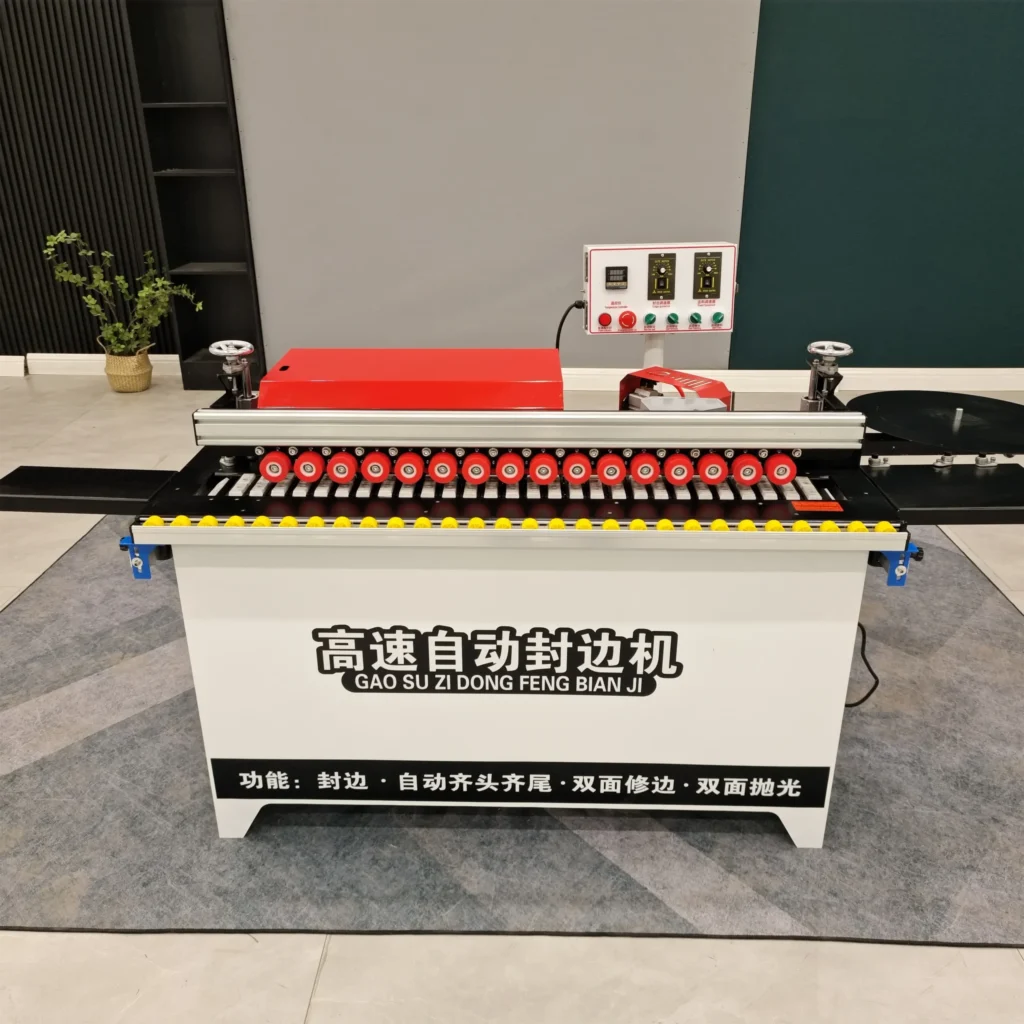
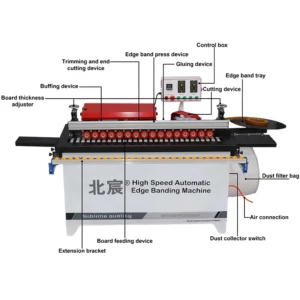
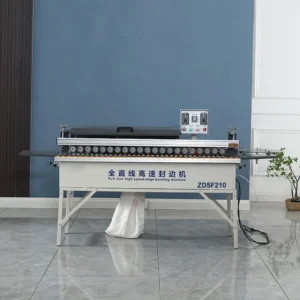
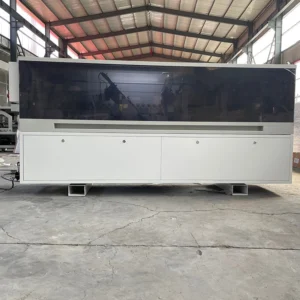
In-house OEM manufacturing — ZDSF802 automatic edge banding machine built with patented cutting mechanisms, verified tolerance, and full private-label customization from voltage to control panel language.
Technical Specifications
| Parameter |
Value |
| Model |
ZDSF802 |
| Product Type |
Automatic Edge Banding Machine |
| Function Sequence |
Gluing, End cutting, Trimming, Vacuuming, Buffing |
| Rated Voltage |
220V (configurable from 110V to 440V) |
| Rated Power |
4KW |
| Working Speed |
0–7 m/min (basis to be confirmed) |
| Conveyor Belt Speed |
0–14 m/min (basis to be confirmed) |
| Strip Thickness Range |
0.5–2.5 mm |
| Sheet Thickness Range |
10–50 mm |
| Glue Pot Capacity |
4000 ml |
| Rated Air Pressure |
0.6–0.8 MPa |
| Overall Size |
190 × 60 × 130 cm |
| Machine Weight |
150 kg |
| Pressure Beam |
Integrated, double rows of silicone pressure wheels |
| Trimming Configuration |
Double high-speed motors, up-and-down trimming |
| Polishing Configuration |
Up and down two polishing motors |
| Strip Breaking |
Pneumatically controlled belt breaking |
| Extension Support |
Extendable fluent strips for large plates |
| Control Panel |
Digital display of glue pot temperature, independent switch |
| Conveyor Belt Material |
Silicone |
| Assembly State |
Partial assembly required (KD packing for spare parts, main unit assembled) |
| Warranty |
One year |
Application Suitability
| Application |
Material or Output |
| Custom furniture panel edge banding |
MDF, particleboard, plywood substrates |
| Cabinet door and carcass production |
PVC and melamine edge banding strips |
| Joinery workshop automation |
Solid wood panels with veneer banding |
| Small-batch panel processing |
Laminate and acrylic edge materials up to 2.5 mm |
| Entry-level production line integration |
Board stock from 10 mm to 50 mm thickness |
Why Voltage Confirmation Must Precede the Purchase Order
Every export automatic edge banding machine must have its electrical system validated against the destination grid before production begins.
I learned this the hard way early in my career. A 440V control cabinet was shipped to a Middle East customer whose facility ran on 380V. The on-site electrician spent two weeks rewiring before the machine could power up, and the customer nearly withheld final payment. Since that incident, I personally review every electrical schematic and nameplate before a unit leaves the workshop. The ZDSF802 is configurable across the 110V–440V range, but the exact voltage and frequency must be locked in at the quotation stage — not discovered at the container door [NEED_CITE: voltage and frequency standards by export market].
Distributors and OEM partners know that a machine arriving with the wrong voltage is not just an installation headache. It becomes a credibility problem with your end customer, a potential safety liability, and a delay that compresses the commissioning window. For an automatic edge banding machine factory handling private-label orders, electrical verification is the single most important pre-production checkpoint.

Component Sourcing and Precision Assembly for OEM Partners
When a distributor commits to container-quantity orders, the consistency of every unit matters as much as the specification sheet. The ZDSF802 is manufactured in-house from the frame up, with precision-ground components subject to multi-stage inspection throughout assembly. The trimming stations use double high-speed motors that are individually aligned during build to maintain edge finish consistency across MDF, plywood, and particleboard. For OEM partners, this means the machine carrying your brand name performs identically across every unit in the shipment.
Private-Label Customization Beyond the Logo Plate
A private-label automatic edge banding machine requires more than swapping a badge. The control panel language must match the operator’s working environment, the documentation set must reflect the agreed terminology, and the packaging must align with the distributor’s unboxing and commissioning process. The ZDSF802 supports multilingual control interfaces, custom documentation in the agreed language, and branded packaging configurations. Each of these elements is confirmed during the specification phase and verified again at pre-shipment inspection [NEED_CITE: CE machinery directive requirements for industrial equipment].
How Core Parameters Shape Downstream Assembly Quality
The 10–50 mm sheet thickness range and 0.5–2.5 mm strip thickness range define which panel types and edge materials this machine can process in a single pass. A workshop running thin 10 mm shelving stock needs precise feed control at the lower end of the speed range, while 50 mm worktop panels demand consistent pressure from the integrated double-row silicone wheels to prevent band lift. The 4000 ml glue pot capacity reduces refill interruptions during continuous runs, which matters when a distributor’s customer is processing a batch of cabinet carcasses and cannot afford a cold glue joint mid-run.
The pneumatically controlled strip breaking mechanism eliminates manual cutting at the end of each panel, producing a clean break that reduces the load on the downstream trimming motors. The up-and-down trimming and polishing stations then finish both edges in one pass, so the panel moves directly to boring or assembly without secondary cleanup. Tolerance at the trimming stage directly affects whether panels fit together during cabinet assembly — an edge that is proud or recessed by even a fraction of a millimeter creates visible gaps in finished furniture [NEED_CITE: woodworking panel assembly tolerance standards].
The Cost of Skipping Factory Verification
A distributor who orders on specification alone risks discovering tolerance issues only after panels fail assembly at the customer’s site. Edge banding quality that varies across MDF versus plywood substrates, visible glue lines on certain materials, and feed inconsistencies that appear only under sustained production loads — none of these surface in a brochure. The ZDSF802 is available for sample processing tests on the buyer’s specified material before a bulk order commitment, so the edge finish and bonding strength are verified against real stock rather than assumed from a data sheet [NEED_CITE: edge banding adhesion testing standards for panel substrates].
Why OEM Buyers Source This Automatic Edge Banding Machine Here
The ZDSF802 is built on a workshop floor that has produced woodworking machinery for approximately two decades, with engineers who understand both the mechanical assembly and the export documentation requirements. In-house manufacturing with patented cutting mechanisms means the core trimming and feed components are not outsourced, giving OEM partners direct access to engineering adjustments for regional market needs. The four-stage quality control process — incoming material, in-process, finished product, and pre-shipment verification — provides documentation at each gate. Voltage adaptation from 110V to 440V and multilingual control panels are standard customization options, not special requests. Engineer-led configuration recommendations are delivered with a formal quotation, so the distributor’s technical team can review and confirm before production begins.
Documentation & Verification
- Factory test record on your specified panel thickness and edge material before dispatch
- Electrical schematic with confirmed voltage and frequency for your destination market
- CE declaration of conformity and ISO 9001 certificate included in shipment package
- Operation and maintenance manual produced in the agreed operator language
- Spare parts list with part numbers matching the KD packing contents
- Packing photographs documenting crate condition and component placement before container loading
Installation, Commissioning & Support
- 190 × 60 × 130 cm footprint requires level concrete floor with clearance for extendable fluent strips
- 4KW rated power at confirmed voltage needs a dedicated circuit with appropriate breaker rating
- Main unit arrives assembled; KD-packed spare parts and accessories require on-site unpacking and mounting
- Digital glue pot temperature display and independent switches calibrated during first power-on
- Pneumatic strip breaking system requires connection to shop air supply at 0.6–0.8 MPa
- Silicone conveyor belt inspected and tension adjusted during commissioning before production runs begin
Preparing Your Inquiry for Accurate Configuration
To receive a configuration proposal that matches your market, share the panel substrates and edge banding materials your customers process most frequently, along with the target voltage and frequency for the destination country. If you are planning a phased line rollout, indicate which upstream and downstream equipment the ZDSF802 will integrate with so feed height and throughput can be matched. For OEM orders, specify the control panel language, logo placement requirements, and any documentation branding preferences at the inquiry stage.
Frequently Asked Questions
Q: What OEM customization options are available for private-label orders?
A: The ZDSF802 supports custom logo application, voltage configuration from 110V to 440V, multilingual control panel interfaces, and branded packaging. Each element is confirmed during the specification phase and verified at pre-shipment inspection. Documentation sets are produced in the agreed language to match your market’s operator requirements.
Q: How is edge banding tolerance verified before shipment?
A: The four-stage quality control process includes in-process checks during assembly and a pre-shipment test run on actual panel samples. The factory test record documents trimming accuracy and edge finish quality on the buyer’s specified substrate, providing verifiable evidence rather than a claimed tolerance figure.
Q: Can the factory run sample processing tests before I commit to a container order?
A: Yes. You can submit your specific MDF, plywood, particleboard, or solid wood panel stock along with the edge banding material you intend to use. The factory processes sample panels on the ZDSF802 and ships them for your evaluation, so edge quality and bonding strength are confirmed on real material.
Q: What documentation ships with each OEM unit?
A: Each unit ships with a CE declaration of conformity, ISO 9001 certificate, machine specification sheet, confirmed electrical schematic, factory test record, operation manual in the agreed language, spare parts list, and packing photographs. This documentation set supports your import clearance and end-customer handover process.
Q: How does production scheduling work for container-quantity OEM orders?
A: After specification and voltage confirmation, the order enters a production schedule with defined milestones. Pre-shipment verification is completed for every unit before container loading. The engineering team coordinates with your logistics schedule to align dispatch timing with your warehouse or distribution plan.