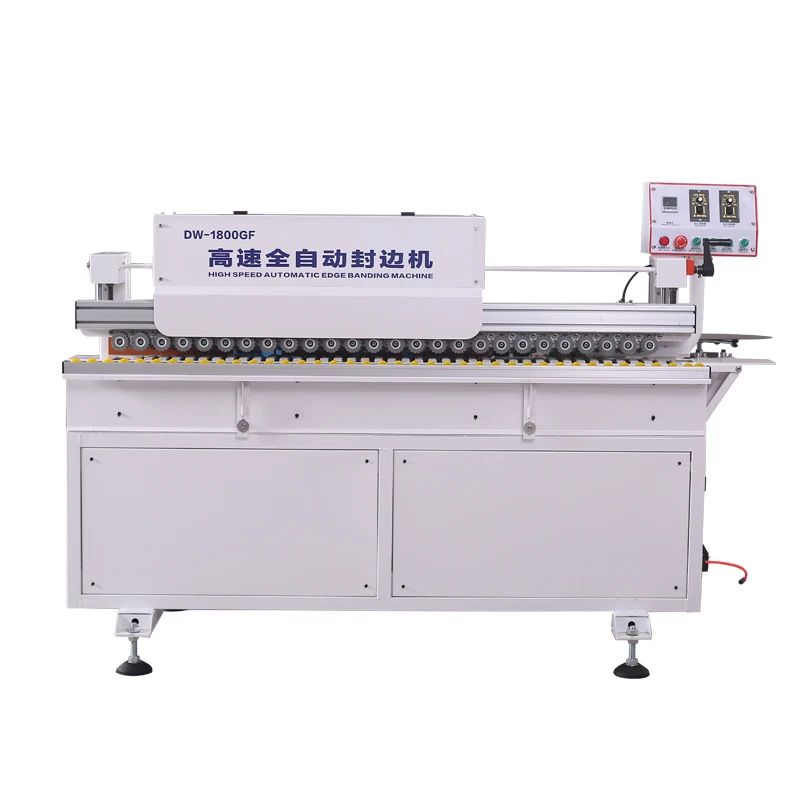
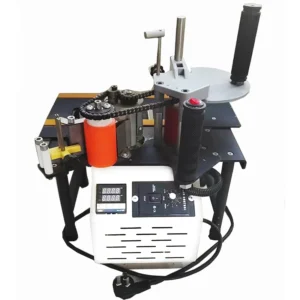
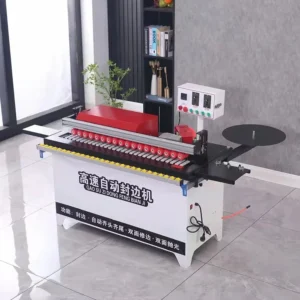
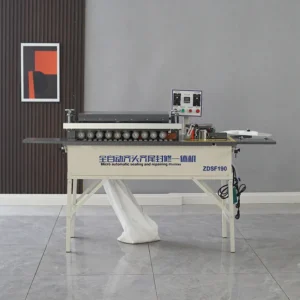
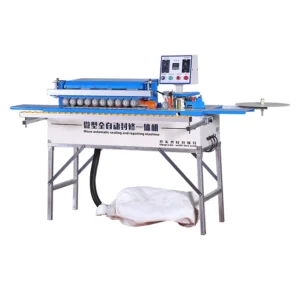
Voltage-Verified Before Build — every DW1800 electrical schematic is cross-checked against destination grid standards before the control cabinet is wired, eliminating the three-week transformer delay that stalls commissioning on arrival.
Technical Specifications
| Parameter |
Value |
| Model |
DW1800 |
| Product Type |
Automatic Edge Banding Machine |
| Total Installed Power |
4.9 kW |
| Voltage Options |
380V / 220V / 415V (frequency confirmed per destination) |
| Overall Dimensions (L×W×H) |
220 × 65 × 125 cm |
| Net Weight |
320 kg |
| Minimum Sheet Length |
20 cm |
| Minimum Sheet Width |
10 cm |
| Edge Banding Height Range |
0–50 mm |
| Edge Banding Thickness Range |
0.3–3 mm |
| Feed Speed |
0–14 m/min |
| Trimming Motors |
800 W × 2, 24,000 r/min |
| Polishing Motors |
380 W × 2 |
| Glue Pot Capacity |
4,000 ml |
| Air Source Pressure |
0.4–0.6 MPa |
| Vacuum Power |
550 W |
| Transmission Power |
180 W |
| Standard Functions |
Double-sided gluing, top/bottom trimming, top/bottom polishing, front/rear alignment, flexible edge scraping, dust extraction |
| Profile Tracking |
Rounds four corners for smooth edge finish |
| Language Options |
Chinese, English; other languages on request |
| Plug Options |
EU, USA, AU, UK |
| Assembly State |
Fully assembled in wooden crate |
Application Suitability
| Application |
Material or Output |
| Custom cabinet door edge finishing |
MDF and particleboard with PVC or melamine banding |
| Plywood furniture panel production |
Plywood sheets 0.3–3 mm veneer or ABS edge |
| Joinery workshop small-batch runs |
Solid wood panels requiring corner rounding |
| Panel processing plant continuous runs |
ABB boards and organic glass plates with adhesive trim |
Why Voltage Must Be Settled Before the Purchase Order
Confirming local voltage and frequency before production prevents the most common commissioning failure in exported woodworking machinery.
An Automatic Edge Banding Machine manufacturer that ships without verifying destination grid specs delivers a machine that sits silent while the buyer sources a step-down transformer. In workshops running tight production schedules, that delay cascades into missed delivery windows and strained customer relationships [NEED_CITE: voltage and frequency standards by export market]. I have watched a 380V motor hum uselessly in a 220V plant because nobody asked the right question at the quotation stage. The DW1800 is configurable across 220V, 380V, and 415V inputs, and the electrical schematic is locked to the buyer’s confirmed frequency before assembly begins.

Component Sourcing and Assembly Discipline
Every DW1800 Automatic Edge Banding Machine is built on the same assembly line, meaning the trimming motors, glue pot, and polishing heads all come from the same supplier batches regardless of destination market. The 800 W trimming motors running at 24,000 r/min are matched to the transmission system during bench testing before the frame is closed. This controlled sourcing ensures that an OEM partner ordering under a private label receives the same internal components as a direct end-user purchase.
Four-Stage QC Across the Build Cycle
Incoming raw materials, in-process sub-assemblies, finished machine function tests, and pre-shipment verification form the four gates every unit passes through. The 4,000 ml glue pot is pressure-tested for leaks at operating temperature before it is mounted. Trimming and polishing stations are run against sample panels to confirm edge finish consistency. Pre-shipment verification includes a full electrical continuity check and a simulated production cycle that mirrors the buyer’s stated panel thickness [NEED_CITE: CE machinery directive requirements for industrial equipment].
How Feed Speed and Trimming Stations Shape Edge Quality
The 0–14 m/min feed speed range matters because different banding materials demand different throughput settings. PVC at 0.3 mm bonds cleanly at higher feed rates, while 3 mm solid wood edging requires a slower pass to let the adhesive set under pressure before trimming. The two-stage trimming setup — top and bottom cutters each driven by independent 800 W motors — removes excess banding in one pass without secondary handwork. Polishing follows immediately at 380 W per head, bringing the trimmed edge to a smooth finish that is ready for assembly without additional sanding. The profile tracking function rounds all four corners, eliminating the sharp edges that catch during handling and cause delamination over time.
The Cost of Skipping Configuration Verification
Machines ordered without confirming local plug standards arrive with pigtails that do not match the workshop’s socket outlets, forcing an electrician to rewire before the first panel is fed. Control panels delivered in a language the operator cannot read stall commissioning while the buyer waits for translated documentation. Entry-level edge banders pushed into continuous production volumes they were never designed for develop premature wear on the transmission chain and trimming bearings [NEED_CITE: equipment lifecycle under mismatched production load]. These are not defects — they are configuration oversights that surface only after the machine is on the buyer’s floor.
Why Procurement Teams Source the DW1800 From This Line
In-house manufacturing means the cutting mechanisms and trimming assemblies are produced under the same roof, keeping tolerance control within the factory rather than outsourced to third-party sub-assemblers. Voltage and plug customization is standard procedure, not an upcharge or an afterthought noted on the packing list. OEM partners can specify custom logo placement, panel color, and control language without minimum order thresholds that exclude smaller distributors. Factory visits are open, so a buyer evaluating manufacturing depth can watch the four-stage QC sequence on a unit already in progress. Formal quotations with confirmed specifications are issued within 24 hours of receiving the buyer’s panel range and daily throughput target.
Documentation & Verification
- CE declaration of conformity matched to DW1800 model specifications
- ISO 9001 certificate covering the manufacturing facility
- Electrical schematic confirming destination voltage and frequency
- Factory test record run on buyer’s stated panel thickness range
- Operation and maintenance manual in the agreed operator language
- Spare parts list with part numbers and packing photographs
Installation, Commissioning & Support
- Requires a level concrete floor capable of supporting 320 kg static load across the 220 cm frame length
- Dedicated circuit matching confirmed voltage with isolation switch within 2 m of the control cabinet
- Arrives fully assembled; only dust extraction ducting and air line connection required on site
- First-run calibration sets feed speed and glue temperature to match buyer’s banding material thickness
- Operator training covers glue pot refill procedure, trimming adjustment, and daily lubrication points
- Spare trimming cutters and polishing wheels included for initial consumable replacement cycle
Request a Configuration Proposal
Provide your primary panel material, edge banding thickness range, and daily production volume so the engineering team can confirm feed speed settings and glue pot cycle times. Include your workshop voltage and frequency so the electrical schematic matches your grid before assembly. Specify the control panel language your operators need, and note any OEM branding requirements if you are a distributor placing the DW1800 under your own label.
Frequently Asked Questions
Q: Can the DW1800 carry our distributor logo and custom color scheme?
A: Yes. OEM and private-label orders are supported with custom logo printing, machine color, and specification adjustments. There is no minimum order quantity barrier for branding changes, so both single-unit and batch orders can carry your market identity. Confirm logo artwork and color codes at the quotation stage.
Q: How is voltage and frequency confirmed before the machine is built?
A: The buyer provides local voltage, phase, and frequency data at the inquiry stage. The engineering team issues an electrical schematic reflecting those values for written approval. Production of the control cabinet does not begin until that schematic is signed off, preventing grid mismatch on arrival.
Q: What languages are available for the control panel and manual?
A: Chinese and English are standard. Additional languages are configured on request based on the operator market. The operation and maintenance manual is delivered in the same agreed language, ensuring the commissioning team can read all parameter settings and safety instructions.
Q: Is it possible to visit the factory and run a sample test before ordering?
A: Factory visits are welcomed at any stage. Buyers can bring their own panel samples to run through the DW1800, observing edge finish quality, trimming accuracy, and corner rounding on their actual material before committing to a purchase order.
Q: How are spare parts and technical training handled for distributor service teams?
A: A spare parts list with numbered components ships with every unit. Distributors can arrange technical training sessions for their own service technicians, covering trimming motor replacement, glue pot maintenance, and electrical troubleshooting procedures specific to the DW1800 platform.