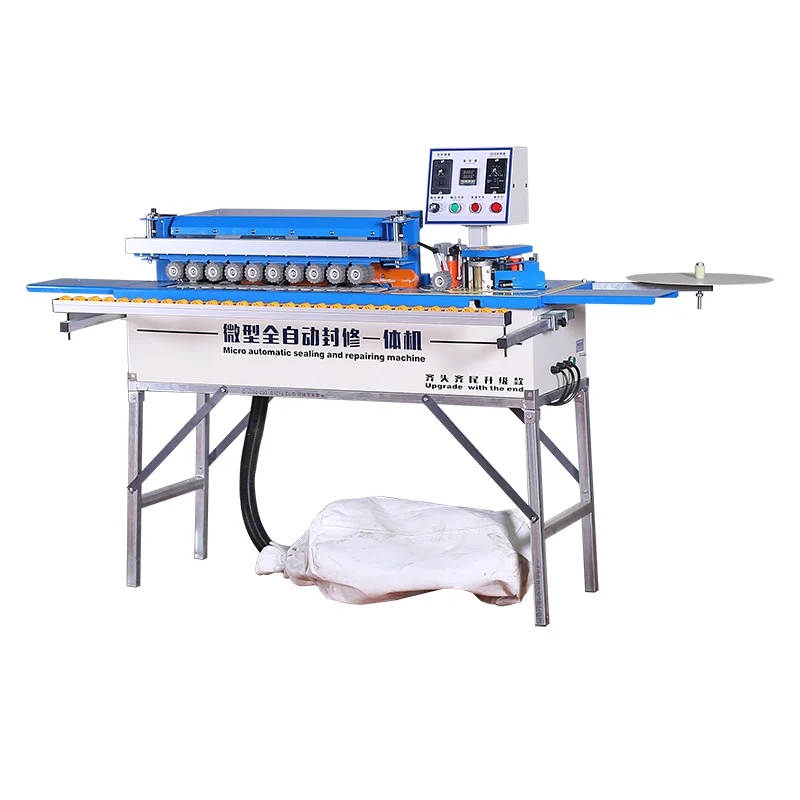
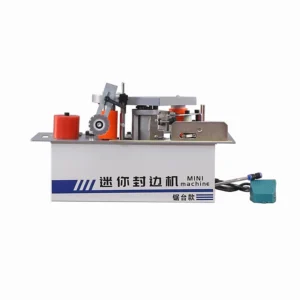
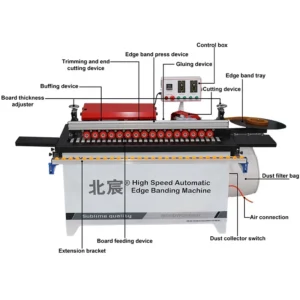
Voltage-Confirmed Production Build — every electrical schematic and frequency parameter is locked at the quotation stage before the first component enters precision grinding, preventing the grid-incompatibility failures that strand machines on workshop floors.
Technical Specifications
| Parameter |
Value |
| Product Type |
Automatic Edge Banding Machine |
| Voltage |
220V (configurable from 110V to 440V based on target market frequency and voltage requirements) |
| Rated Power |
4000W |
| Feed Speed |
0–6 m/min |
| Glue Pot Capacity |
1000 ml |
| Panel Thickness Range |
10–60 mm |
| Edge Banding Thickness Range |
0.5–3 mm PVC |
| Overall Dimensions (L×W×H) |
120×54×72 cm |
| Net Weight |
81 kg |
| Polishing Motors |
Two 180W motors, cross polishing up and down |
| Edge Trimming Motors |
Two 800W motors with integrated dust suction device |
| Gluing Device Rotation |
180° for curved edge banding |
| Feeding Mechanism |
Double-row rubber pressure wheels |
| Control System |
Individual function control panel |
| Functions |
Automatic feeding, double-sided gluing, head and tail cutting, trimming, vacuuming, polishing, curved and line dual purpose |
| Assembly State |
Partially assembled, KD packing for select spare parts |
| Warranty |
One year (coverage scope to be confirmed per agreement) |
Application Suitability
| Application |
Material or Output |
| Custom furniture panel edge banding |
MDF, particleboard, and plywood substrates with 0.5–3 mm PVC edge material |
| Cabinet door and carcass production |
Straight and curved profile panels requiring double-sided gluing for substrate adhesion |
| Small to medium joinery workshop output |
Transition from manual edge application to semi-automated trimming and polishing |
| Curved component finishing |
Radiused panels and contoured furniture parts using 180° rotating glue pot |
Why the Voltage Question Must Precede the Machine Order
Formal voltage and frequency confirmation at the quotation stage eliminates the most common reason imported woodworking machinery sits idle after delivery.
I have watched a trimmer edgebander land in a Dubai workshop only to discover the local three-phase supply did not match the motor winding configuration. Three weeks of production schedule dissolved while a transformer was sourced locally. That Automatic Edge Banding Machine manufacturer oversight — assuming a standard voltage without verifying the installation site — repeats across export markets with predictable frequency [NEED_CITE: voltage and frequency standards by export market]. When the electrical specification is treated as an afterthought rather than a gate in the sales process, the distributor absorbs the cost and the end user loses confidence in the equipment brand.
Precision Ground Components and Patented Cutting Geometry
The trimming station uses an in-house cutting mechanism with proprietary geometry held to ±0.02 mm tolerance through multi-stage precision grinding. This tolerance band matters directly when panels move downstream to assembly, where accumulated edge deviation causes visible misalignment on cabinet carcass joints. Each component passes incoming material inspection before entering the machining line, and in-process verification catches dimensional drift before it reaches the finishing stage.
Four-Stage Quality Control Across the Build Cycle
Incoming material inspection, in-process verification, finished product testing, and pre-shipment functional run form a sequential gate system rather than a single final check. The pre-shipment stage includes a full operational run on the buyer’s specified panel thickness range with a factory test record generated before crating [NEED_CITE: ISO 9001 quality management system requirements for manufacturing verification]. This protocol applies to every unit, whether it is a single evaluation sample or a container load destined for a private label program.

How Feed Speed, Glue Temperature, and Panel Thickness Interact
The 0–6 m/min feed speed range must be matched to panel thickness and edge banding material behaviour. Thicker PVC stock at 3 mm requires slower feed rates to allow the double-sided gluing system adequate contact time for adhesion, while 0.5 mm material can run toward the upper feed limit without bond degradation. The 1000 ml glue pot capacity supports continuous operation across a typical shift without thermal cycling interruptions, and the 180° rotation mechanism means curved panels do not require a separate machine or manual re-fixturing. The two 800W trimming motors with integrated dust extraction maintain cut consistency across the full 10–60 mm panel thickness range, preventing the burn marks and chatter that appear when underpowered trimmers encounter dense MDF cores [NEED_CITE: MDF density variation and its effect on edge trimming quality].
The Hidden Cost of Skipping Specification Alignment
Ordering a single machine without confirming how it integrates with existing upstream saws and downstream assembly benches leads to feed height mismatches and throughput bottlenecks that only surface during commissioning. Entry-level machines pushed into production volumes they were never designed for show accelerated wear on feed wheels and trimming bearings, generating warranty claims that erode distributor margins. Control panels delivered in a language the workshop operator cannot read stall installation for days while translated overlays are produced. These failures are specification problems, not manufacturing defects, and they originate at the inquiry stage [NEED_CITE: common causes of commissioning delays in imported industrial machinery].
Why Distributors Source This Automatic Edge Banding Machine Manufacturer
In-house manufacturing with patented cutting mechanisms means engineering accountability stays with the factory rather than passing through a trading intermediary. Voltage, language, and mechanical specifications are confirmed formally before production begins, not assumed from a catalog default. The four-stage QC protocol with documented pre-shipment verification gives distributors a defensible quality position when their own customers request traceability. OEM branding and private label packaging are standard production options, not special requests requiring minimum order negotiations. Factory visits are open, allowing distributor technical teams to inspect precision grinding stations and assembly benches before committing to a program order.
Documentation & Verification
- CE declaration of conformity matched to the exported machine configuration
- ISO 9001 certificate covering the manufacturing quality management scope
- Machine specification sheet with confirmed voltage, frequency, and panel range
- Electrical schematic and voltage confirmation document signed at quotation stage
- Factory test record on buyer’s specified panel thickness before dispatch
- Operation and maintenance manual in the agreed language with spare parts list
Installation, Commissioning & Support
- 120×54×72 cm footprint requires a level concrete floor with clearance for panel infeed and outfeed
- 4000W rated power demands a dedicated 220V circuit with frequency matched to local supply
- Partially assembled delivery with KD-packed spare parts and video-guided reassembly
- First-run parameter setting for feed speed and glue temperature on site-specific panel stock
- Multilingual control panel configuration confirmed before shipment to match operator language
- Integrated dust extraction port connects to existing workshop collection system at trimming station
What We Need to Configure Your Order
Provide the panel materials and thickness range your customers process most frequently, along with the edge banding stock type and thickness. Confirm the workshop voltage and frequency at the installation site, including whether single-phase or three-phase supply is available. Specify the control panel language and whether OEM branding or neutral packing is required for your market.
Frequently Asked Questions
Q: How is ±0.02 mm trimming tolerance verified before the machine ships?
A: Each unit runs through a four-stage quality protocol ending with a pre-shipment functional test on the buyer’s specified panel thickness. Precision measurement is recorded at the trimming station and included in the factory test record, which ships with the machine documentation package so distributors can present verified tolerance data to their own customers.
Q: What can be customized under an OEM or private label arrangement?
A: Logo placement, control panel language, voltage configuration from 110V to 440V, and mechanical specifications are all adjustable. Orders range from single-unit evaluation samples to production runs, and packing can carry the distributor’s own branding and documentation set without referencing the original factory identity.
Q: Can our technical team visit the factory to assess manufacturing capability?
A: Factory visits are open and encouraged. Distributor teams can inspect precision grinding equipment, observe four-stage QC processes on the assembly floor, and review component sourcing documentation. On-site demonstrations use the buyer’s own panel samples when provided in advance.
Q: How do you prevent voltage incompatibility for different export markets?
A: Voltage and frequency are confirmed formally at the quotation stage, not assumed from a default setting. An electrical schematic and voltage confirmation document are produced before the machine enters production, ensuring the motor winding, control transformer, and heating elements match the destination workshop supply.
Q: What spare parts and training support do distributors receive?
A: A full spare parts list ships with every unit, covering wear items such as feed wheels, trimming cutters, and polishing pads. Technical training is available for distributor service teams covering commissioning procedures, common fault diagnosis, and routine maintenance intervals aligned to the machine’s operating specifications.