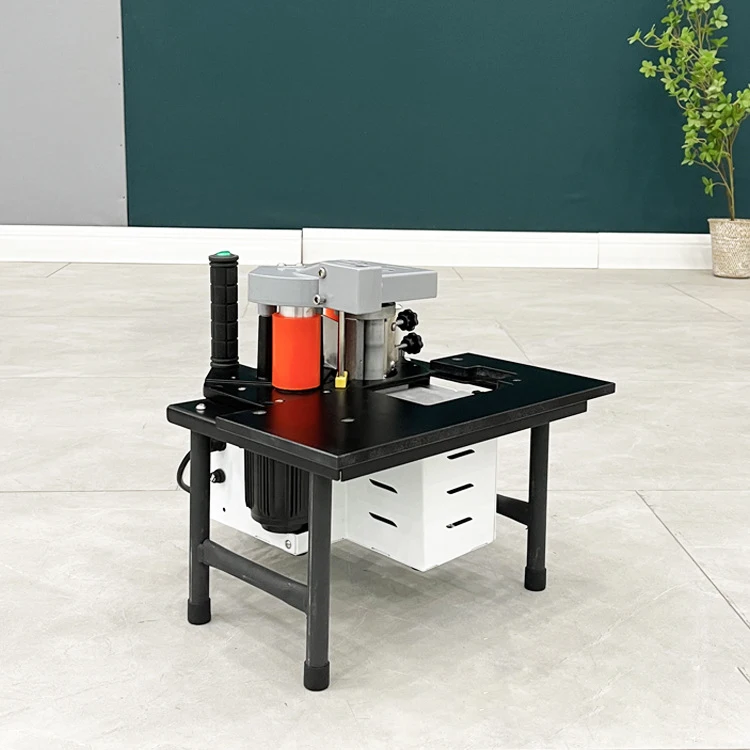
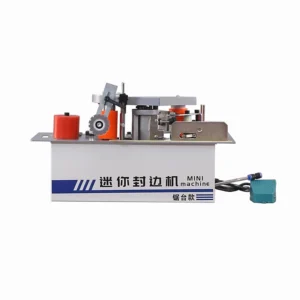
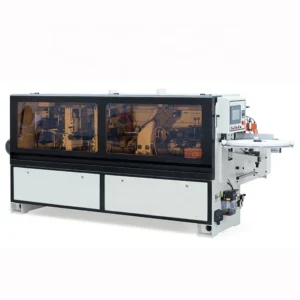
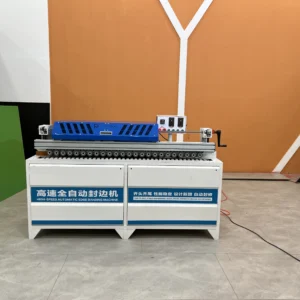
Factory-built for private-label markets — Our Shandong facility produces portable edge banding machines with full OEM branding, configurable plug types, and multilingual manuals ready for regional distribution.
Technical Specifications
| Parameter |
Value |
| Product Type |
Portable Edge Banding Machine |
| Shape of Edge-banding Plates |
Curved, Straight, and Special-shaped Sheet |
| Edge Thickness |
0.3–3mm |
| Edge Sealing Speed |
0–6 m/min |
| Edge Sealing Height |
7–60mm |
| Gluing Method |
Double-sided gluing |
| Glue Pot Volume |
1000ml |
| Machine Weight |
14kg |
| Package Size |
440×410×450mm |
| Voltage & Frequency |
Configurable (basis to be confirmed per target market) |
| Plug Options |
EU / AU / UK / USA / CN |
| Assembly State |
KD packing (user assembly required) |
| Warranty |
1 year |
| Logo Customization |
Available |
Application Suitability
| Application |
Material or Output |
| Small Workshop Edge Sealing |
MDF, Particleboard, Plywood, Solid Wood |
| On-site Joinery & Repair |
PVC and Veneer Edge Banding (0.3–3mm) |
| Special-shaped Panel Processing |
Curved and Contoured Furniture Components |
| Low-volume Production Runs |
Custom Cabinet Doors and Drawer Fronts |
Why the Voltage Specification Must Be Defined Before the Portable Edge Banding Machine Leaves the Factory
Electrical compatibility is the most frequent cause of delayed commissioning in cross-border machinery exports.
I have seen edge banders of this class sit idle for weeks because the local grid frequency did not match the motor specification. For importers and distributors, a Portable Edge Banding Machine factory OEM order must include a confirmed voltage and frequency sheet. If the destination market operates on 60Hz and the machine is wired for 50Hz, the glue pot heating element and feed motor will behave unpredictably, potentially damaging the unit before the first panel is edged [NEED_CITE: voltage and frequency standards by export market].
Configuring the Assembly Line for Private-Label Distribution
When a distributor evaluates a Portable Edge Banding Machine, the manufacturing depth determines the viability of the private-label strategy. Our facility supports OEM logo application on the machine housing and customized packaging that aligns with your regional brand identity. The 14kg unit weight and compact 440×410×450mm package size allow for cost-effective container loading, enabling importers to build a mixed product line that includes both entry-level portable units and larger automatic edge banders.
Ensuring Regional Compliance and Documentation
Every market has specific requirements for industrial equipment entering its territory. We provide the necessary CE declaration of conformity and ISO 9001 documentation to support your customs clearance and local resale compliance. For a Portable Edge Banding Machine intended for the European or Australian market, the electrical schematic must reflect the specific plug standard and safety earth requirements of that region [NEED_CITE: CE machinery directive requirements for industrial equipment]. This level of detail ensures your technical support team receives a machine that matches the documentation provided.
Interpreting the Sealing Speed and Gluing Method
The 0–6 m/min edge sealing speed is designed for manual control, allowing the operator to adjust the feed rate based on the complexity of the curve or the fragility of the veneer. Unlike high-speed automatic lines, this portable unit relies on the operator’s skill to maintain consistent pressure. The double-sided gluing method is particularly critical when working with porous materials like MDF or raw plywood, as it ensures adhesive penetration on both the panel edge and the back of the banding strip, creating a bond that withstands the thermal expansion differences between wood and PVC.

The Consequence of Inconsistent Adhesive Application
If the glue pot volume is insufficient for a continuous run, the adhesive temperature fluctuates, leading to visible glue lines or premature delamination. In a portable unit, the 1000ml pot requires monitoring during extended use. When the adhesive cools below its activation threshold, the bond fails during the trimming stage or, worse, after the furniture is delivered to the end user. This is why the KD packing assembly instructions must emphasize the correct initial heating cycle before the first edge is applied [NEED_CITE: thermal properties of hot melt adhesives in woodworking].
Why Manufacturing Transparency Matters for Distributors
We operate a four-stage QC process that covers incoming material inspection, in-process assembly checks, finished product testing, and pre-shipment verification. For a Portable Edge Banding Machine, this includes a functional test of the curved edge tracking and the straight-line stability. We provide factory test records and photographs that show your specific machine running the edge thickness range you intend to stock (0.3–3mm). This transparency allows you to verify the manufacturing depth and the consistency of the units before they are loaded into the shipping container.
Documentation & Verification
- Electrical schematic confirming the specific plug type and voltage for your target market.
- Operation and maintenance manual translated into the language of your end users.
- Factory test record demonstrating performance across the 0.3–3mm edge thickness range.
- Pre-shipment verification photographs of your branded units before container loading.
- Spare parts list with cross-referenced part numbers for your local service inventory.
Installation, Commissioning & Support
- Assembly guidance provided via video or manual to support the KD packing configuration.
- Glue pot heating element and feed motor wiring verified against your local voltage and frequency.
- Initial temperature calibration instructions for the 1000ml glue pot to ensure proper adhesion.
- Spare parts kit recommendation focusing on high-wear items like the trimming knife and pressure rollers.
- Technical training outline for your regional service team covering the double-sided gluing mechanism.
Initiating the OEM Evaluation Process
To properly configure a Portable Edge Banding Machine for your market, please provide your target region’s standard voltage and frequency, along with the specific plug type required. We also need to know your preferred manual language and any specific branding requirements for the machine housing and packaging. If you require a sample unit to evaluate the edge quality on your local panel materials, specify the MDF or plywood thickness you intend to process most frequently.
Frequently Asked Questions
Q: Can the Portable Edge Banding Machine be customized with our company logo and packaging?
A: Yes, our facility supports full OEM customization. We can apply your logo to the machine housing and configure the packaging to match your brand standards. This includes customized manuals and branded spare parts lists, ensuring a consistent private-label experience for your regional market.
Q: How do you ensure the electrical specifications match our local grid?
A: We require a formal voltage and frequency confirmation sheet before production. Our engineering team will configure the motor and heating elements to match your specific grid, and we provide an electrical schematic that verifies the plug type and safety earth configuration for your market’s standards.
Q: What quality control measures are in place for OEM production batches?
A: Every unit undergoes a four-stage QC process, including a pre-shipment functional test on the curved and straight edge capabilities. We provide test records and photographs for each batch, allowing you to verify the consistency of the 0.3–3mm edge thickness range before the machines leave our facility.