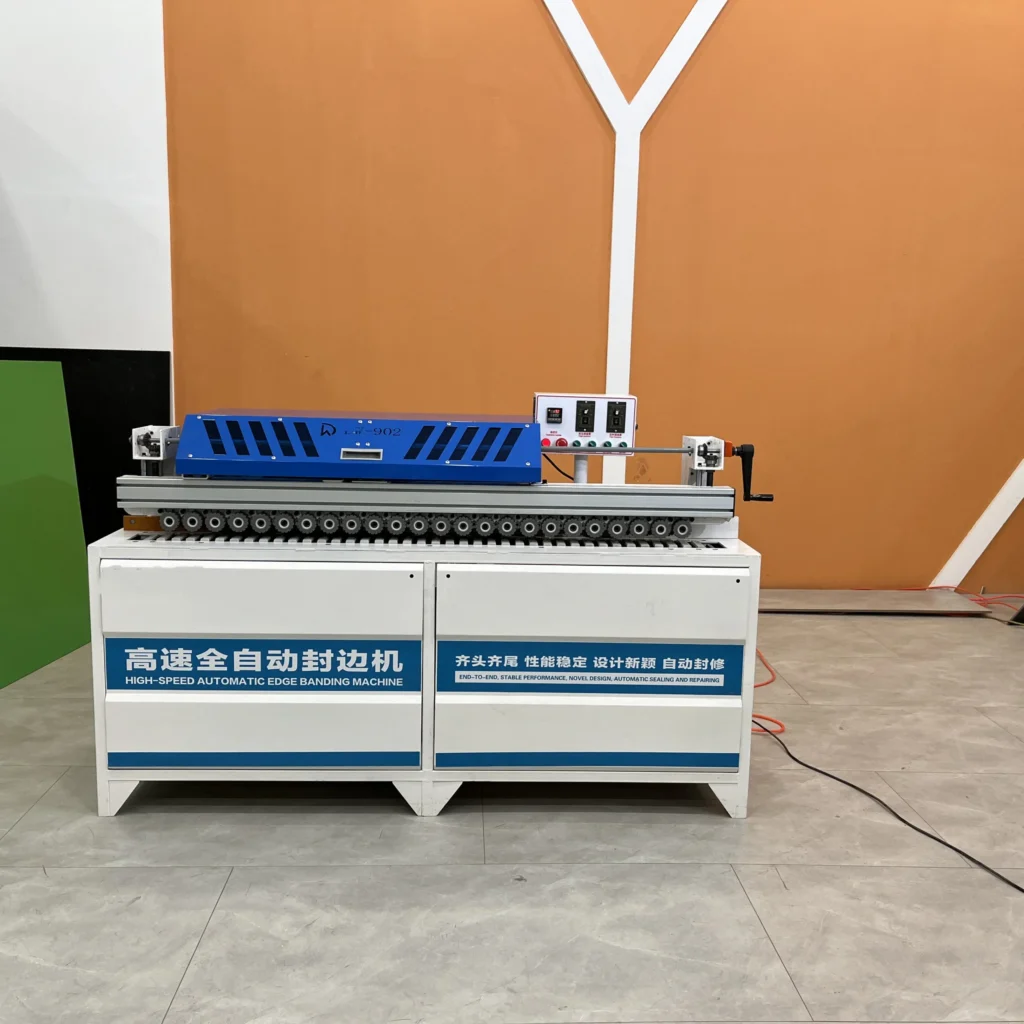
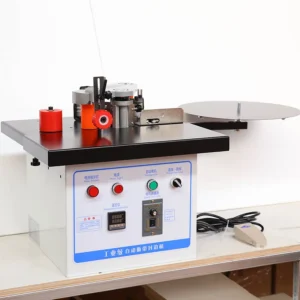
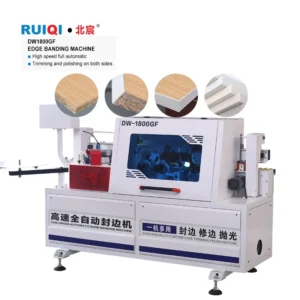
Precision-Ground Assembly — every DW902 edge bander leaves the factory with a verified test record on your specified panel thickness range, not a generic bench run.
Technical Specifications
| Parameter |
Value |
| Model |
DW902 |
| Product Type |
High-speed Fully Automatic Edge Banding Machine |
| Function Sequence |
Gluing, Trimming, End Cutting, Scraping, Polishing |
| Total Power |
3300W |
| Voltage |
220V (frequency to be confirmed: 50Hz or 60Hz) |
| Board Thickness Range |
0–50mm |
| Strip Thickness Range |
0.5–3mm |
| Glue Pot Capacity |
4000ml |
| Pressure Beam |
Integrated, double rows of pressure wheels |
| Conveyor Belt Material |
Silicone |
| Pressure Beam Adjustment |
Manual adjustable handle for board height |
| Edge Strip Cutting Device |
Pneumatically controlled |
| Trimming Configuration |
Double high-speed motors, up-and-down action |
| Polishing Configuration |
Dual motors, up and down |
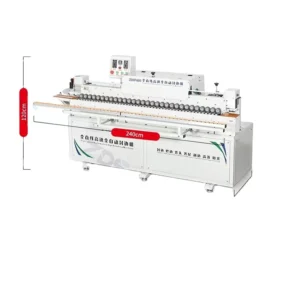
| Machine Dimensions |
175 × 60 × 112 cm |
| Machine Weight |
240kg |
| Warranty |
One year |
| Delivery Time |
25–30 days (varies by configuration and order volume) |
Application Suitability
| Application |
Material or Output |
| Cabinet door edge finishing |
MDF and particleboard with PVC or ABS edge banding |
| Custom furniture panel processing |
Plywood and melamine-faced board with veneer or PVC strips |
| Wardrobe and shelving production |
Particleboard panels up to 50mm thick |
| Small-batch joinery components |
Solid wood panels with thin veneer banding (0.5mm+) |
| Workshop-scale batch runs |
Boards requiring full gluing-to-polishing sequence in one pass |
Why the Voltage Question Must Come Before the Quotation
A machine built for the wrong frequency will burn out its motors before the first production shift ends.
I have watched importers unpack an edge bander only to find the motor hums, overheats, and trips the breaker within minutes. The factory shipped exactly what was on the purchase order — but nobody confirmed whether the buyer’s workshop runs 50Hz or 60Hz [NEED_CITE: voltage and frequency standards by export market]. For OEM partners and distributors reselling into multiple territories, this single oversight generates warranty claims that erode margin and damage the brand printed on the machine’s side panel. The DW902 is configurable from 110V to 440V, and frequency confirmation is locked in before production starts, not assumed from the destination country’s general standard.

How Private-Label Partners Protect Their Brand on Every Shipment
When a distributor stamps their logo on an edge banding machine factory unit, every defect that reaches the end user carries the distributor’s name — not the factory’s. The DW902 platform supports custom color schemes, branded control panels, and logo placement on the machine housing and packaging. More importantly, the four-stage QC process — incoming material inspection, in-process assembly checks, finished product verification, and pre-shipment testing — means the OEM edge banding machine you receive matches the sample your technicians approved. Each unit ships with factory test photographs taken on the panel thickness range you specified.
Component Sourcing Transparency for Distributor Due Diligence
Distributors evaluating a manufacturing partner need to see beyond the final assembly floor. The DW902’s pneumatic trimming and polishing motors are sourced from named suppliers, and the precision-ground pressure beam components undergo multi-stage inspection before assembly [NEED_CITE: precision grinding tolerances in woodworking machinery]. Factory visits are welcomed at any stage — prospective OEM partners can inspect the component warehouse, observe assembly line practices, and review the electrical schematic package that accompanies every machine. This level of access matters when your regional reputation depends on the equipment you put your name on.
Reading the Specs That Actually Determine Edge Quality
The 4000ml glue pot capacity is not just a volume figure — it determines how long the machine can run continuous panels before the adhesive temperature drops and glue lines become visible on lighter substrates like white melamine. The double high-speed trimming motors with up-and-down action address a specific failure mode: single-direction trimming leaves a micro-step at the panel’s top or bottom edge that shows up under raking light after finishing. The integrated pressure beam with double rows of pressure wheels, combined with the silicone conveyor belt, keeps the panel flat against the fence throughout the gluing and trimming sequence — critical when processing warped particleboard that would otherwise drift and produce uneven edge overhang. Board thickness range from 0 to 50mm covers everything from thin cabinet back panels to thick shelving stock without requiring fixture changes.
What Happens When Configuration Is Skipped
A distributor once ordered a batch of edge banders for a Southeast Asian market without specifying control panel language. The machines arrived with Chinese-only interfaces, and the local operators could not navigate the menu to adjust glue temperature or feed parameters [NEED_CITE: operator interface language requirements for industrial machinery exports]. Commissioning stalled for weeks while translated overlays were produced and shipped. Another common failure: machines rated for a specific voltage range but shipped without confirming whether the buyer’s facility uses single-phase or three-phase supply. The result is a machine that technically powers on but cannot reach operating temperature or maintain consistent feed speed under load. These are not manufacturing defects — they are configuration gaps that a proper pre-production checklist eliminates.
Why Manufacturing Depth Matters for Your Supply Chain
In-house precision grinding of pressure beam components means replacement parts match original tolerances without sourcing from third-party suppliers who may have discontinued the specification. The pneumatic edge strip cutting device on the DW902 uses standardized cylinder sizes that your local service team can maintain without proprietary tooling. Four-stage quality control with documented pre-shipment verification means your inspection team can review test records remotely before authorizing container loading. Custom voltage configuration from 110V to 440V is handled during production, not as a field modification that voids the motor warranty. Factory visits are open to distributor technical teams who want to audit assembly practices and component traceability before committing to a regional stocking agreement.
Documentation & Verification
- CE declaration of conformity matched to the DW902’s specific motor and electrical configuration
- Factory test record showing edge quality on your specified board thickness and strip material
- Electrical schematic with confirmed voltage and frequency for your target market
- Pre-shipment inspection photographs of your exact units before crating
- Operation and maintenance manual translated into the language your service team requires
- Spare parts list with OEM part numbers for local procurement planning
Installation, Commissioning & Support
- Requires a dedicated 220V circuit rated for the DW902’s 3300W total draw plus startup surge
- Machine footprint of 175 × 60 cm plus operator clearance on feed and discharge sides
- Pressure beam handle must be calibrated to your thinnest panel before first production run
- Pneumatic strip cutting device requires connection to workshop compressed air at specified pressure
- Dual polishing motors should be tested on scrap material from your actual edge banding stock
- Silicone conveyor belt inspected for flatness after transit and before loading production panels
Preparing Your Inquiry for Accurate Configuration
To receive a configuration that matches your market, share the panel materials and thickness range your customers process most frequently, along with the edge banding strip types and thicknesses in your catalog. Confirm the local voltage and frequency standard — including whether single-phase or three-phase supply is available at the installation site. Specify the control panel language your end users require and whether your branding needs to appear on the machine housing, packaging, or both.
Frequently Asked Questions
Q: What OEM customization is available on the DW902 for private-label distribution?
A: The DW902 supports custom logo placement on the machine housing and packaging, color-matched panels to align with your brand identity, control panel language configured to your market, and voltage settings from 110V to 440V confirmed before production. Each unit ships with your branding and documentation package.
Q: How is voltage and frequency confirmed before the machine enters production?
A: After receiving your inquiry, the engineering team requests your market’s voltage, phase configuration, and frequency standard. These values are locked into the production order and reflected in the electrical schematic included with your shipment. No unit leaves the factory with an assumed frequency setting.
Q: Can distributor technical teams visit the factory before placing a stocking order?
A: Factory visits are welcomed at any stage. Your technical team can inspect the precision grinding area, observe assembly line QC checkpoints, review component sourcing records, and witness a test run on panel material you provide. Visits can be arranged before or after sample approval.
Q: What spare parts documentation is included for local service planning?
A: Every DW902 ships with a spare parts list using OEM part numbers for wear components including trimming blades, polishing wheels, and pneumatic cylinder seals. The list identifies which parts are standardized and locally procurable versus factory-specific, helping you plan regional inventory.
Q: Which certifications and documents support customs clearance in destination markets?
A: The documentation package includes a CE declaration of conformity, ISO 9001 certificate, factory test record, electrical schematic, and packing photographs. Additional documentation for specific import requirements can be discussed during the configuration stage to ensure smooth customs processing.