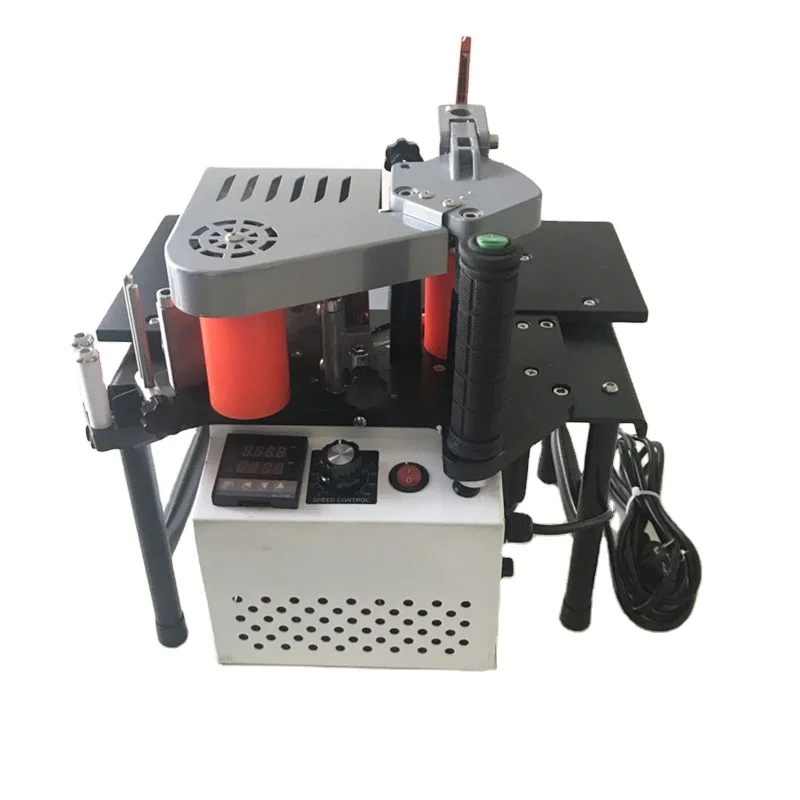
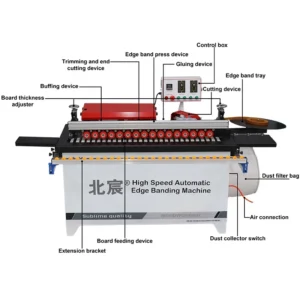
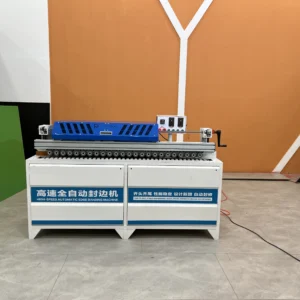
Precision-ground assembly — every portable unit is built on verified tolerances with four-stage QC from incoming material to pre-shipment test, ensuring each OEM batch ships electrically matched to the destination market.
Technical Specifications
| Parameter |
Value |
| Product Type |
Portable Edge Banding Machine |
| Voltage |
220V (confirm local frequency and plug type required) |
| Rated Power |
1000W |
| Shape of Plates |
Curved and straight |
| Edge Thickness Range |
0.3–3 mm |
| Board Thickness Range |
7–60 mm |
| Gluing Method |
Double-sided gluing |
| Glue Pot Capacity |
800 ml |
| Net Weight |
14 kg |
| Assembly State |
Portable hand-held unit |
| Plug Options |
EU / AU / UK / USA / CN |
| Key Features |
Logo customization available, CE certified, ISO 9001 compliant manufacturing |
Application Suitability
| Application |
Material or Output |
| Small workshop manual edge banding |
MDF, particleboard, plywood panels |
| On-site custom furniture finishing |
Solid wood panels with PVC or veneer banding |
| Curved profile edge finishing |
Shaped cabinet doors and contoured joinery components |
| Low-volume production runs |
Laminated board edge sealing in joinery shops |
Why the Voltage Question Must Come Before the Crate Is Sealed
A machine that cannot power on at its destination is not a shipment — it is a liability.
I remember standing in a Shandong assembly bay watching a crate get nailed shut for a Middle East customer. The wiring had been done for a 50 Hz grid, and nobody on the floor had confirmed the site frequency. That oversight stalled commissioning for weeks while we rerouted an engineer overseas. With a Portable Edge Banding Machine OEM manufacturer arrangement, the risk multiplies because these units ship single-phase and the margin for error is narrower than on three-phase lines. Every order now goes through an electrical checklist before the glue pot is ever filled for its pre-shipment test [NEED_CITE: voltage and frequency standards by export market].
How Component Sourcing Defines Field Reliability
The glue pot, motor winding, and feed roller are sourced against a controlled bill of materials rather than spot-market availability. When an OEM partner requests private labeling, the underlying component grade does not change — only the external branding and documentation package shift. This discipline is what separates a repeat order from a warranty claim.
What Four-Stage QC Actually Catches Before Dispatch
Incoming material inspection flags dimensional drift in feed rollers before they reach the assembly bench. In-process checks verify motor winding resistance and insulation integrity. Finished product verification runs the double-sided gluing system across both straight and curved profiles. Pre-shipment testing confirms the unit heats to operating temperature and feeds banding at the rated thickness range under the exact voltage specified on the purchase order [NEED_CITE: CE machinery directive requirements for industrial equipment].
Reading the Specs That Matter for Hand-Held Edge Banding
The 0.3–3 mm edge thickness range covers the full span from thin PVC foil to thicker veneer strips, meaning a single unit handles most substrates a small workshop encounters. Board thickness capacity from 7 to 60 mm is governed by the roller gap and feed pressure; pushing beyond that upper limit causes the feed roller to skip rather than apply consistent pressure on the banding. The 800 ml glue pot capacity is sized for intermittent manual operation — large enough to avoid constant refilling during a cabinet run, small enough that adhesive does not degrade from prolonged heating cycles. Double-sided gluing applies adhesive to both the panel edge and the banding material simultaneously, which is critical when bonding porous substrates like particleboard where single-sided application leaves visible starved joints. At 14 kg net weight, the unit is designed to be clamped to a bench or held against a workpiece, so the operator must account for the downward and lateral force required to maintain contact along curved profiles.

The Cost of Skipping Specification Confirmation
Ordering a batch for a distributor territory without locking in the plug type and frequency means some units arrive needing rewiring before they can be demonstrated to end customers. Skipping the pre-shipment electrical test record means a tolerance issue or heating fault only surfaces once the machine is in an overseas warehouse, where rectification is slow and expensive. When an OEM run ships without multilingual documentation, the local reseller’s service team cannot interpret fault codes or perform basic maintenance, driving warranty calls back to the factory [NEED_CITE: industrial equipment documentation requirements for export markets].
Manufacturing Depth Behind the OEM Label
In-house precision grinding of feed components means replacement parts match the original assembly tolerance. The patented cutting mechanism lineage carries through to the trimming accessories offered alongside the portable range. Four-stage QC with formal pre-shipment records gives distributor partners audit-ready documentation for their own compliance files. OEM scope covers logo placement, retail packaging format, and voltage adaptation without outsourcing to third-party rework shops. Engineer-led configuration review ensures the quoted specification matches the distributor’s target market rather than defaulting to a domestic configuration.
Documentation & Verification
- CE Declaration of Conformity covering the portable edge banding unit
- ISO 9001 certificate for the manufacturing facility producing this model
- Electrical schematic and voltage confirmation matched to the destination market
- Factory test record verifying glue temperature and feed performance before dispatch
- Operation and maintenance manual in the language specified on the purchase order
Installation, Commissioning & Support
- Requires a dedicated 220V circuit rated above the 1000W draw to avoid voltage sag during glue heating
- Arrives fully assembled — operator only needs to load banding material and fill the 800 ml glue pot
- Bench-mounting fixture recommended for straight-edge runs to maintain consistent feed pressure
- First heat-up cycle should run without banding to verify glue pot reaches operating temperature evenly
- Spare glue pot seals and feed roller sleeves included for initial maintenance intervals
- Curved-profile operation requires operator training on lateral pressure technique to prevent banding lift
What to Include in Your OEM Inquiry
Provide your target market’s voltage and frequency standard, the plug type required at point of sale, and whether the operation manual needs translation into a specific language. If your distribution channel requires retail-ready packaging with branded artwork, include the packaging format and logo file specifications with the inquiry. Clarify whether you need a sample unit for market testing before committing to a production run.
Frequently Asked Questions
Q: What OEM customization options are available for logo, packaging, and voltage specifications?
A: Logo placement on the machine housing, retail packaging artwork, and voltage adaptation to your market standard are all handled in-house. Plug type is configured per destination — EU, AU, UK, USA, or CN. Multilingual operation manuals are produced in the language you specify. No third-party rework is involved in the customization process.
Q: How is manufacturing quality verified — what does the four-stage QC process cover?
A: Incoming material inspection checks component dimensions against tolerance. In-process verification tests motor winding and insulation. Finished product testing runs the gluing system on straight and curved profiles. Pre-shipment verification confirms voltage, heating performance, and feed accuracy under your specified configuration. All four stages generate records included with your shipment.
Q: Can the factory support private-label production runs with consistent lead times for distributor markets?
A: Private-label runs follow the same production scheduling as standard orders, with dedicated slots allocated once artwork and electrical specifications are confirmed. Component sourcing is managed against the controlled bill of materials, so specification consistency is maintained across repeat batches. Factory visits are available for partners evaluating production capacity firsthand.
Q: What documentation ships with each OEM order?
A: Each shipment includes the CE Declaration of Conformity, ISO 9001 manufacturing certificate, electrical schematic with confirmed voltage and plug type, factory test record, operation manual in your specified language, spare parts list, and packing photographs. Customs documentation support is provided to facilitate clearance at the destination port.
Q: How does the factory handle specification adaptation for different regional market requirements?
A: Regional adaptations cover voltage, frequency, plug type, control labeling language, and safety marking format. Each adaptation is reviewed by the engineering team before production to confirm component compatibility. A formal specification confirmation document is issued for your approval before the production run begins, preventing mismatches that only surface at commissioning.