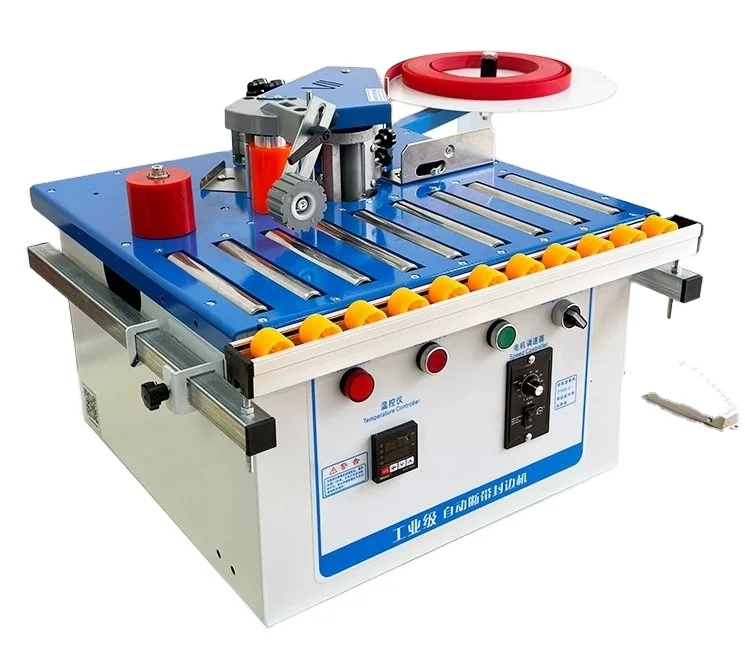
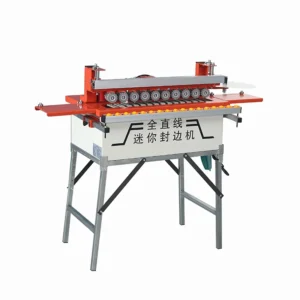
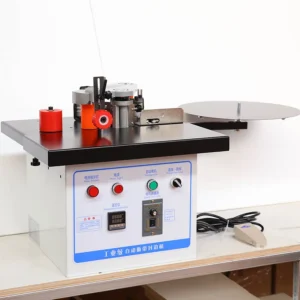
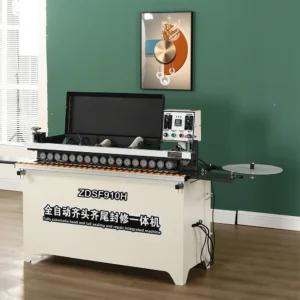
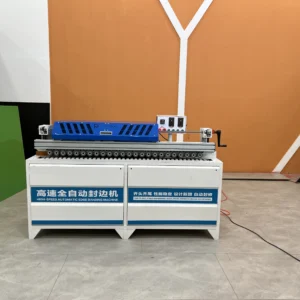
In-House Precision Control — Every ZDSF50+ mini edge banding machine is assembled under four-stage quality checks with patented mechanisms verified before dispatch, giving OEM partners a traceable manufacturing foundation rather than a rebranded trading product.
Technical Specifications
| Parameter |
Value |
| Model |
ZDSF50+ |
| Product Type |
Mini Manual Curve Edge Banding Machine |
| Rated Power |
1.2 kW |
| Voltage & Frequency |
220V (frequency configurable to destination market) |
| Control System |
Manual operation with pneumatic tape breaking and foot switch |
| Overall Dimensions |
54 × 54 × 56 cm |
| Net Weight |
28 kg |
| Panel Thickness Range |
10–60 mm |
| Strip Thickness Range |
0.5–1.5 mm |
| Edge Banding Speed |
0–6 m/min |
| Glue Pot Capacity |
1000 ml |
| Glue Pot Temperature |
150–180 °C (medium temperature granular glue) |
| Heating Time |
5–10 min |
| Air Supply Requirement |
0.4–0.6 MPa (compressor not included) |
| Assembly State |
Portable, table-top unit |
| Color Options |
Two colors available |
| Optional Accessories |
Bracket (optional) |
Application Suitability
| Application |
Material or Output |
| Small workshop edge banding on straight panels |
MDF, particleboard, and plywood with PVC strips |
| Curved profile edge finishing |
Solid wood panels and shaped MDF with veneer or PVC banding |
| On-site carpentry and installation work |
Plywood and blockboard with 0.5–1.5 mm edge strips |
| Custom furniture prototyping |
Laminate and melamine-faced boards requiring both straight and curve sealing |
| Manual-to-machine transition for joinery shops |
Mixed substrates including MDF and plywood at low daily volumes |
Why Voltage Must Be Locked Down Before a Mini Edge Banding Machine OEM Factory Ships Your Order
We confirm voltage, frequency, and plug type in writing before production begins, not after the crate arrives at your port.
I once watched a distributor in Southeast Asia receive a batch of portable edge banders wired for a frequency that did not match the local grid. The glue pot overheated within minutes, the banding strips blistered, and the operators blamed the machine before anyone checked the nameplate. Mismatches like this are surprisingly common when a Mini Edge Banding Machine OEM factory quotes fast without asking where the machine will actually run. The cost of rewinding a motor or replacing a control transformer on-site is never trivial, and it delays commissioning by days or weeks while you source parts locally [NEED_CITE: voltage and frequency standards by export market].

What the Four-Stage QC Process Covers on This Portable Unit
Incoming material inspection checks each pressure roller and pneumatic cylinder against dimensional tolerances before they reach the assembly bench. In-process verification confirms the glue pot reaches and holds 150–180 °C across its full 1000 ml capacity, because uneven heat directly causes strip adhesion failure on curved profiles. Finished-product testing runs actual PVC and veneer strips through both straight and curve modes, and pre-shipment verification documents every result so you can cross-reference the test record against your own acceptance criteria.
Private-Label Depth Beyond a Logo Sticker
A serious Mini Edge Banding Machine OEM factory customizes the control panel language, the color scheme, and the packaging artwork — not just the nameplate. We configure the electrical schematic to match your market’s documentation standards and print the operation manual in the language your end users actually read. Distributors who have received machines with English-only manuals in non-English-speaking markets know how quickly that creates support calls [NEED_CITE: CE machinery directive requirements for industrial equipment]. The bracket, voltage, and color are all configurable line items, so your catalog can offer a coherent product family without sourcing from multiple suppliers.
How Key Specs Translate to Real Workshop Performance
The 10–60 mm panel thickness range means the adjustable pressure rollers accommodate everything from thin MDF shelf panels to thicker solid wood tabletops without swapping hardware. The 0–6 m/min banding speed is operator-controlled, which matters for curve work where feed rate must match the profile radius — too fast and the strip lifts, too slow and the glue skins over before contact. The 0.4–0.6 MPa air requirement drives the pneumatic tape breaker and the foot switch mechanism, keeping both hands free to guide the workpiece. A 1.2 kW rated power draw keeps this unit within the capacity of a standard single-phase workshop circuit, avoiding the need for dedicated three-phase wiring that a small shop may not have. The 1000 ml glue pot sustains continuous banding through a typical small-batch run without mid-job refills, and the 5–10 minute heating time means the machine is ready shortly after power-on rather than consuming the first hour of a shift waiting for temperature stabilization.
The Hidden Cost of Skipping a Pre-Shipment Material Test
When a buyer orders a compact edge bander without sending sample strips and offcuts for a factory test, the first real trial happens on the shop floor with the production clock running. I have seen thin 0.5 mm veneer curl and split because the glue temperature was set for PVC, and the operator spent two weeks adjusting parameters that could have been documented before the machine left the factory [NEED_CITE: edge banding adhesion requirements for veneer versus PVC substrates]. Curved profiles amplify every setting error — a strip that adheres on a straight cut may gap on a 50 mm radius if the pressure roller angle was never validated against that geometry. A pre-shipment test with your actual material removes this variable entirely.
Why Distributors Source This Unit From Our Production Floor
In-house manufacturing means the cutting mechanism and pressure roller assemblies are machined and inspected here, not outsourced and bolted together. Four-stage QC with documented pre-shipment verification gives you a test record for every unit, not a statistical sample from a batch. Voltage, frequency, language, and color customization are standard line items, so you do not pay a premium or accept extended lead times for market-specific configurations. Patented mechanism designs are traceable to our engineering team, which matters when your end user asks about the origin of the technology. Engineer-led configuration recommendations arrive as a formal quotation within one working day, with spec sheets detailed enough for your technical team to approve without a second round of clarification emails.
Documentation & Verification
- CE declaration of conformity covering the ZDSF50+ portable edge bander
- ISO 9001 certificate documenting the quality management system behind each unit
- Factory test record on your specified strip material and panel substrate before dispatch
- Electrical schematic and written voltage confirmation matched to your destination country
- Operation and maintenance manual in your agreed language with illustrated spare parts list
- Packing photographs taken at crating stage for condition verification on arrival
Installation, Commissioning & Support
- Requires a stable workbench or optional bracket to support the 28 kg table-top unit during operation
- 220V single-phase circuit with appropriate breaker rating for the 1.2 kW rated power draw
- Connects to a 0.4–0.6 MPa air compressor for pneumatic tape breaking and foot switch actuation
- First run should verify glue pot temperature stability across the 150–180 °C range with your chosen adhesive
- Adjustable pressure rollers calibrated during commissioning to match your 10–60 mm panel thickness range
- Spare rollers, glue pot liners, and pneumatic fittings listed in the included parts documentation
What We Need to Configure Your Order Correctly
Send us the edge banding strip materials and thicknesses you use most often, along with the panel substrates and thickness range in your typical workload. Confirm the local voltage and frequency at the installation site, and let us know the preferred control panel language for your operators. If you carry multiple brands or plan to private-label this unit, specify your branding requirements and packaging preferences so we can include them in the initial quotation.
Frequently Asked Questions
Q: What branding, voltage, color, and packaging customization options are available for private-label orders?
A: We customize the machine color from two available options, configure voltage and frequency to your destination market, print your logo on the unit and packaging, and produce the control panel labeling and operation manual in your preferred language. Electrical schematics are updated to reflect the configured specifications, and packaging artwork is approved by you before printing begins.
Q: Can we visit the factory to inspect manufacturing processes and run sample edge banding tests?
A: Factory visits are welcomed at our production facility. You can observe the four-stage QC checkpoints in operation, review component sourcing records, and run edge banding tests on the ZDSF50+ using your own sample panels and strips. We recommend sending test materials in advance so the engineering team can prepare the appropriate glue and pressure settings for your visit.
Q: How do you confirm and document the correct voltage and frequency for our destination country before shipment?
A: During the quotation stage, our engineer confirms the voltage, frequency, and plug type required at your installation site and records these in the formal specification document. The electrical schematic included with the shipment reflects the confirmed configuration, and a voltage confirmation certificate is part of the pre-shipment documentation package.
Q: What spare parts are included, and what is the supply chain for replacement components?
A: Each unit ships with a spare parts list covering consumable and wear items such as pressure rollers, glue pot components, and pneumatic fittings. Replacement parts are manufactured or sourced through our supply chain and can be ordered directly with documented lead times. The operation manual includes maintenance intervals to help you plan spare part inventory based on your usage volume.
Q: Which edge banding strip materials and board substrates is the ZDSF50+ verified to handle?
A: The machine is configured for PVC and veneer edge banding strips in the 0.5–1.5 mm thickness range, applied to MDF, plywood, particleboard, and solid wood panels from 10 mm to 60 mm thick. Glue pot temperature covers 150–180 °C for medium-temperature granular adhesives. For substrates or strip materials outside this range, we recommend a factory material test to verify adhesion and finish quality.