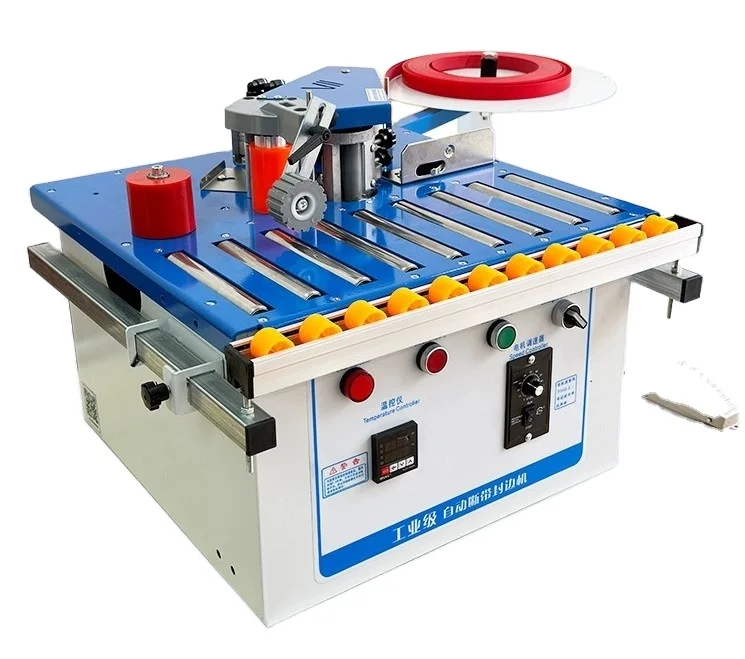
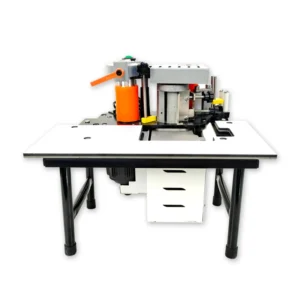
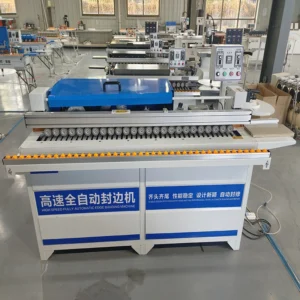
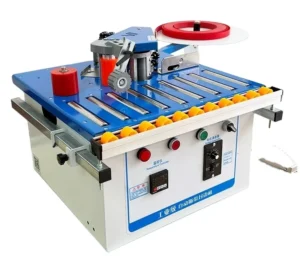
Precision-Built for Compact Operations — Every ZDSF50+ mini edge banding machine leaving our facility carries a factory test record run on the buyer’s specified board thickness and strip material before crating.
Technical Specifications
| Parameter |
Value |
| Product Type |
Mini Edge Banding Machine |
| Model |
ZDSF50+ |
| Rated Power |
1.2 kW |
| Rated Voltage |
220V |
| Edge Banding Speed |
0–6 m/min |
| Sheet Thickness Range |
10–60 mm |
| Strip Thickness Range |
0.5–1.5 mm |
| Glue Pot Capacity |
1000 ml |
| Heating Time |
5–10 min |
| Rated Air Pressure |
0.4–0.6 MPa |
| Gluing Type |
Double-sided gluing with glue-coated rollers |
| Pressure Roller Material |
Rubber |
| Control System |
Foot switch / Pneumatic tape breaking / Travel switch for straight-line auto-breaking |
| Overall Dimensions |
54 × 54 × 56 cm |
| Net Weight |
28 kg |
Application Suitability
| Application |
Material or Output |
| Joinery workshops transitioning from manual edge sealing |
MDF, plywood, and particleboard panels up to 60 mm thick |
| On-site custom furniture fabrication |
Solid wood panels with PVC or veneer edge banding |
| Low-volume curved panel production |
Shaped cabinet doors and radius furniture components |
| Prototyping and sample runs in small factories |
Mixed substrates requiring quick changeover between strip thicknesses |
Why Voltage Confirmation Must Happen Before the Order Is Placed
A mini edge banding machine factory that does not verify your local voltage and frequency before production is shipping a problem, not a solution.
I have walked into workshops where a brand-new compact edge bander sat idle for weeks because the motor was wound for 380V three-phase while the shop only had 220V single-phase available. The 1.2 kW motor on this unit can be configured for the target market, but only if the specification is locked in at quotation stage. Buyers who skip this step face rewinding costs, transformer purchases, or outright returns — none of which appear on the original proforma invoice. [NEED_CITE: voltage and frequency standards by export market]

Component Sourcing and Precision Assembly
Every ZDSF50+ begins with incoming material inspection before a single part reaches the assembly bench. The rubber pressure rollers, glue-coated feed rollers, and pneumatic tape-breaking cylinder are individually checked against dimensional tolerances. This matters because a mini edge banding machine factory that skips incoming inspection passes component defects downstream, where they surface as uneven glue lines or inconsistent strip feed during the buyer’s first production run.
Four-Stage Quality Control Across the Build
The ZDSF50+ moves through in-process inspection during sub-assembly, finished-product testing under load, and a pre-shipment verification run on actual board stock. Each stage is documented. For OEM partners and private-label distributors, this traceability means you can show your own customers the test record for the exact unit they receive — not a generic batch certificate. [NEED_CITE: ISO 9001 quality management system requirements for manufacturing traceability]
How Core Specifications Shape Daily Output
The 1000 ml glue pot with four heating tubes maintains a stable melt temperature across continuous runs, preventing the cold-start glue starvation that causes strip lift on the first few panels of the day. The 0.4–0.6 MPa air pressure range drives the pneumatic tape-breaking cylinder, giving the operator clean breaks on curves without manual trimming. Board thickness capacity of 10–60 mm covers most cabinet and furniture stock, while the 0.5–1.5 mm strip range handles both thin PVC and real-wood veneer banding. The foot-switch control frees both hands to guide curved workpieces, and the travel switch enables automatic straight-line tape breaking when the panel edge passes the sensor.
The Cost of Overloading a Compact Machine
A machine in this class is designed for low-to-moderate volume. Pushing it into continuous high-throughput production leads to accelerated wear on the rubber pressure rollers, glue pot carbon buildup from prolonged heating cycles, and premature failure of the pneumatic cylinder seals. Buyers who need sustained output should evaluate a full-size automatic edge bander instead of running a portable unit beyond its design envelope. The result of that mismatch is inconsistent edge adhesion, increasing reject rates, and unplanned downtime. [NEED_CITE: manufacturer duty cycle classification for woodworking machinery]
Why OEM and Private-Label Partners Source Here
In-house manufacturing means the cutting mechanism, glue roller assembly, and frame are built under one roof — not sourced from three vendors and bolted together. Voltage configuration from 110V to 440V is handled at the motor-specification stage, not as an afterthought with external transformers. Custom logo placement, multilingual control panel overlays, and packaging to your brand standard are integrated into the production workflow. Pre-shipment test runs are performed on the board thickness and strip material you specify, with photographic evidence included in the shipping documentation.
Documentation & Verification
- Machine specification sheet confirming all parameters for the ZDSF50+ as built
- Electrical schematic with voltage and frequency confirmation for the destination market
- Factory test record run on buyer-specified sheet thickness and strip material
- Operation and maintenance manual supplied in the agreed language
- Spare parts list with part numbers for rollers, heating tubes, and pneumatic seals
Installation, Commissioning & Support
- Requires a dedicated 220V single-phase circuit rated for at least 1.2 kW continuous draw
- Compact 54 × 54 × 56 cm footprint fits standard workbenches without floor anchoring
- Arrives fully assembled; connect air supply at 0.4–0.6 MPa and power on
- First-run calibration of pressure rollers and glue flow rate included in commissioning guidance
- Glue pot cleaning procedure and heating tube replacement intervals documented in manual
What to Include in Your Inquiry
Provide your target board material and thickness range, the strip material and thickness you plan to run, your local voltage and frequency, and your preferred language for the control panel and documentation. If you are evaluating this unit as part of a distributor portfolio, indicate the quantity range and any private-label requirements so the engineering team can prepare a configuration proposal within 24 hours.
Frequently Asked Questions
Q: What customization is available for OEM branding and packaging?
A: Custom logo placement on the machine body, branded packaging, and private-label documentation are all supported. Voltage can be configured from 110V to 440V, and control panel overlays can be produced in your target market language. The engineering team provides a specification confirmation document before production begins.
Q: How does the four-stage QC process work for this model?
A: Incoming components are inspected before assembly. In-process checks cover sub-assembly alignment. Finished-product testing runs the ZDSF50+ under load. Pre-shipment verification is performed on the buyer’s specified board and strip material, with a test record included in the shipping package.
Q: Can the machine be built for 110V or other non-standard voltages?
A: Yes. The motor and electrical system are configured at the specification stage to match your local voltage and frequency, anywhere from 110V to 440V. This is confirmed on the electrical schematic before production starts, eliminating the need for external transformers at your facility.
Q: Is it possible to run sample panels before placing a production order?
A: Factory visits are welcomed. You can bring or specify your own board stock and edge banding strip, run test panels on the ZDSF50+, and evaluate edge adhesion, tape-breaking accuracy, and surface finish before committing to an order.
Q: What spare parts and documentation ship with each unit?
A: Each ZDSF50+ ships with a spare parts list covering wear items such as rubber pressure rollers, heating tubes, and pneumatic seals. The operation manual, electrical schematic, and maintenance schedule are included in the agreed language to support your local after-sales service.