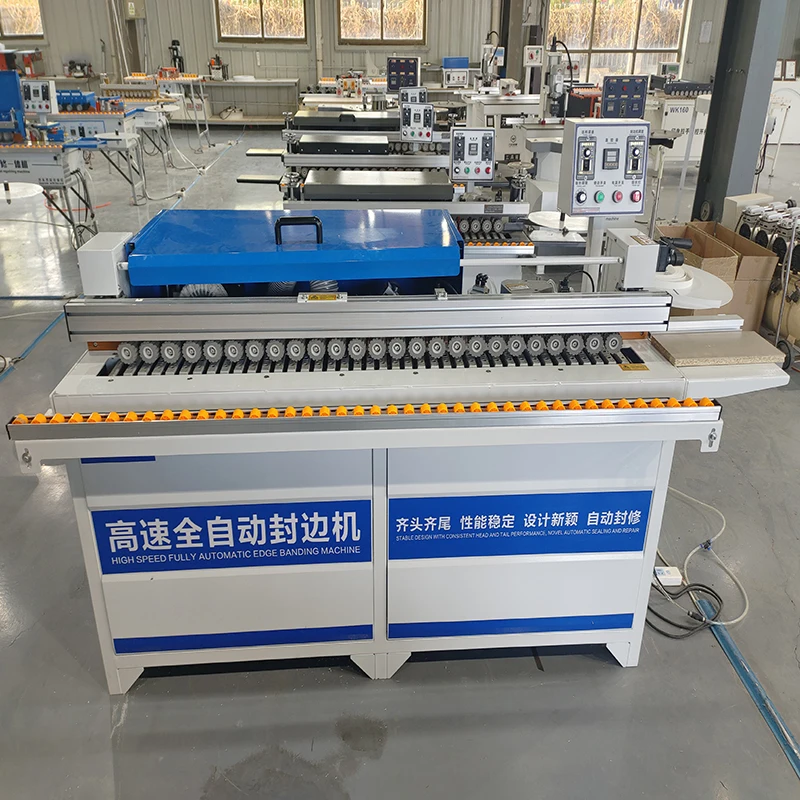
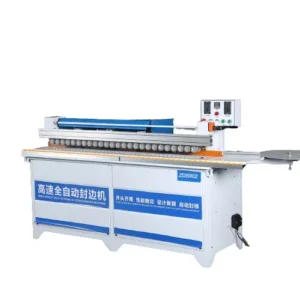
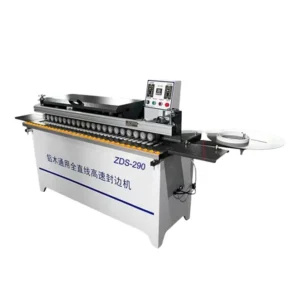
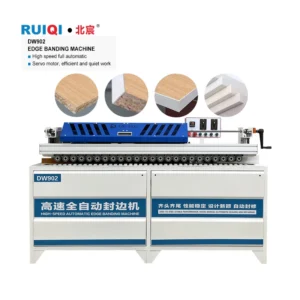
Precision-Assembled Manufacturing — every component undergoes multi-stage inspection before assembly, ensuring the edge banding mechanism holds tight tolerances across long production runs.
Technical Specifications
| Parameter |
Value |
| Product Type |
High-Speed Fully Automatic Edge Banding Machine |
| Voltage |
220V (configurable from 110V to 440V) |
| Total Power |
4200W |
| Overall Dimensions (L×W×H) |
207×60×122 cm |
| Net Weight |
245 kg |
| Edge Banding Type |
Linear Edge Banding Machine |
| Edge Band Height Range |
0–35 mm |
| Edge Band Thickness Range |
0.5–2.5 mm |
| Glue Pot Capacity |
4000 ml |
| Pressure Beam |
Integrated pressure beam with double rows of pressure wheels, adjustable via handle |
| Conveyor Belt |
Silicone material |
| Edge Strip Cutting Device |
Pneumatically controlled |
| Polishing Stations |
Up and down dual polishing motors |
| Trimming Stations |
Double high-speed trimming motors, trimming up and down |
| Feed Speed |
(basis to be confirmed) |
| Panel Thickness Range |
(basis to be confirmed) |
| Control System |
(basis to be confirmed) |
| Air Supply Requirement |
(basis to be confirmed) |
| Assembly State |
Partially assembled; KD packing for some items, assembly required per manual |
| Warranty |
One year (factory defects; spare parts replacement) |
Application Suitability
| Application |
Material or Output |
| Custom cabinet door edge banding |
Melamine-faced particleboard with PVC edge banding |
| Wardrobe panel finishing |
MDF panels with veneer or PVC edge strips |
| Office furniture panel production |
Plywood substrates with 0.5–2.5 mm edge banding |
| Joinery workshop linear edging |
Solid wood panels requiring trimming and polishing |
| Batch panel processing |
Standard-size boards in furniture factory environments |
Why Voltage Confirmation Must Happen Before the Machine Ships
An automatic edge banding machine rated for 380V/50Hz will stall or burn its motors on a 220V/60Hz supply, and the damage is not covered under standard warranty.
I once watched a distributor in West Africa take delivery of a fully automatic edge bander only to discover the local grid ran at a frequency the motors were never wound for. The machine sat idle for three weeks while replacement motors shipped overseas. Electrical mismatch remains one of the most common causes of commissioning failure in cross-border machinery trade, yet it is rarely discussed before the purchase order is signed [NEED_CITE: voltage and frequency standards by export market]. Confirming the destination voltage and frequency is the first engineering step, not an afterthought.

Component Sourcing and Assembly Depth
This automatic edge banding machine is built on a factory floor where the cutting mechanism carries a proprietary patent and the pressure beam components are precision-ground in-house. Sourcing critical parts internally means the assembly team controls fit and alignment from the first fixture to the final belt tension check. When distributors evaluate manufacturing partners, the depth of in-house machining directly determines how quickly tolerance drift appears after months of continuous operation.
Private Label and Branding Capability
OEM partners can specify custom logo placement on the machine body, control panel fascia, and packing materials. The factory supports private label documentation, meaning the operation manual, spare parts catalog, and electrical schematic all carry the distributor’s brand identity rather than the manufacturer’s. For regional importers building their own service reputation, this level of branding consistency matters when the end customer opens the crate. Color options for the machine housing are configurable at the order stage [NEED_CITE: OEM machinery branding standards for woodworking equipment].
How Glue Pot Capacity and Trimming Stations Affect Daily Output
The 4000 ml glue pot on this automatic edge banding machine reduces the frequency of adhesive refills during a production shift. A smaller pot forces the operator to stop the line, wait for temperature recovery, and resume — each interruption introducing cold-start inconsistency in glue adhesion. The double high-speed trimming motors handle both top and bottom edges in a single pass, which removes the need for manual rework on panels where the edge band overhangs the substrate. Combined with the pneumatically controlled cutting device, the trimming sequence maintains a clean edge profile across varying board thicknesses without manual blade adjustment between panels.
The Cost of Skipping Substrate Samples Before Ordering
When a buyer selects an automatic edge banding machine based on catalog specifications alone, the gap between rated performance and actual output often surfaces only after installation. Recycled particleboard with high surface roughness absorbs glue unevenly, producing visible glue lines that no amount of trimming or polishing can hide. I saw this firsthand at a cabinet factory where the panels fed through a brand-new edger looked acceptable at first glance, but the edge bands peeled off within days of the furniture reaching the showroom floor [NEED_CITE: surface roughness impact on adhesive bonding in panel processing]. Sending substrate samples to the factory before finalizing the configuration allows the engineering team to adjust glue application rate, pressure wheel tension, and feed parameters to the actual material.
Why Distributors Source From This Production Floor
The four-stage quality control process covers incoming raw material, in-process assembly, finished unit testing, and pre-shipment verification — each stage documented and available for review. Patented cutting mechanisms developed in-house mean replacement parts are manufactured on the same floor, eliminating dependency on third-party suppliers with unpredictable lead times. Voltage customization from 110V to 440V is handled at the winding stage rather than through external transformers, which preserves motor efficiency and thermal performance. Factory visits are scheduled around the buyer’s timeline, allowing distributors to witness sample processing tests on their own panel stock before committing to a container order.
Documentation & Verification
- CE declaration of conformity covering the full automatic edge banding machine assembly
- ISO 9001 certificate tied to the factory’s quality management scope
- Electrical schematic confirming the exact voltage and frequency built into your unit
- Factory test record showing edge banding results on your specified panel thickness range
- Operation and maintenance manual in the operator’s language with illustrated troubleshooting
- Spare parts list with OEM part numbers matching the as-built configuration
Installation, Commissioning & Support
- 207×60×122 cm footprint requires a level concrete floor with clearance for panel infeed and outfeed
- 4200W total power draw needs a dedicated circuit matching the confirmed voltage and frequency
- Partially assembled delivery means the pressure beam and polishing stations require on-site alignment per manual
- Pneumatically controlled cutting device requires a compressed air supply connected before first run
- 4000 ml glue pot must be charged with the correct adhesive type for the specified edge band material
- Dual polishing motors need belt tension verification after the initial break-in period
What to Include With Your Inquiry
Provide the substrate types and thickness range your workshop processes most frequently, along with the edge banding material — PVC, ABS, or veneer — and its thickness. Specify the local voltage and frequency at the installation site so the motor and control components are wound correctly. If you are planning a production line rather than a single machine, share the upstream and downstream equipment models so feed height and throughput can be matched.
Frequently Asked Questions
Q: What OEM customizations are available at the factory level for this edge bander?
A: The factory supports custom logo application on the machine body and control panel, voltage configuration from 110V to 440V, multilingual control interfaces, and specification adjustments to feed speed or glue system capacity. Private label documentation including manuals and spare parts catalogs can carry your brand identity throughout.
Q: How does the factory confirm the machine matches local electrical standards?
A: Voltage and frequency are confirmed during the quotation stage before production begins. The motor winding, control transformer, and heating elements are all built to the specified electrical standard, and a complete electrical schematic is included with every shipment for local electrician reference.
Q: Which components are manufactured in-house versus sourced externally?
A: The cutting mechanism, pressure beam assembly, and precision-ground structural components are manufactured on the factory floor. Motors, pneumatic valves, and electrical components are sourced from verified suppliers and undergo incoming material inspection before entering the assembly line.
Q: What pre-shipment tests are performed before the machine leaves the factory?
A: Each automatic edge banding machine runs a full production test using panel samples matching the buyer’s specified substrate and edge band material. The test record documents edge quality, trimming accuracy, and glue adhesion results, and is included in the shipping documentation package.
Q: How does the factory support distributor service teams after delivery?
A: Technical training covers assembly, commissioning, and common fault diagnosis. A spare parts list with OEM numbers is provided, and replacement components are manufactured in-house to match the as-built machine configuration, reducing dependency on external supply chains.