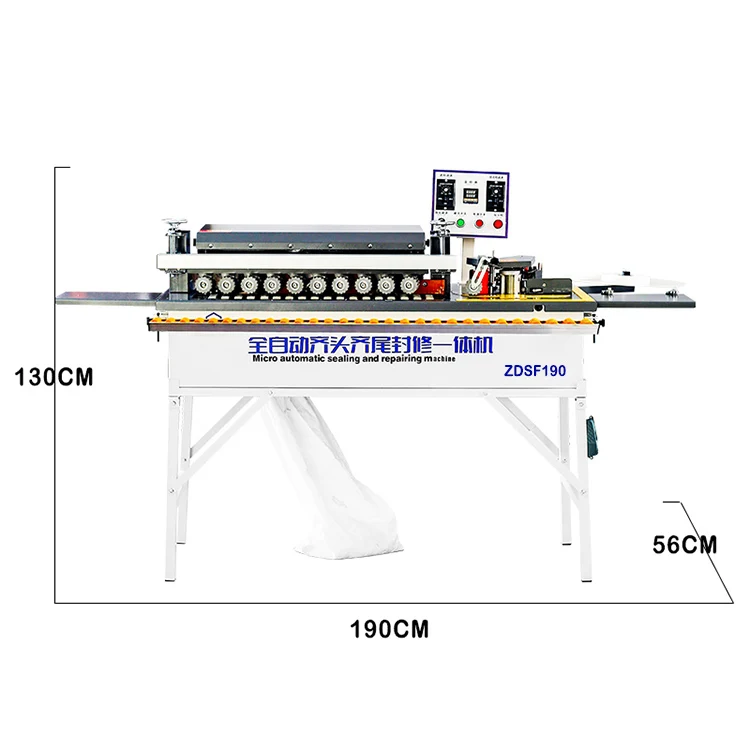
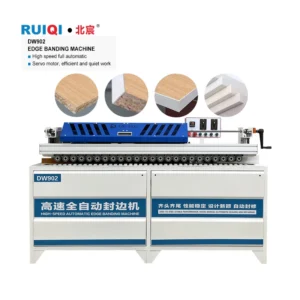
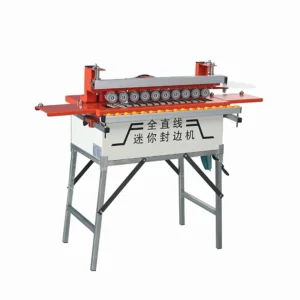
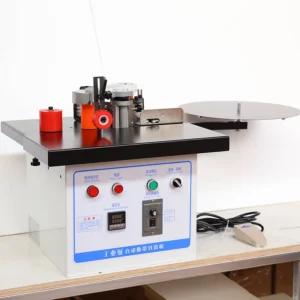
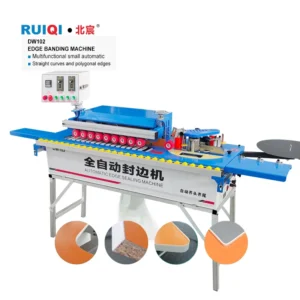
Precision Manufacturing Foundation — Every WFS190 unit undergoes four-stage quality verification from incoming material through pre-shipment testing, ensuring tolerance claims hold up when panels reach assembly.
Technical Specifications
| Parameter |
Value |
| Model |
WFS190 |
| Product Type |
Small Automatic Edge Banding Machine |
| Function |
Automatic plate feeding, double-sided gluing, upper and lower polishing, head/tail trimming, bending and straightening |
| Edge Type |
Curved and straight lines |
| Voltage & Frequency |
220V 50Hz |
| Rated Power |
4kW |
| Rated Air Pressure |
0.4-0.6MPa |
| Conveyor Belt Speed |
0-14m/min |
| Feed Speed |
0-14m/min |
| Sheet Thickness Range |
10-50mm |
| Strip Thickness Range |
0.5-2.5mm |
| Glue Capacity |
1000ml |
| Overall Dimensions |
1900×560×1300mm |
| Net Weight |
140kg |
| Warranty |
1 year |
Application Suitability
| Application |
Material or Output |
| Small-scale cabinet production |
MDF and particleboard with PVC edge banding |
| Custom joinery workshops |
Plywood panels with veneer edge strips |
| Furniture prototype runs |
Solid wood panels with curved edge profiles |
| Repair and modification shops |
Mixed substrate panels requiring straight and curved edge finishing |
The Voltage Mismatch That Stopped Production for a Month
Confirming local electrical standards before shipment prevents costly on-site delays.
I once watched a machine sit idle in a Middle Eastern workshop because the voltage specification wasn’t verified against local grid parameters. The customer waited nearly a month while transformers were sourced and wiring was modified. Since that incident, every order I handle gets electrical schematics cross-referenced with destination country standards before production begins [NEED_CITE: voltage and frequency standards by export market].
For an Automatic Edge Banding Machine factory producing equipment for international markets, this verification step isn’t optional. Different regions operate on different voltage systems, and a machine configured for one market may require substantial modification to run safely in another.
Component Sourcing and Assembly Transparency
The WFS190’s component chain starts with precision-ground parts that go through multi-stage inspection before assembly. When an OEM edge bander manufacturer sources motors, polishing heads, and trimming assemblies, each component carries traceability documentation. This matters when a distributor needs to verify build quality for their own customers or when warranty claims require identifying specific production batches.
Quality Control at Every Production Stage
The four-stage QC process means incoming materials get checked before they enter the assembly line, not after problems surface during testing. In-process inspections catch alignment issues while the machine is still on the bench. Finished product testing runs actual panel material through the edge banding sequence, verifying glue distribution and trimming accuracy [NEED_CITE: CE machinery directive requirements for industrial equipment].
Pre-shipment verification involves running the machine with test panels at the voltage configuration specified for the destination market. This final check catches issues that earlier stages might miss, like heating element performance under the actual voltage conditions the machine will experience.
Feed Speed and Panel Thickness Interaction
The 0-14m/min feed speed range works across the 10-50mm sheet thickness specification, but these parameters interact during actual production. Thicker panels require slower feed rates to maintain consistent glue application and trimming quality. The 1000ml glue capacity supports continuous runs on standard panel sizes, though curved edge profiles consume adhesive differently than straight edges due to varying contact geometry.
The dual 800W trimming motors handle both head and tail trimming automatically, which matters when processing panels with frequent starts and stops. The 0.5-2.5mm strip thickness range accommodates both thin PVC and thicker veneer materials, though different materials require different heating profiles from the 800W heating element.

When Specifications Don’t Match Reality
Edge banding tolerance gets claimed in sales conversations but often goes unverified until panels fail during assembly. A machine that leaves visible glue lines on certain substrates creates rework downstream. When operators can’t read the control panel because it’s in the wrong language, commissioning stalls while someone finds a translator or waits for documentation [NEED_CITE: operator interface language requirements for industrial machinery].
Machines quoted without confirming local voltage arrive unusable. Single machines bought piecemeal sometimes prove incompatible with existing equipment in feed height or throughput, forcing either replacement or production bottlenecks.
Manufacturing Depth Over Assembly-Only Operations
This facility handles OEM logo application and private-label packaging as standard practice, not as special requests requiring negotiation. Voltage customization from 110V to 440V gets confirmed at order stage with electrical schematics provided for verification. Multilingual control panels match operator requirements in the destination market.
Factory test records document actual machine performance on specified panel materials before shipment. Engineer-led configuration recommendations address production requirements rather than pushing highest-specification models regardless of actual need. The facility welcomes buyer visits to observe assembly and testing processes firsthand.
Documentation & Verification
- Factory test record showing performance on your specified panel thickness and material type
- Electrical schematic confirming voltage and frequency match your local grid parameters
- Operation manual in your operators’ language with maintenance schedules and troubleshooting
- CE declaration of conformity for European market entry requirements
- Spare parts list with component specifications for local sourcing or direct ordering
Installation, Commissioning & Support
- The 1900×560×1300mm footprint requires level flooring with adequate clearance for panel loading on the infeed side
- 4kW rated power demands a dedicated circuit with proper overcurrent protection matching local electrical codes
- Machine arrives fully assembled requiring only utility connections and conveyor belt tension adjustment
- First commissioning includes verifying 0.4-0.6MPa air pressure supply and testing both curved and straight edge functions
- Glue pot heating to operating temperature and feed speed calibration across the 0-14m/min range before production runs begin
- 140kg weight allows positioning with standard workshop equipment without specialized rigging
What We Need to Quote Your Configuration
Provide your typical panel materials and thickness range so we can verify the machine handles your production requirements. Specify your local voltage and frequency so electrical configuration happens before shipment, not after arrival. Let us know if you need OEM branding or private-label documentation for your market distribution.
Frequently Asked Questions
Q: Can the WFS190 be manufactured under private label with custom logo and packaging?
A: Yes, OEM edge bander manufacturer capabilities include custom logo application on machine bodies and private-label packaging. Control panel branding and documentation can match your company identity. These customizations get confirmed during order specification, with samples or mock-ups available before full production runs begin for your approval.
Q: What voltage and frequency options are available for different target markets?
A: The Automatic Edge Banding Machine factory configures units from 110V to 440V based on destination market requirements. Electrical schematics are provided at quotation stage for your electrician to verify compatibility with local grid parameters. This prevents the month-long delays that occur when voltage mismatches are discovered only after equipment arrives at your facility.
Q: How is edge banding tolerance verified during factory testing before shipment?
A: Pre-shipment testing runs actual panel material through the complete edge banding sequence at your specified voltage. Test records document glue distribution uniformity, trimming accuracy, and polish quality on both curved and straight edge profiles. These records ship with the machine, providing verification that tolerance claims hold up under actual operating conditions.
Q: What is the OEM minimum order quantity and lead time for customized configurations?
A: Single-unit orders with full customization are accepted through large production runs. Lead time varies based on customization scope and current production schedule. Voltage configuration, multilingual control panels, and OEM branding typically fit within standard production workflows, while extensive mechanical modifications require additional engineering review before timeline confirmation.
Q: What spare parts and technical documentation are included for distributor after-sales support?
A: Each machine ships with a detailed spare parts list, electrical schematics, and operation manual in the agreed language. Maintenance schedules identify wear components and replacement intervals. This documentation supports your service team in handling routine maintenance and troubleshooting without requiring factory intervention for common issues that arise during normal operation.