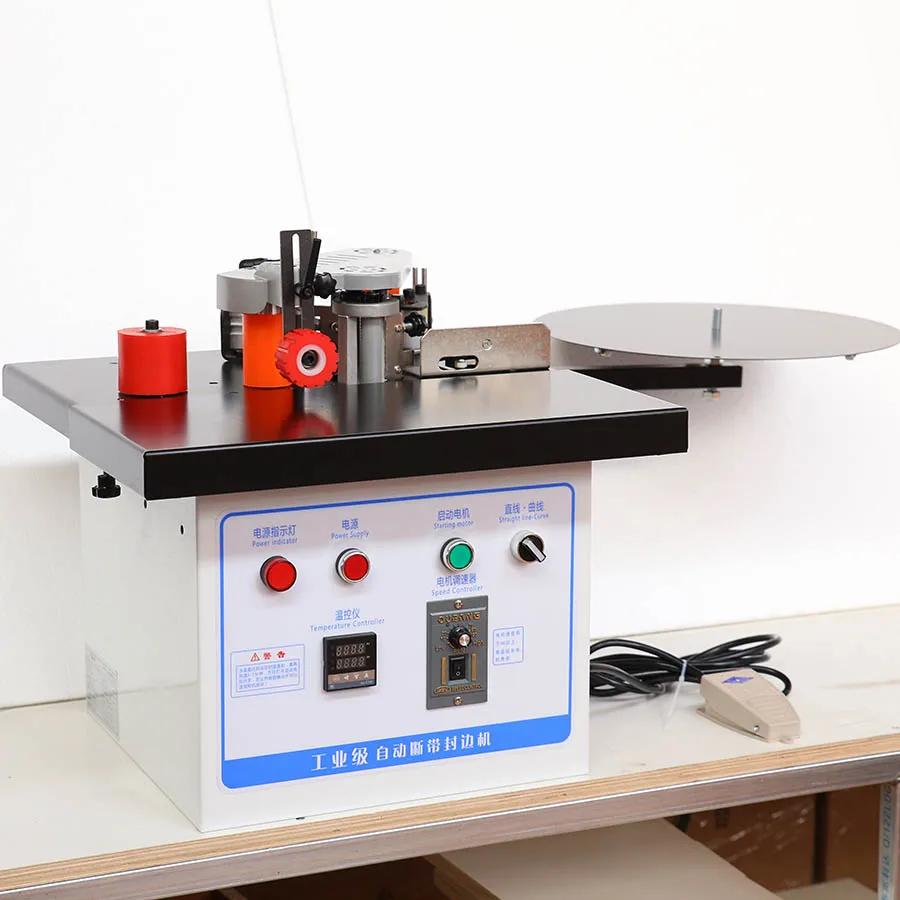
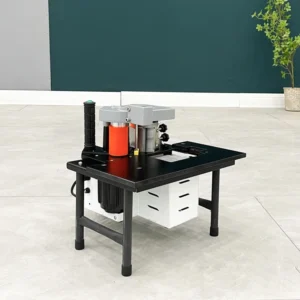
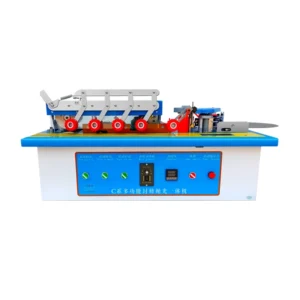
Precision-ground mechanisms — every ZDSF60 unit undergoes a four-stage factory QC protocol before dispatch, ensuring the mini edge banding machine meets its ±0.02 mm tolerance claims on your actual panel stock.
Technical Specifications
| Parameter |
Value |
| Model |
ZDSF60 |
| Product Type |
Mini Portable Edge Banding Machine |
| Function |
Automatic tape breaking, straight and curved edge banding, double-sided gluing |
| Rated Voltage |
220V (configurable from 110V to 440V) |
| Rated Air Pressure |
0.4–0.6 MPa |
| Strip Thickness Range |
0.5–2 mm |
| Sheet Thickness Range |
7–60 mm |
| Glue Pot Capacity |
1000 ml |
| Heating Power |
800 W (heat-up time 5–8 min) |
| Edge Banding Speed |
0–6 m/min |
| Heating System |
4 heating tubes |
| Glue Application |
Double-sided glue-coated rollers |
| Pressure Roller |
Adjustable, rubber material |
| Edge Strip Transport |
Adjustable bayonet for strip height |
| Belt Breaking |
Pneumatically controlled with foot switch and travel switch |
| Overall Dimensions (L×W×H) |
540×540×560 mm |
| Machine Weight |
26 kg |
Application Suitability
| Application |
Material or Output |
| Small-scale custom furniture edge finishing |
MDF and plywood panels with PVC edge banding |
| On-site cabinet installation |
Curved and straight edges on particleboard substrates |
| Joinery workshop production |
Solid wood panels with veneer strip edging |
| Startup woodworking shop edge sealing |
Melamine-faced board with 0.5–2 mm PVC strips |
Why "Portable" Should Not Mean "Unverified" on the Shop Floor
A Mini Edge Banding Machine factory OEM build must survive the same production realities as a full-size line — portability is a footprint advantage, not a quality shortcut.
I have seen compact edge banders arrive at small workshops and run fine on thick PVC for the first week. Then the operator switches to 0.5 mm veneer, the glue temperature profile does not match the thinner material, and delamination shows up on finished cabinet doors. The machine was never tested on the actual strip stock the shop intended to use. [NEED_CITE: edge banding adhesion failure modes on thin veneer substrates] That gap between factory validation and real-world material is where most portable units earn a bad reputation — not because the design is wrong, but because the pre-shipment test skipped the buyer’s specific panel and strip combination.

How the ZDSF60 Is Built for OEM and Private-Label Programs
Distributors sourcing a Mini Edge Banding Machine factory OEM partner need more than a logo swap. The ZDSF60 platform supports voltage reconfiguration from 110V to 440V, multilingual control panel overlays, and custom packaging — all integrated during assembly rather than retrofitted after the fact. The pneumatic belt-breaking system and adjustable bayonet strip transport are standardized across units, which means a distributor can commit to a regional stock order knowing that every machine in the batch shares identical service procedures and spare part lists.
Manufacturing Depth Behind a Compact Footprint
The 540×540×560 mm frame houses the same four-stage QC sequence applied to Ruiqi’s full-size automatic edge banders: incoming material inspection on rollers and heating elements, in-process checks during sub-assembly, finished-product functional testing under load, and pre-shipment verification with the buyer’s material sample. [NEED_CITE: multi-stage quality control protocols in woodworking machinery manufacturing] The 4-tube heating system is individually tested for thermal uniformity across the 1000 ml glue pot before installation. For OEM partners, this means the unit you brand and resell carries a factory test record tied to its serial number — not just a corporate-level certificate.
Reading the Specs That Matter for Panel Edge Quality
The 7–60 mm sheet thickness range and 0.5–2 mm strip thickness range together define what this machine can realistically handle in a working shop. A 60 mm panel requires the adjustable pressure roller to exert consistent force across a tall edge face, while a 0.5 mm veneer strip demands precise glue temperature control to prevent bleed-through. The 800 W heating system with four tubes distributes heat across the glue pot volume, maintaining stable viscosity during continuous runs at up to 6 m/min. Double-sided glue-coated rollers apply adhesive to both the panel edge and the strip simultaneously, which improves bond consistency on curved edges where single-sided application tends to starve the inside radius. The pneumatically controlled belt-breaking system, triggered by foot switch or travel switch, removes operator timing judgment from straight-edge cuts — a frequent source of strip overhang or shortage on manual units.
What Happens When the Voltage Question Gets Skipped
A compact edge bander shipped at 220V/50Hz into a 110V/60Hz market will either underheat the glue pot or trip the breaker on startup — and neither outcome is discovered until the crate is opened on the buyer’s floor. [NEED_CITE: voltage and frequency mismatches in exported industrial machinery] The 800 W heating system and pneumatic solenoids are both frequency-sensitive components. When a distributor orders portable edge banders without confirming local electrical standards, the result is machines that sit idle while transformers are sourced locally, or worse, heating elements that degrade from chronic undervoltage. The ZDSF60 platform is built with voltage reconfiguration as a standard factory option, not an afterthought.
What Factory-Direct Procurement Actually Delivers
In-house manufacturing with patented cutting mechanisms means the ZDSF60’s edge-trimming accuracy is designed and controlled under one roof, not outsourced to an unnamed assembly shop. Full product family coverage — from this portable unit through full-function pre-milling edge banders — lets a distributor build a regional catalog around a single supplier relationship. Voltage, language, and specification customization is processed during production planning, not bolted on post-assembly. The four-stage QC protocol generates a unit-level factory test record that travels with the machine. Engineer-led configuration review ensures that a distributor’s first order matches the target market’s panel materials and workshop conditions, with formal quotation provided within 24 hours of inquiry.
Documentation & Verification
- CE declaration of conformity applicable to the ZDSF60 portable edge bander
- ISO 9001 certificate covering the manufacturing facility and QC process
- Machine specification sheet with confirmed voltage and air pressure ratings
- Factory test record documenting glue temperature and feed performance on sample material
- Operation and maintenance manual provided in the buyer’s agreed language
- Electrical schematic matching the as-built voltage configuration
Installation, Commissioning & Support
- Requires a dedicated 220V circuit (or confirmed local equivalent) to support the 800 W heating load without voltage drop
- Pneumatic connection at 0.4–0.6 MPa needed for belt-breaking solenoid and foot switch operation
- Arrives fully assembled at 26 kg — bench-mount or floor-stand deployment by a single operator
- First-run glue temperature profiling against the buyer’s specific PVC or veneer strip stock
- Adjustable bayonet and pressure roller calibration included in commissioning guidance
- Spare parts list covering heating tubes, glue rollers, and rubber pressure elements
Before You Request a Quote
Tell us the panel substrates and edge strip materials your workshop or your distributor network actually runs — MDF, plywood, particleboard, and whether the strips are PVC, ABS, or wood veneer. Confirm the local voltage and frequency at the installation site so the machine is built to match. If you are evaluating this unit for OEM branding or regional resale, specify the order volume, target markets, and any language or packaging requirements up front so the engineer configuration proposal covers the full scope.
Frequently Asked Questions
Q: How is the ZDSF60 edge banding speed and glue consistency verified during factory QC?
A: Each unit runs a pre-shipment test using panel and strip samples matching the buyer’s specification. Glue pot temperature stability across the 1000 ml capacity is logged at the target feed speed, and the pneumatic belt-breaking cycle is verified for both straight and curved edge paths before the machine is cleared for packing.
Q: What OEM customization options are available for distributors?
A: The ZDSF60 supports custom logo application, voltage configuration from 110V to 440V, multilingual control panel overlays, and branded packaging. All modifications are integrated during factory assembly, and every OEM unit receives the same four-stage QC documentation as standard-production machines.
Q: Can we arrange a factory visit or request sample tests on our own materials?
A: Factory visits are welcomed and can be scheduled around your procurement timeline. If travel is not practical, send your panel stock and edge strip samples to the facility — the engineering team will run a live edge banding test and share the results, including glue adhesion and trim quality, before you commit to an order.
Q: What spare parts ship with the machine, and how are service teams trained?
A: A spare parts kit covering high-wear items such as glue-coated rollers, heating tubes, and rubber pressure elements is included at dispatch. Distributor service teams receive technical documentation and can request remote or on-site training on maintenance procedures specific to the ZDSF60 platform.
Q: How does the ZDSF60 fit alongside larger edge banders in a workshop line?
A: The portable unit handles curved edges and small-batch jobs that would slow down a full-size automatic edge bander. In a mixed line, the ZDSF60 takes custom-radius work and on-site installation tasks while the primary machine runs straight-edge panel throughput, keeping both stations within their designed capacity.