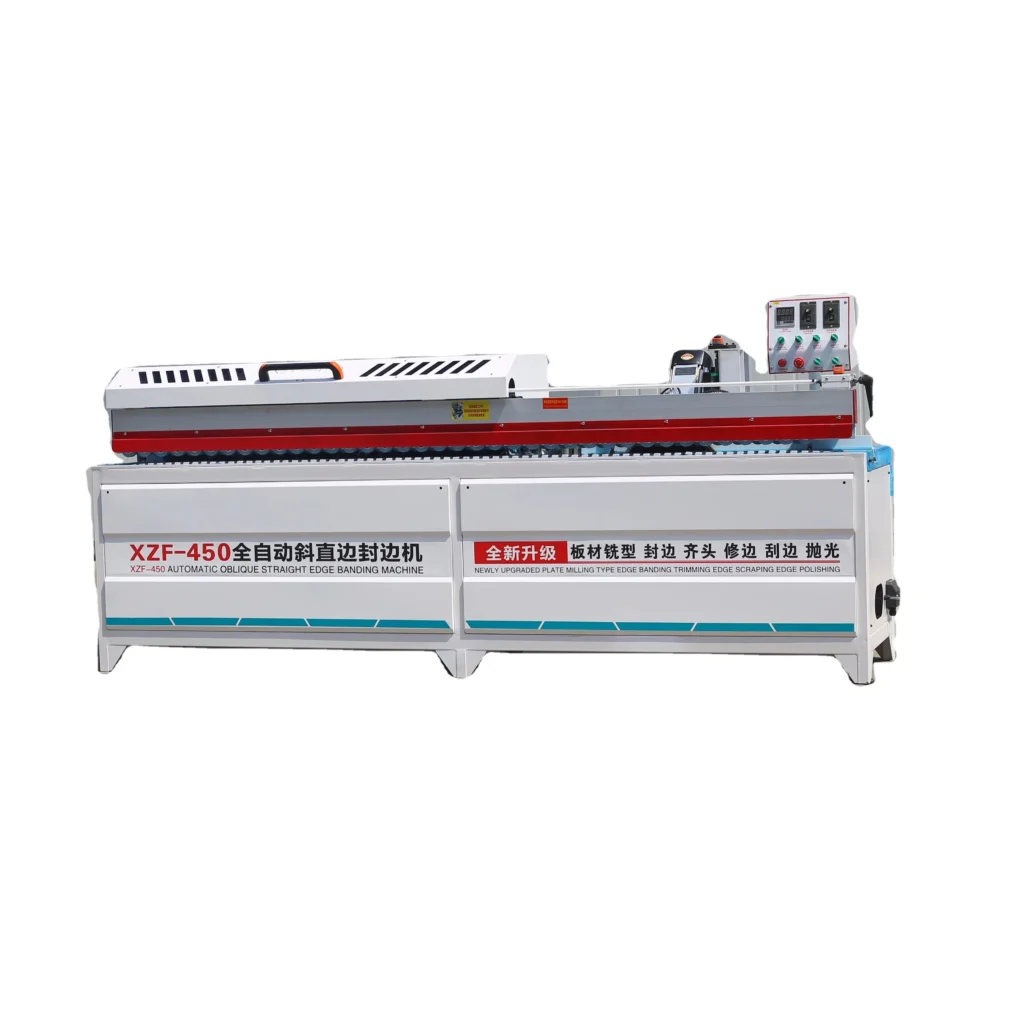
Custom Voltage Lock — Every ZXF-450 leaves the facility with electrical schematics matched to your grid, verified before assembly begins.
Technical Specifications
| Parameter |
Value |
| Model |
ZXF-450 |
| Product Type |
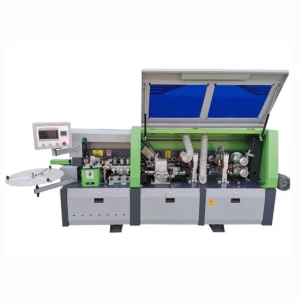
Fully Automatic Bevel & Straight Edge Banding Machine |
| Function Stations |
Gluing, End Cutting, Trimming, Scraping, Buffing |
| Edge Shape Capability |
Bevel & Straight (30°/45°/60° Bevel, 90° Straight) |
| Voltage |
380V (220V available on request) |
| Total Power |
9.5 kW |
| Feed Speed |
0–12 m/min |
| Board Thickness Range |
0–50 mm |
| Strip Thickness Range |
0.5–3 mm |
| Glue Pot Capacity |
4000 ml |
| Overall Dimensions (L×W×H) |
300×65×135 cm |
| Net Weight |
430 kg |
| Control System |
Control panel |
| Warranty |
One year |
Application Suitability
| Application |
Material or Output |
| Furniture door edge banding |
MDF and plywood with PVC or melamine paper strips |
| Panel furniture bevel edge processing |
Particleboard with 30°/45°/60° bevel profiles |
| Custom cabinet straight edge finishing |
Plywood and MDF with 90° straight banding |
| Workshop-scale batch production |
Mixed panel substrates up to 50 mm thickness |
Why the Voltage Question Must Come Before the Quotation
A machine wired for the wrong grid is a machine that never runs.
I have watched containers arrive at port with motors wound for 380V/50Hz heading to workshops running 220V/60Hz. The Automatic Bevel Edge Banding Machine factory OEM process should catch this at the inquiry stage, yet too many quotations go out without a single question about local power infrastructure. The result is a machine that sits idle while transformers are sourced, or worse, a motor burns out on first startup [NEED_CITE: voltage and frequency standards by export market]. Our configuration workflow locks voltage, frequency, and phase before the first component is pulled from inventory.

Dual-Edge Platform for Regional Market Versatility
Distributors stocking inventory for diverse customer bases need a single platform that handles both bevel and straight edge profiles. The ZXF-450 covers 30°, 45°, and 60° bevel angles alongside standard 90° straight edging, meaning one Automatic Bevel Edge Banding Machine factory OEM order serves furniture door makers and cabinet shops without splitting the SKU count. This reduces warehouse complexity and lets regional partners fulfill a wider range of orders from the same container load.
Private Label Readiness from Day One
Building a brand around imported woodworking equipment requires more than a sticker on the guard panel. The OEM scope here extends to custom color schemes, branded control panel overlays in the destination language, and logo placement on both the machine body and packing materials. For distributors establishing their own product line, the ZXF-450 ships with documentation and markings that carry your brand identity through to the end user [NEED_CITE: CE machinery directive requirements for industrial equipment]. The factory test record photographs are captured with your branding visible, so your technical team receives commissioning-ready imagery.
How Feed Speed and Board Thickness Interact on the Shop Floor
The 0–12 m/min feed speed range paired with a 0–50 mm board thickness capacity determines how this machine fits into a real production rhythm. Thicker panels demand slower feed rates to maintain consistent glue transfer and clean trimming across the full edge profile. At the upper thickness limit, operators typically reduce feed speed to allow the glue pot — rated at 4000 ml — to maintain thermal stability across the bonding zone. The five function stations (gluing, end cutting, trimming, scraping, buffing) work sequentially, and any mismatch between feed rate and station cycle time shows up immediately as chatter marks or incomplete scraping on the finished edge.
The Cost of Skipping Pre-Shipment Voltage Verification
When voltage confirmation gets treated as an afterthought, the consequences compound. A 9.5 kW motor designed for 380V will draw excessive current on a 220V supply, tripping breakers or damaging windings within the first hour of operation. I have seen workshops lose days of production while waiting for replacement contactors to ship internationally. The ZXF-450 configuration process requires written voltage and frequency confirmation before the electrical cabinet is wired, and the schematic is included in the documentation package so your local electrician can verify the installation [NEED_CITE: electrical safety standards for imported industrial machinery].
What Manufacturing Depth Means for Your Supply Chain
In-house precision grinding of critical components keeps tolerance control within the facility rather than depending on third-party machining shops. The four-stage QC sequence — incoming material inspection, in-process checks, finished product verification, and pre-shipment audit — generates documented records at each gate. For OEM partners, this means you can review inspection data before authorizing shipment. Patented cutting mechanisms in the trimming stations deliver consistent edge finish across PVC and melamine substrates without requiring field adjustments that erode your brand reputation.
Documentation & Verification
- Factory test record captured on your specified panel thickness and edge strip material
- Electrical schematic confirming voltage, frequency, and phase for your target market grid
- CE declaration of conformity and ISO 9001 certificate for customs clearance
- OEM logo placement and branding scope detailed in the formal quotation
- Operation manual translated into the operator language you specify at order stage
Installation, Commissioning & Support
- 9.5 kW total power requires a dedicated circuit with correctly rated breaker and cable cross-section
- 300 cm length and 430 kg weight need level concrete flooring with adequate clearance for panel infeed
- KD packing option allows container loading with on-site reassembly guided by the electrical schematic
- Glue pot thermal calibration performed during commissioning to match your edge strip adhesive type
- Buffer and scraping station alignment verified against your actual panel material before handover
- Spare parts list covers consumable trimmer blades and scraper inserts for the first maintenance cycle
What We Need to Configure Your Machine
Send us your target market voltage and frequency, the edge strip materials you plan to stock (PVC, melamine paper, or veneer), and the board thickness range your customers typically demand. If you are building a private label line, include your branding guidelines and preferred control panel language. We will return a configuration proposal with matched specifications and a formal quotation.
Frequently Asked Questions
Q: What OEM and private label options are available for the ZXF-450?
A: Customization covers logo placement on the machine body and packaging, custom paint color, and control panel overlays printed in your chosen language. The formal quotation documents the full branding scope so both parties agree on placement and appearance before production begins. Electrical markings and nameplates carry your brand identity.
Q: How is voltage confirmed before production starts?
A: We require written confirmation of your local voltage, frequency, and phase configuration before the electrical cabinet is wired. The schematic is then produced to match those exact specifications and included in your documentation package. This prevents the common failure mode of machines arriving with incompatible motor windings.
Q: Can we review quality control records before shipment?
A: The four-stage QC process generates inspection data at incoming material, in-process, finished product, and pre-shipment stages. OEM partners can request these records for review before authorizing dispatch. Pre-shipment verification photographs show the machine running with your branding visible.
Q: Is a factory visit possible before placing an OEM order?
A: Factory visits are welcomed at any stage. You can audit component sourcing, observe precision grinding operations, and witness test runs on your specified panel materials. Many distributors use the visit to finalize configuration details and confirm the manufacturing depth matches their market positioning requirements.