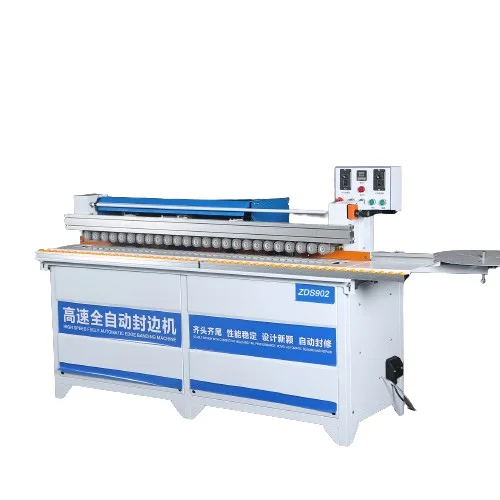
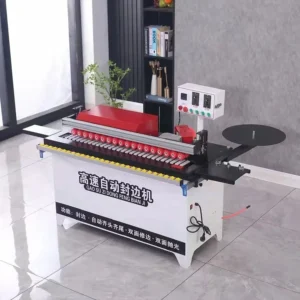
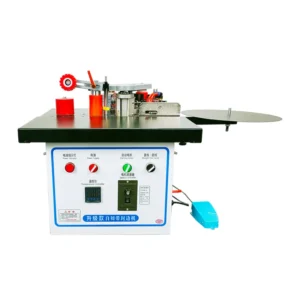
Verified Tolerance at Source — every High-speed Fully Automatic Edge Banding Machine leaves our Shandong facility with a signed test record proving ±0.02mm cutting accuracy on your specified panel stock, not a catalog promise discovered false at assembly.
Technical Specifications
| Parameter |
Value |
| Product Type |
Automatic Edge Banding Machine |
| Voltage |
Configurable from 110V to 440V (frequency to be confirmed per market) |
| Total Power |
4200W |
| Equipment Size |
207×60×122 cm |
| Net Weight |
245 kg |
| Edge Banding Type |
Linear Edge Banding |
| Edge Band Height Range |
0–35 mm |
| Edge Band Thickness Range |
0.5–2.5 mm |
| Glue Pot Capacity |
4000 ml |
| Pressure Beam |
Integrated, adjustable handle for board height |
| Conveyor Belt |
Silicone material, double rows of pressure wheels |
| Edge Strip Cutting |
Pneumatically controlled |
| Trimming |
Double high-speed motors, up and down action |
| Polishing |
Up and down dual motors |
| Control System |
Intelligent temperature control |
| Assembly State |
KD packing or assembled depending on configuration |
| Warranty |
1 year |
Application Suitability
| Application |
Material or Output |
| Custom cabinet door production |
MDF and particleboard with PVC edge banding |
| Plywood case goods manufacturing |
Plywood panels with veneer or melamine banding |
| Solid wood furniture components |
Solid wood panels requiring glue application and precision trimming |
| Batch panel processing for joinery workshops |
Mixed substrate runs transitioning between MDF, plywood, and particleboard |
Why the Voltage Question Must Precede the Purchase Order
An automatic edge banding machine manufacturer must confirm local grid specifications before production begins, not after the crate arrives.
I once watched a 380V main motor smoke and fail on a 440V supply in South America because the frequency and phase weren’t locked down during the quoting stage. The customer lost two weeks of production waiting for a replacement motor by sea freight. That failure shaped how every OEM order is now handled: the electrical schematic and voltage confirmation document are signed off before the first component is cut. [NEED_CITE: voltage and frequency standards by export market]

How OEM Partners Configure This Platform
Distributors requesting private-label branding receive more than a logo swap on the housing. The control panel language, color scheme, and documentation package are configured to match the destination market. An automatic edge banding machine manufacturer working with regional partners must deliver units that look and read as locally supported equipment, not generic imports with a sticker applied.
Component Sourcing and Precision Grinding Protocols
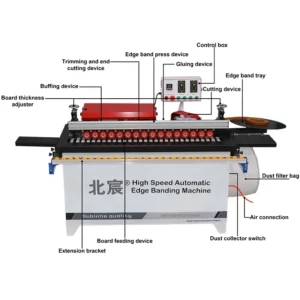
The trimming and polishing motors are matched for speed and bearing grade before assembly, and the pneumatic cutting cylinder is bench-tested for stroke consistency. Precision-ground contact surfaces on the pressure beam and conveyor bed are inspected at the in-process stage, not just at final assembly. This depth of manufacturing control is what separates a genuine OEM source from a trading company relabeling catalog machines. [NEED_CITE: CE machinery directive requirements for industrial equipment]
What the Glue Pot and Trimming Configuration Mean for Panel Output
The 4000 ml glue pot capacity reduces refill interruptions during continuous runs, which matters when a furniture factory is processing full batches of cabinet components. The double high-speed trimming motors working in an up-and-down action address both the top and bottom edge simultaneously, so the operator does not need to flip or re-feed panels for a second pass. A smaller glue pot would force stoppages every few dozen panels, while single-direction trimming leaves the opposite edge rough and requiring manual cleanup. The silicone conveyor belt with double rows of pressure wheels keeps panels flat against the fence throughout the feed path, which is critical when working thin MDF or warped particleboard that tends to lift under standard rubber belts.
When Incompatible Feed Heights Disrupt a Production Line
A workshop that sources machines piecemeal from different suppliers often discovers the edge bander’s infeed height does not align with the panel saw outfeed table or the boring machine intake. Panels must then be manually lifted or lowered between stations, introducing scratches and slowing throughput. [NEED_CITE: production line integration standards for woodworking machinery]
Manufacturing Depth Behind Every Shipped Unit
The 10,000㎡ facility in Ningjin operates with 60 engineers overseeing assembly, and every unit undergoes four-stage QC covering incoming material, in-process checks, finished product verification, and pre-shipment testing. Patented cutting mechanisms achieve the ±0.02mm tolerance stated in every quotation, and this is proven on the customer’s own panel stock before crating. Voltage customization from 110V to 440V is standard, not an upcharge, and the electrical schematic is confirmed in writing before production. Factory visits are open for OEM partners who want to inspect precision grinding stations and assembly lines firsthand.
Documentation & Verification
- Electrical schematic and voltage confirmation signed before your unit enters production
- Factory test record run on your specified panel thickness and edge band material
- Operation and maintenance manual translated into the language your operators read
- Spare parts list with OEM part numbers for local sourcing or direct reorder
- Packing photographs documenting crating condition before container loading
- CE declaration of conformity for markets requiring European machinery compliance
Installation, Commissioning & Support
- 207×60×122 cm footprint requires a clear zone for panel infeed and outfeed on both ends
- 4200W total draw requires a dedicated circuit matching the confirmed voltage and frequency
- KD-packed units include alignment fixtures so the pressure beam and conveyor reassemble to factory tolerance
- First-run parameter setting covers glue temperature, feed speed, and trimming depth on your actual panel stock
- Silicone conveyor belt and pneumatic cylinder seals identified as first-order spare parts
What to Include in Your Inquiry
Provide the panel materials you process most frequently, the edge band types and thicknesses in your current spec sheet, and the voltage and frequency at your facility. If you are evaluating this automatic edge banding machine manufacturer for an OEM program, include your target market, preferred control panel language, and any branding or color requirements for the machine housing.
Frequently Asked Questions
Q: What OEM and private-label options are available for this edge banding platform?
A: Logo placement, housing color, control panel language, and voltage configuration are all adjustable per your market requirements. Documentation including manuals and spare parts lists can be produced in your local language. The electrical schematic is confirmed and signed before production begins to ensure grid compatibility at your destination.
Q: How is the ±0.02mm cutting tolerance verified before the machine ships?
A: Each unit is run on panel stock matching the buyer’s specification during the pre-shipment verification stage. The trimming and cutting results are measured, and a factory test record documenting these readings accompanies the shipment. This is the fourth stage of a four-stage QC protocol covering the entire build cycle.
Q: What manufacturing lead time should OEM partners expect for batch orders?
A: Lead time varies with order quantity, customization depth, and current production scheduling. Single-unit orders with standard specifications move through the line faster, while OEM batches requiring custom voltage, branding, and multilingual documentation follow a longer preparation cycle. A formal timeline is provided with each quotation.
Q: How does the factory maintain precision grinding consistency across units?
A: Contact surfaces on the pressure beam, conveyor bed, and trimming stations are precision-ground and inspected during the in-process QC stage. Component traceability records track each critical part back to its grinding batch. Visiting partners can observe these inspection protocols on the assembly floor.