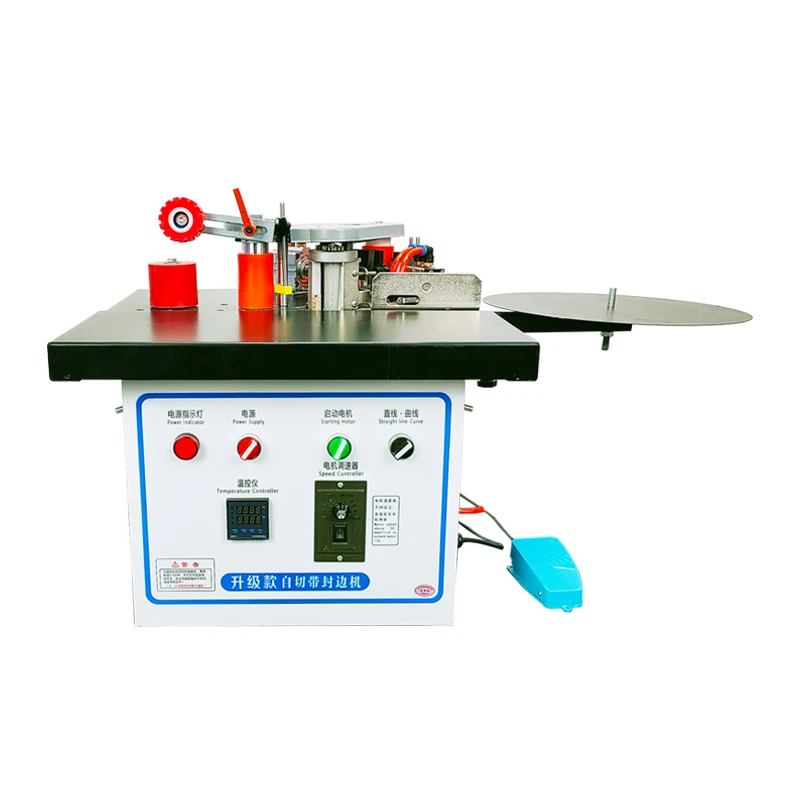
OEM-Capable Production — Every portable edge banding unit is assembled on our floor, tested at the buyer’s confirmed voltage, and shipped with full private-label documentation.
Technical Specifications
| Parameter |
Value |
| Product Type |
Manual Edge Banding Machine |
| Rated Power |
1000W |
| Voltage & Frequency |
220V/380V/customization |
| Standard Features |
Curved and straight edge banding |
| Minimum Length of Sheet |
25CM |
| Minimum Width of Sheet |
3CM |
| Edge Banding Height |
0-50MM |
| Edge Banding Thickness |
0.3-3MM |
| Edge Power |
20W |
| Air Source Pressure |
0.5-0.8Mpa |
| Overall Dimensions (L×W×H) |
505047CM |
| Net Weight |
22KG |
| Glue Pot Capacity |
1000ml |
| Assembly State |
Benchtop portable unit |
| Language Options |
Chinese, English, customizable to Spanish or other languages |
| Plug Options |
EU, USA, AU, UK |
Application Suitability
| Application |
Material or Output |
| Home decoration production |
MDF, particleboard, ecological board |
| Small-scale workshop edge banding |
Solid wood board, plywood |
| Furniture repairing and on-site adjustments |
Curved and straight panel edges up to 50mm height |
| Regional distributor catalog entry |
Entry-level equipment for joinery startups and repair shops |
Why the Voltage Question Should Come Before the Price
A machine that trips the breaker on arrival is a loss for both the importer and the end user.
Back in Shandong, I spent years on the assembly floor before moving into export roles. One shipment stands out: a compact manual edge banding machine sent to a Middle East customer. The workshop ran on 110V. The unit was wired for 220V. The moment they switched it on, the breaker tripped and the control board fried. The customer waited nearly a month for a step-down transformer, and the distributor lost credibility they had spent years building [NEED_CITE: voltage and frequency standards by export market]. That incident reshaped how we prepare every unit before it leaves the factory, regardless of how small or inexpensive the machine is.

How OEM Partners Reshape the Product Mix
Distributors entering emerging markets often need an entry-level manual edge banding machine that can be branded locally, priced competitively, and supported without a dedicated service team. The ST-50 format fills that gap: benchtop footprint, single-operator use, and a glue pot large enough for sustained small-batch runs. An OEM partner can specify custom logo placement, control panel language, and packaging artwork — turning a generic unit into a market-specific SKU that sits alongside larger automated lines in the same catalog.
Private-Label Depth Beyond a Sticker
Applying a brand to a manual edge banding machine involves more than swapping a nameplate. Motor winding must match the destination grid, plug configuration must comply with local wiring codes, and the operation manual must be readable by the technician who will service it [NEED_CITE: CE machinery directive requirements for industrial equipment]. We handle voltage confirmation, plug selection from EU, USA, AU, and UK standards, and multilingual documentation as part of the standard OEM workflow — so the distributor does not have to source those adaptations after the container arrives.
Specs That Actually Matter at the Bench
The edge banding thickness range of 0.3–3mm covers PVC, melamine, and thin veneer tapes used in repair and small-batch furniture work. A 1000ml glue pot reduces refill interruptions during a day of mixed panel runs. The 0.5–0.8 MPa air pressure requirement is compatible with standard workshop compressors already present in most joinery environments. The 22KG net weight and benchtop assembly state mean the unit can be positioned next to a sliding table saw without dedicated floor space or special foundations, which matters when a workshop is scaling from manual tools to its first powered edge sealer.
The Hidden Cost of Skipping Voltage Confirmation
When a distributor orders a batch of portable edge sealers without confirming local voltage and frequency, the consequences cascade. The end user cannot commission the machine, the distributor’s service team has no immediate fix, and the container sits in a warehouse generating demurrage. Even a single incorrect unit in a mixed-load shipment can delay an entire product launch in a new territory. We treat voltage confirmation as a non-negotiable checkpoint before production begins, not an afterthought during packing [NEED_CITE: electrical compliance requirements for imported machinery].
What Makes This Sourcing Decision Different
In-house manufacturing means every component — from the glue pot casting to the feed roller assembly — passes through our own precision grinding and four-stage QC sequence. Voltage customization from 220V to 380V is handled on the production line, not outsourced after assembly. The CE declaration and ISO 9001 certification cover the manufacturing process itself, not just a paper exercise. OEM logo, control panel language, and packaging are configured per order, with a formal quotation typically provided within 24 hours of receiving specifications. Factory visits are welcomed so buyers can inspect the assembly floor before committing to a production run.
Documentation & Verification
- CE declaration of conformity matched to the manual edge banding machine category
- Electrical schematic with confirmed voltage, frequency, and plug type for the destination market
- Factory test record showing curved and straight edge sealing performance on buyer-specified panel stock
- Operation and maintenance manual translated into the agreed language before dispatch
- Spare parts list with part numbers compatible with the shipped configuration
Installation, Commissioning & Support
- Benchtop unit requires a stable workbench rated for at least 30KG to absorb vibration during operation
- Dedicated circuit matching confirmed voltage and frequency — 1000W draw plus compressor load
- Air compressor must deliver 0.5–0.8 MPa at a stable flow rate for consistent glue feed
- First run includes glue temperature calibration for the specified PVC or veneer tape thickness
- Multilingual operation manual covers daily cleaning of the glue pot and feed roller maintenance
What to Include in Your Inquiry
To match the right configuration, share the destination market’s voltage and frequency, the edge banding materials you plan to stock (PVC, melamine, or veneer), and whether you need custom branding on the machine body and packaging. If you are mixing this model with other woodworking machinery in a single container, let us know the full product list so we can plan load sequencing and documentation accordingly.
Frequently Asked Questions
Q: Can I apply my own brand logo and customize the packaging for my market?
A: Yes. OEM and private-label options are available, including custom logo on the machine body, branded packaging artwork, and multilingual operation manuals. Provide your artwork files and target language during the inquiry stage so we can confirm layout and production timing alongside the machine configuration.
Q: What voltage, frequency, and plug configurations are available for my country?
A: The unit supports 220V and 380V with customization for other voltages. Plug options include EU, USA, AU, and UK standards. Share your destination country during the inquiry so we can confirm the exact electrical specification and provide a voltage confirmation document before production begins.
Q: What is the MOQ for OEM orders, and can I mix this model with other machines in one container?
A: Single-unit orders are accepted, and mixed-container loading is supported for distributors building a regional product mix. Provide your full equipment list during the inquiry so we can calculate container utilization and coordinate documentation across all models in the shipment.
Q: How do I verify the edge banding thickness range and tolerance before placing a bulk order?
A: We provide a factory test record showing curved and straight edge sealing results on your specified panel material and edge tape thickness. Sample processing tests can be arranged before bulk production, and pre-shipment verification covers every unit in the order.
Q: What spare parts support and technical training do you provide to distributor service teams?
A: Each shipment includes a spare parts list with part numbers matched to the shipped configuration. Technical documentation covers routine maintenance, and we support distributor service teams with troubleshooting guidance during installation and commissioning phases.