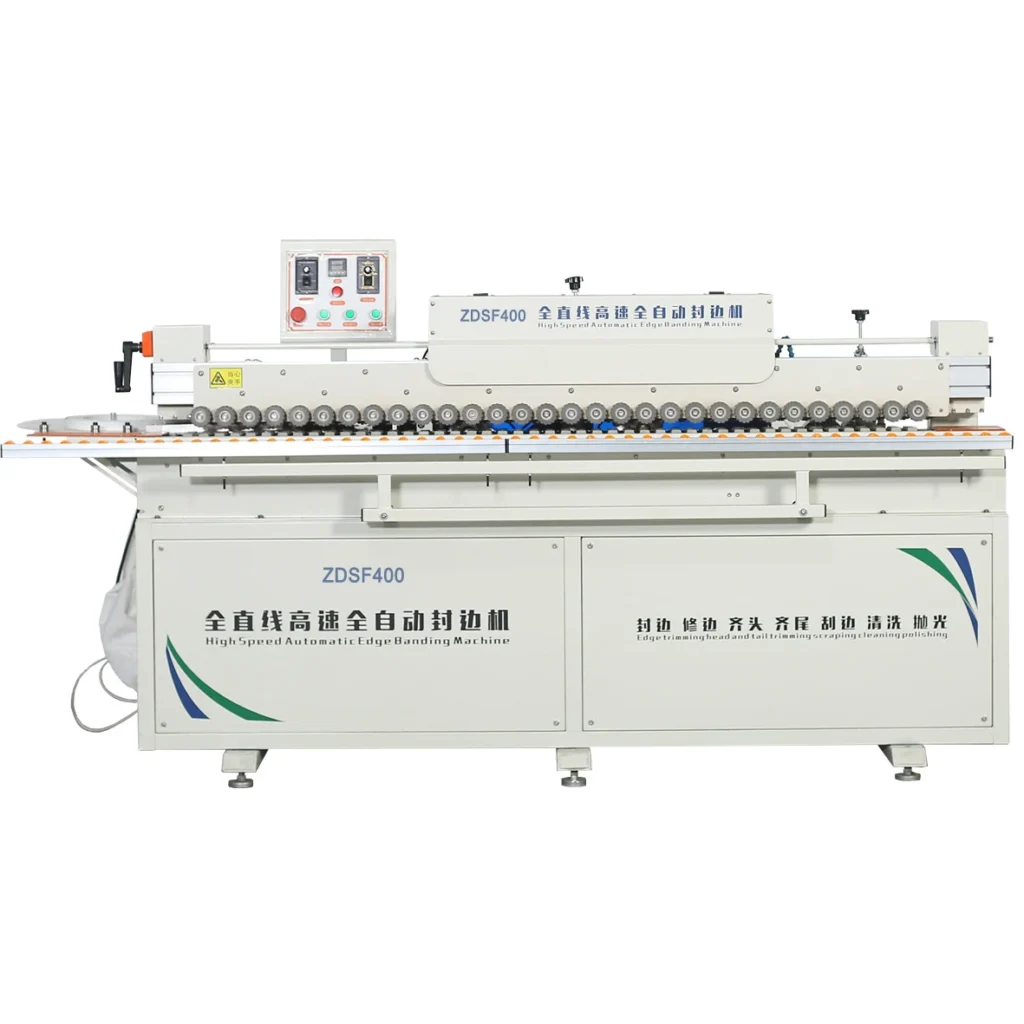
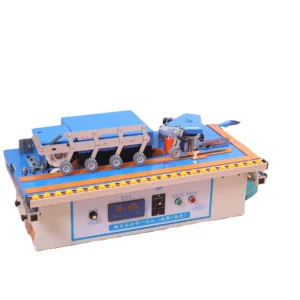
OEM branding & private-label capability — Every ZDSF400 automatic edge banding machine can carry your logo, color scheme, custom voltage plate, and multilingual control panel before it leaves our Ningjin production line.
Technical Specifications
| Parameter |
Value |
| Model |
ZDSF400 |
| Product Type |
Automatic Edge Banding Machine |
| Function Stations |
Gluing, End Cutting, Trimming, Scraping, Polishing, Vacuuming |
| Edge Type |
Straight line |
| Rated Voltage |
220V (50Hz/60Hz to be confirmed) |
| Rated Power |
3 kW |
| Rated Air Pressure |
0.4–0.6 MPa |
| Strip Thickness Range |
1–3 mm |
| Sheet Thickness Range |
10–55 mm |
| Feed Speed |
0–14 m/min |
| Glue Pot Capacity |
1000 ml |
| Heating Power |
800 W (warm-up 5–10 min) |
| Trimming Power |
800 W × 2 (24,000 rpm) |
| Polishing Power |
180 W × 2 (5,500 rpm) |
| Suction Power |
550 W |
| Overall Dimensions (L×W×H) |
240 × 70 × 120 cm |
| Machine Weight |
370 kg |
| Warranty |
1 year |
Application Suitability
| Application |
Material or Output |
| Cabinet door and carcass edge banding |
MDF, particleboard with PVC strips 1–3 mm |
| Plywood shelving edge finishing |
Plywood panels 10–55 mm thick with veneer or PVC |
| Small-batch custom furniture production |
Mixed panel substrates in straight-line workflows |
| Regional distributor catalog units |
Private-label packaging for woodworking machinery importers |
Why "Tolerance Claimed on Paper" Fails the Assembly Test
Tolerance means nothing unless it is measured on the actual panel you will ship.
I used to quote edge banders based purely on the spec sheet, and it worked until a distributor in the Middle East received a batch of machines that left visible glue lines on melamine-faced particleboard. The machines were built to tolerance, but the test panels at the factory ran on bare MDF. When the distributor’s technicians tried to assemble cabinets, the edge-to-face joint had a hairline gap that no amount of scraping could hide [NEED_CITE: typical assembly gap tolerances in cabinet manufacturing]. That experience reshaped how we handle pre-shipment verification. Now, before any ZDSF400 automatic edge banding machine ships, we run test panels matching the buyer’s actual substrate and edge material, document the measured tolerance, and send the report tied to that unit’s serial number.

What Distributors Gain from an OEM-Ready Production Line
Our assembly floor is organized so that private-label configuration happens during build, not as a sticker applied at packing. The ZDSF400 automatic edge banding machine frame accepts custom color powder coating, branded control panel overlays, and laser-engraved nameplates with your company details. Electrical cabinets are wired to your target market voltage before the machine reaches final testing.
Building Machines That Survive the Distributor’s Service Call
A distributor’s reputation depends on how long a machine runs between service visits. We precision-grind the conveyor bed and guide rails in-house, then inspect each assembly across four QC stages — incoming material, in-process fit, finished function, and pre-shipment verification. The ZDSF400 weighs 370 kg with a 240 cm bed, giving it a rigid base that resists deflection during repeated daily cycles [NEED_CITE: effect of machine weight and bed rigidity on edge banding consistency].
Reading the Specs That Actually Matter
The 10–55 mm sheet thickness range covers standard furniture panels from 16 mm melamine board up to 50 mm solid-core worktops, but feeding anything above 40 mm requires checking that the trimming motors clear the upper edge without chatter. The dual 800 W trimming motors at 24,000 rpm handle PVC and thin veneer cleanly; real-wood strips thicker than 2 mm may show micro-fractures at this speed and benefit from a pre-milling station not included on this model. The 800 W glue pot reaches working temperature in 5–10 minutes, which suits short-run workshops that power down between batches rather than leaving the pot hot all shift. Air supply must hold a steady 0.4–0.6 MPa at the machine inlet — pressure drop across long hose runs is a frequent cause of inconsistent end-cutting [NEED_CITE: pneumatic pressure requirements for edge banding stations].
The Cost of Skipping the Voltage Conversation
Sending a 220V/50Hz machine to a market running 220V/60Hz sounds like a minor mismatch, but the 60 Hz frequency pushes the trimming motors to roughly 28,800 rpm instead of the rated 24,000, accelerating bearing wear and changing the trim finish. I once saw an entire container of woodworking equipment sit in a warehouse for weeks because the frequency was wrong and the local electrician could not rewire the control circuits [NEED_CITE: voltage and frequency standards by export market]. The ZDSF400 is configurable from 110V to 440V, but only if the correct voltage and frequency are confirmed before the electrical cabinet is built.
Why Source the ZDSF400 from This Factory
Our patented cutting mechanisms are machined and assembled on-site, not outsourced, which keeps replacement part geometry identical to the original. Voltage, language, and specification customization is handled as a standard build step, not a special-order exception. Every ZDSF400 goes through four-stage QC with documented inspection at each gate. Engineers provide a configuration recommendation within 24 hours of receiving your substrate and edge material details. Factory visits are open — you can watch your unit move through the line from welding to packing.
Documentation & Verification
- CE declaration of conformity covering the ZDSF400 machinery directive scope
- Factory test record on your specified panel thickness and edge strip material
- Electrical schematic and voltage confirmation sheet matched to your grid standard
- Operation and maintenance manual translated into your operator’s language
- Spare parts list with OEM part numbers for long-term reordering
Installation, Commissioning & Support
- Level the 240 × 70 cm bed on a flat concrete floor before anchoring
- Provide a dedicated 220V circuit rated above the 3 kW total draw
- Verify 0.4–0.6 MPa air pressure at the machine inlet, not just at the compressor
- Run warm-up cycle for 5–10 minutes to bring the 800 W glue pot to working temperature
- Set trimming motor speed and scraping depth on your actual substrate before production starts
- Stock spare trimming cutters and scraper blades from the included spare parts list
What We Need to Configure Your Machine
Share your target panel material and thickness range, the edge strip type and thickness you plan to run, and your local voltage and frequency. If you are a distributor building a standard catalog package, tell us which upstream panel saws and downstream boring machines your customers typically pair with this class of edge bander so we can verify feed-height and throughput compatibility.
Frequently Asked Questions
Q: What OEM and private-label options are available for the ZDSF400?
A: We apply your logo, custom color, branded nameplate, and control panel overlay during assembly. Voltage is configurable from 110V to 440V, and manuals are translated into your chosen language. Private-label electrical schematics and packing photos carry your branding throughout.
Q: How do you verify edge banding quality before the machine ships?
A: Each ZDSF400 runs test panels using the buyer’s specified substrate and edge strip material. We measure edge-to-face tolerance, check glue line visibility, and document results in a pre-shipment verification report tied to the unit’s serial number.
Q: What is the production lead time for distributor-volume orders?
A: Single units ship from finished stock when available. Larger distributor orders follow a typical multi-week production schedule depending on the level of OEM customization requested. We confirm the dispatch date at order placement.
Q: Which spare parts are included, and how is long-term supply handled?
A: Each ZDSF400 ships with a starter set of trimming cutters, scraper blades, and wear-prone pneumatic seals. The spare parts list includes OEM part numbers so distributors can reorder directly or through their own supply chain without reverse-engineering components.