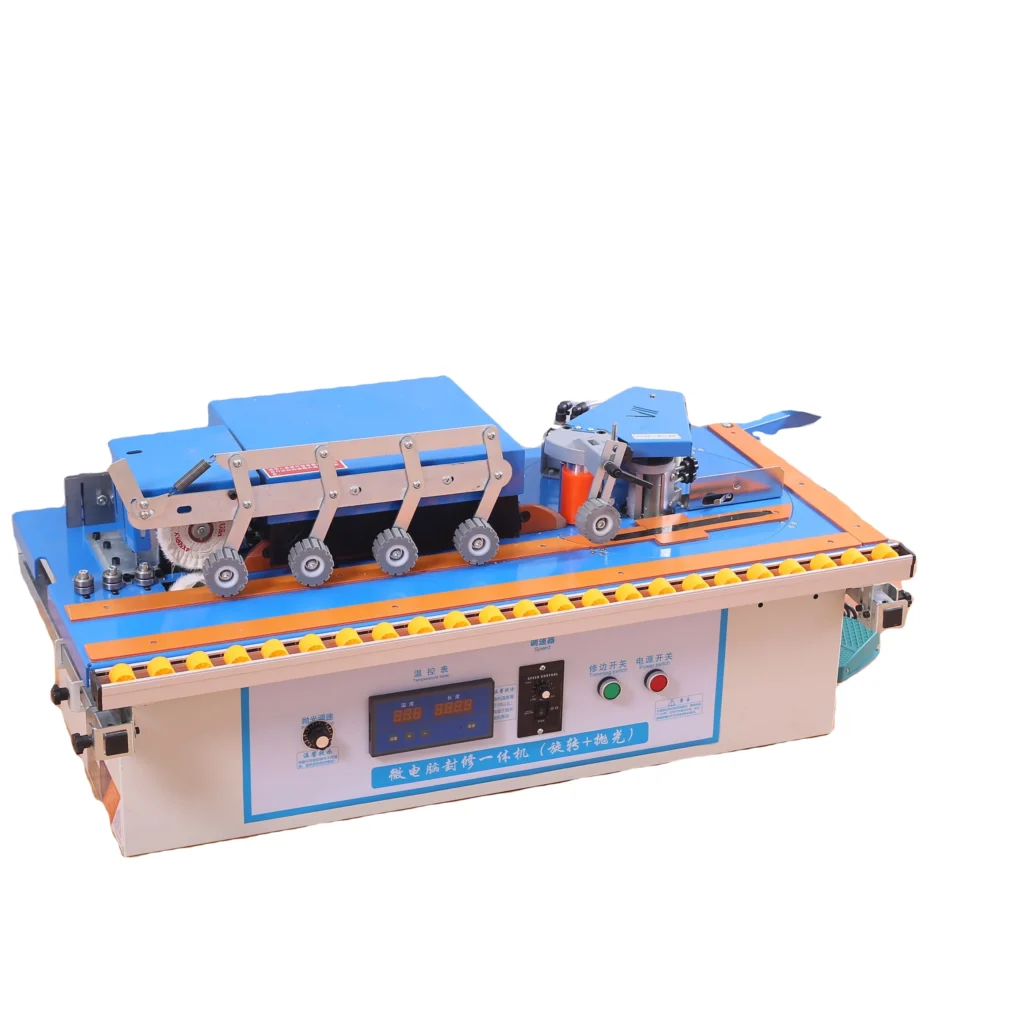
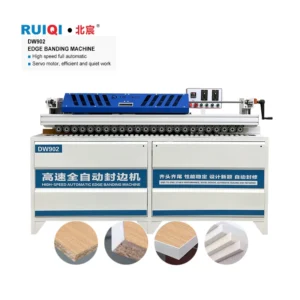
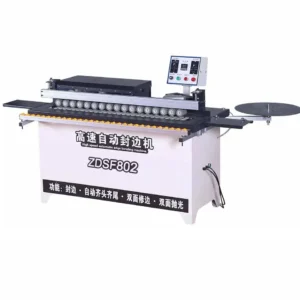
Precision-Built Portable Edge Sealing — Every Mini Edge Banding Machine OEM batch we ship carries a factory test record traced to its destination voltage and panel spec, verified before it leaves our assembly bench.
Technical Specifications
| Parameter |
Value |
| Product Type |
Mini Edge Banding Machine |
| Rated Power |
2.4 kW |
| Voltage |
220V (single/three-phase and frequency to be confirmed) |
| Overall Dimensions (L×W×H) |
105 × 50 × 45 cm |
| Net Weight |
45 kg |
| Rated Air Pressure |
0.4–0.6 MPa |
| Strip Thickness Range |
0.5–2 mm |
| Panel Thickness Range |
10–50 mm |
| Glue Pot Capacity |
1000 ml |
| Glue Heating Power |
800 W |
| Belt Feeding Speed |
0–14 m/min |
| Feeding Motor |
25 W |
| Trimming Power |
800 W × 2 |
| Trimming Configuration |
Top and bottom trimming, pneumatic trim, straightening |
| Gluing Method |
Double-sided gluing |
| Heat-Up Time |
5–10 minutes (basis not stated in source) |
| Warranty |
1 year (core components 1 year) |
Application Suitability
| Application |
Material or Output |
| Small workshop cabinet edge sealing |
MDF and particleboard with PVC strips 0.5–2 mm |
| On-site furniture repair and touch-up |
Pre-assembled plywood panels requiring straight-edge banding |
| Joinery startup transitioning from manual to machine |
Plywood and blockboard with veneer or PVC edge strips |
| Regional distributor private-label portable range |
Compact woodworking SKU for resale to carpentry trades |
Why the Voltage Question Must Come Before the Mini Edge Banding Machine OEM Order
Confirming local voltage and frequency before production starts prevents weeks of idle time on site.
A few years back, a South American buyer ordered an automatic edge bander from our line. We shipped it with standard configuration. When it arrived, the local supply was a different voltage and frequency combination than what we had built for. The machine sat in a crate while a step-down transformer was sourced locally — nearly a month of downtime before it ever ran. That delay is not something any distributor wants to explain to their end customer. For a Mini Edge Banding Machine OEM order, the electrical mismatch risk is just as real, even on a 2.4 kW portable unit. We now treat voltage and plug confirmation as a hard gate before any machine enters assembly [NEED_CITE: voltage and frequency standards by export market].

How We Build This Unit for OEM and Private-Label Partners
When a distributor evaluates a compact edge sealer for their catalog, the manufacturing depth behind it matters as much as the spec sheet. This Mini Edge Banding Machine OEM configuration is assembled on the same production floor as our full-size automatic models. The trimming stations, glue pot, and feed mechanism are sourced through the same component inspection chain. We do not treat portable units as an afterthought or outsource them to a separate workshop. Every unit goes through our standard assembly sequence, and OEM partners can specify logo placement, color scheme, and manual language at the order stage.
The Four-Stage QC Chain Applied to a Portable Machine
Our QC process covers incoming material inspection, in-process checks during assembly, finished product testing, and pre-shipment verification. On a portable edge sealer, this means we inspect the trimming motor bearings before they go into the housing, verify the glue pot heating element reaches stable temperature within the expected window, and run actual PVC and veneer strips through the feed path before crating. The factory test record documents each of these stages. For OEM batches, we can align our inspection documentation with the distributor’s own quality requirements so the paperwork package matches their market expectations [NEED_CITE: CE machinery directive requirements for industrial equipment].
What the Numbers on the Spec Sheet Actually Mean in Practice
The 10–50 mm panel thickness range defines what substrates this machine can physically accept. Thinner stock below 10 mm risks flexing under the feed belt pressure, while panels above 50 mm exceed the trimming station’s vertical travel. The dual 800 W trimming motors — one top, one bottom — handle PVC strips up to 2 mm without stalling, but veneer at the lower 0.5 mm end demands a lighter feed speed setting to prevent tear-out. The 1000 ml glue pot capacity is sized for intermittent use: enough for a batch of cabinet sides before needing a refill, which suits the on-site and small-workshop workflow this machine is designed for. Belt feeding at 0–14 m/min gives the operator control when working around pre-drilled hinge holes or unusual panel shapes. The 0.4–0.6 MPa air pressure requirement means a standard small compressor is sufficient — no dedicated industrial air supply needed.
The Hidden Cost of Skipping Electrical and Configuration Verification
When a compact edge sealer arrives with the wrong plug type or an incompatible control panel language, the problems cascade. The end user cannot read the operating instructions, commissioning stalls, and the distributor’s service team gets pulled into troubleshooting what is fundamentally a paperwork failure rather than a mechanical fault. We have seen situations where a machine technically works perfectly but sits idle because the operator interface is in a language the workshop does not use. These are not warranty claims — they are configuration oversights that no amount of on-site repair can fix quickly [NEED_CITE: operator interface language requirements for industrial machinery imports].
Why Distributors Source This SKU from Our Factory
Our in-house manufacturing covers the full assembly chain for this portable edge sealer, meaning OEM partners deal with one factory rather than a trading intermediary. Voltage configuration from 110V to 440V is handled as a standard order parameter, not a special request. We provide engineer-led configuration recommendations with formal quotation within the next business day, so distributors can respond to their own market inquiries without delay. Every unit ships with a pre-shipment test record, and factory visits are welcomed for OEM partners who want to audit the production line before committing to a batch order. The same four-stage QC applied to our full-function automatic models covers this portable range without exception.
Documentation & Verification
- Factory test record covering glue temperature stability and trim quality on specified strip thickness
- Electrical schematic with voltage and plug configuration matched to destination country
- CE declaration of conformity and ISO 9001 certificate available for customs and market entry
- Operation and maintenance manual produced in the buyer’s agreed language before dispatch
- Spare parts list with part numbers matching the trimming motors, feed belt, and glue pot components
Installation, Commissioning & Support
- Requires a stable 220V circuit rated for at least 2.4 kW with appropriate breaker protection
- Compact 105 × 50 × 45 cm footprint fits on a standard workbench without floor anchoring
- Arrives fully assembled — unbox, connect compressed air at 0.4–0.6 MPa, and power on
- First run should use scrap panels at slow feed speed to verify trim alignment before production use
- Glue pot requires cleaning after each session to prevent residue buildup in the 1000 ml chamber
- Trimming blades and feed belt are standard wear items included in the spare parts package
What We Need to Configure Your OEM Batch
To prepare an accurate specification and quotation for a Mini Edge Banding Machine OEM order, share your target market’s standard voltage and frequency, the plug type your end users expect, and the control panel or manual language required. If you are building a private-label range, let us know your logo artwork format and preferred machine color. For distributors evaluating multiple units, tell us the mix of panel materials your customers typically work with so we can align the factory test to those substrates.
Frequently Asked Questions
Q: How are edge quality and trim accuracy verified before the machine ships?
A: Every unit runs through our pre-shipment test using actual PVC and veneer strips within the 0.5–2 mm range. We document glue adhesion, trim finish on both top and bottom edges, and feed belt consistency. The test record travels with the machine, so the buyer can verify performance against the documented results upon arrival.
Q: What OEM customization options are available for branding and documentation?
A: We support custom logo application on the machine body, color matching for the housing, and private-label packaging. Manuals and control panel labels are produced in the buyer’s specified language. Each OEM batch can be configured with a consistent documentation package that matches the distributor’s market requirements and branding standards.
Q: How does the factory inspect core components like trimming motors and bearings?
A: Incoming components go through our first-stage inspection before entering assembly. Trimming motors are bench-tested for runout and thermal behavior. Bearings are checked for play and smoothness. Any component that does not meet tolerance is rejected before it reaches the assembly bench. This incoming inspection is documented as part of the four-stage QC record.
Q: Can the voltage and plug be configured for different export markets?
A: Yes. We configure voltage from 110V to 440V and match the plug type to the destination country’s standard. This is confirmed during the order stage before production begins, so the machine arrives ready to connect without adapters or external transformers. Electrical schematics reflect the as-built configuration for local compliance.
Q: What is the typical lead time and minimum order for an OEM batch?
A: Lead time depends on batch size and customization scope. A single sample unit can be produced relatively quickly for evaluation, while larger OEM runs follow a production schedule aligned with the buyer’s shipment timeline. We provide a confirmed dispatch date at the quotation stage so distributors can plan their inventory and market launch accordingly.