Precision-Ground Assembly — every JL-1 spindle mount is verified against runout tolerance before the machine leaves our Shandong test floor, not after it arrives at your warehouse.
Technical Specifications
| Parameter |
Value |
| Model |
JL-1 |
| Product Type |
Single Row Hinge Boring Machine |
| Total Power |
1.5 kW |
| Drill Configuration |
35 mm large drill + 3 mm small drill |
| Voltage |
380V / 415V three-phase four-wire |
| Motor Type |
Pure copper motor |
| Guide Rails |
Precision guide rails for sliding adjustment |
| Drilling Adjustment |
Vertical and horizontal position adjustable |
| Control |
Foot switch operation |
| Vacuum System |
External vacuum connection required |
| Product Dimensions |
70 × 56 × 145 cm |
| Product Weight |
55 kg |
Application Suitability
| Application |
Material or Output |
| Cabinet door hinge cup drilling |
MDF and particleboard door panels |
| Wardrobe hinge boring |
Plywood and melamine-faced board |
| Loose leaf hinge pilot holes |
Solid wood and blockboard components |
| Furniture hardware hole machining |
PVC-laminated and veneered panel stock |
Why Voltage Confirmation Must Precede the Quotation on Any Hinge Boring Machine
A machine wired for the wrong frequency will burn out its pure copper motor before the first door panel is drilled.
I have watched distributors in the Middle East receive woodworking equipment quoted on price alone, only to find the motor spec matched a grid that did not exist in their facility. The JL-1 hinge boring machine factory configuration starts with a formal voltage and frequency declaration — 380V or 415V, three-phase four-wire — before production is scheduled. [NEED_CITE: voltage and frequency standards by export market] Skipping that step means the spindle may run at the wrong RPM, shifting hinge cup position off tolerance and destroying panel stock on day one.
How Component Sourcing Defines the Machine You Actually Receive
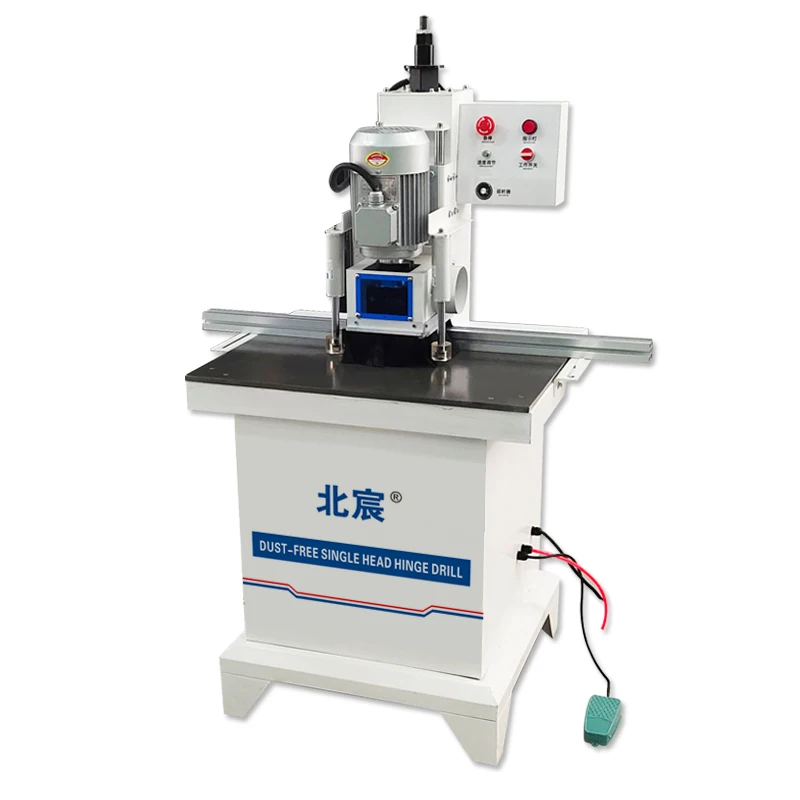
Every hinge boring machine factory output carries the signature of its component supply chain. The JL-1 uses precision guide rails that permit both vertical and horizontal drilling adjustment, a feature that matters when a cabinet line switches between standard 35 mm hinge cups and smaller loose-leaf hardware. The pure copper motor at 1.5 kW was selected for thermal stability across long production shifts, resisting the winding degradation that cheaper aluminum alternatives show after sustained load in warm workshop environments.
Four-Stage QC Applied to a 55 kg Machine
It is easy to assume that a compact single row hinge boring machine requires less oversight than a full CNC nesting cell. Our process treats it identically: incoming material inspection on the motor windings and rail hardness, in-process checks during spindle seat machining, finished-product runout measurement, and a pre-shipment test that drills actual hinge holes in the buyer’s specified panel material. [NEED_CITE: CE machinery directive requirements for industrial equipment] The test record travels with the machine, giving the receiving warehouse a baseline to verify against upon arrival.
What the Drill Configuration and Guide Rail Design Mean for Panel Output
The dual drill setup — 35 mm for the hinge cup and 3 mm for the pilot screw hole — eliminates the need for a secondary operation on standard cabinet doors. In production, that single-setup approach reduces handling marks on melamine and veneer surfaces. The precision guide rails allow the operator to slide the drilling head laterally without losing vertical alignment, which keeps hinge cup depth consistent across a batch of doors with varying widths. Foot switch control frees both hands for panel positioning, reducing fatigue over a full shift and keeping bore position repeatable.

The Hidden Cost of Skipping Spindle and Motor Verification
When a hinge boring machine arrives without documented runout data, the first sign of trouble is usually a batch of cabinet doors that will not close flush. By that point, the spindle bearings may already be wearing unevenly, and the hinge holes are drifting outside the tolerance the hardware manufacturer specifies. [NEED_CITE: woodworking machinery spindle runout and bore accuracy standards] Replacing bearings on a compact machine is straightforward, but the panel stock wasted during the drift period is not recoverable.
Why OEM Partners and Distributors Source This Machine Here
Our manufacturing floor in Shandong builds the JL-1 from the spindle seat up, which means OEM partners can request private-label branding, custom control panel language, and voltage configurations outside the standard 380V/415V range without negotiating with a third-party integrator. The four-stage QC protocol generates test records specific to each unit, not batch-level certificates. Sample processing runs on your actual panel material are available before volume commitment. Factory visits to inspect precision grinding and assembly are scheduled directly, with engineer-led walkthroughs of the production line.
Documentation & Verification
- CE declaration of conformity covering the JL-1 drilling mechanism and electrical assembly
- ISO 9001 certificate referencing our four-stage QC procedure for boring equipment
- Factory test record showing hinge hole position and depth on your specified panel thickness
- Electrical schematic confirming voltage, frequency, and wiring configuration for your market
- Operation and maintenance manual translated into your operator’s working language
- Spare parts list with wear component part numbers for local distributor stocking
Installation, Commissioning & Support
- Requires a dedicated three-phase circuit matching the confirmed 380V or 415V supply specification
- 70 × 56 cm footprint fits standard workshop benches; floor must support the 55 kg static load
- External vacuum connection must be routed before first operation to maintain dust-free boring
- First commissioning includes spindle runout check and hinge cup depth calibration on your panel stock
- Foot switch and guide rail lubrication schedule provided in the maintenance manual
Requesting a Configuration Proposal
To match the JL-1 to your production requirement, we ask for your target panel material and thickness range, the hinge hardware specifications you run most frequently, and your facility’s confirmed voltage and frequency. If you are evaluating this machine for OEM or private-label distribution, include your branding requirements and the control panel language your end users need.
Frequently Asked Questions
Q: What OEM and private label options are available for the JL-1 hinge boring machine?
A: We support custom logo placement on the machine body, voltage adaptation from 110V to 440V, and control panel labels in your target market language. Color customization and packaging branding are confirmed during the sample approval stage before mass production begins.
Q: How does the four-stage QC process verify hinge boring accuracy before the machine ships?
A: Each stage checks a different variable — incoming material hardness and motor winding integrity, in-process spindle seat machining tolerance, finished-product runout measurement, and a final pre-shipment test drilling actual hinge holes in panel material matching your specification. A signed test record accompanies every unit.
Q: Can the voltage be customized for markets outside the standard 380V or 415V range?
A: Yes. We configure the pure copper motor and electrical assembly for voltages from 110V to 440V and frequencies of 50 Hz or 60 Hz based on your confirmed local grid specification, documented in the electrical schematic shipped with the machine.
Q: What spare parts are included, and how are replacements handled for distributors?
A: The initial shipment includes a wear parts kit covering drill bits, guide rail lubrication supplies, and foot switch components. Distributors receive a full spare parts list with part numbers for local stocking, and replacement orders are fulfilled directly from our Shandong facility.
Q: How do we arrange a factory visit or request a sample unit for evaluation?
A: Factory visits are scheduled directly with our engineering team for a walkthrough of precision grinding, assembly, and QC stations. Sample units can be shipped for pre-test evaluation on your own panel material and hinge hardware before you commit to a production order.