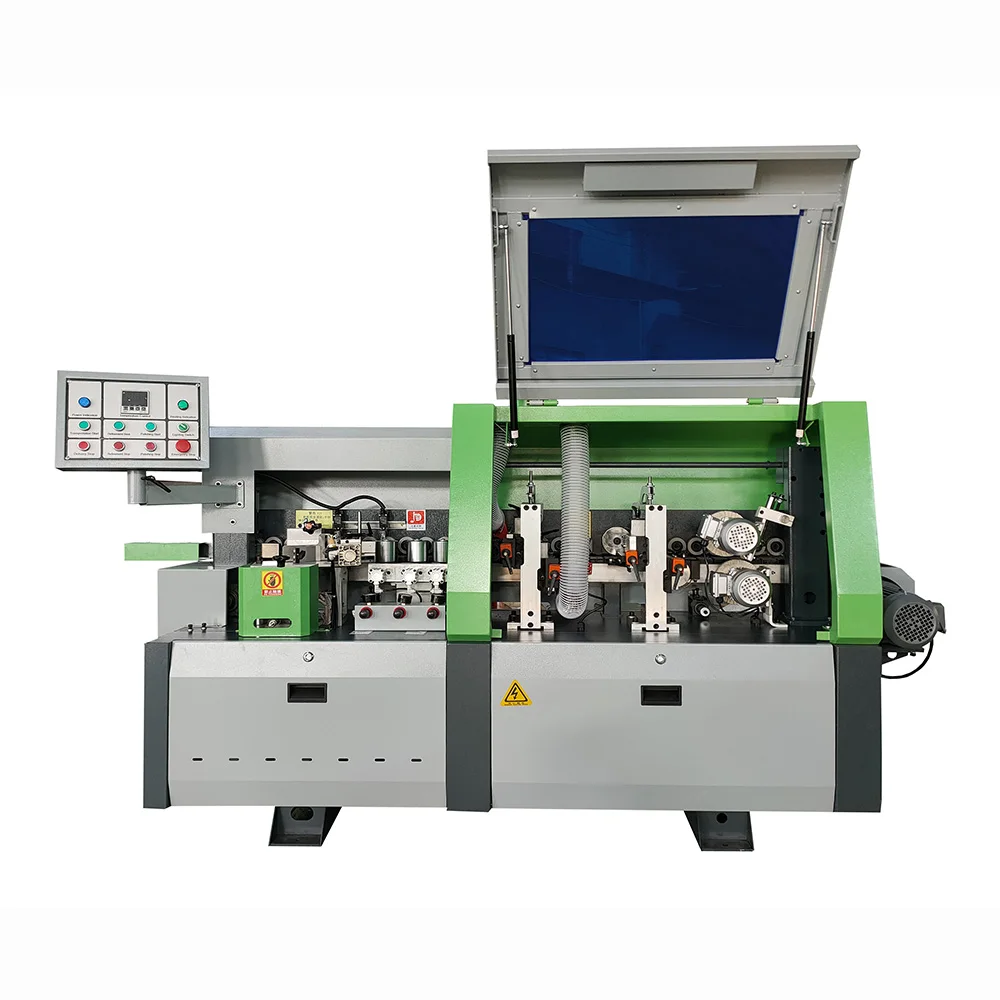
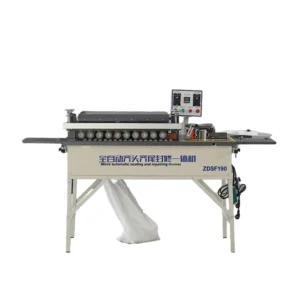
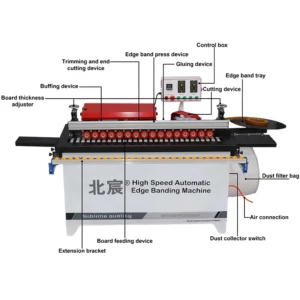
Precision-ground assembly — every ZDSF515 manual edge bander leaves the Ningjin line only after a four-stage inspection covering incoming material verification, in-process dimensional checks, finished-product functional testing, and pre-shipment validation with your actual edge banding stock.
Technical Specifications
| Parameter |
Value |
| Model |
ZDSF515 |
| Product Type |
Manual Edge Banding Machine |
| Main Functions |
Gluing, Fine Trimming, Scraping, Buffing |
| Voltage & Power |
380V (configurable from 110V to 440V for OEM orders) |
| Rated Power |
4 kW |
| Working Pressure |
0.65 MPa |
| Conveyor Belt Speed |
0–16 m/min |
| Min. Panel Width |
60 mm |
| Min. Panel Length |
150 mm |
| Panel Thickness Range |
10–60 mm |
| Edge Thickness Range |
0.4–3 mm |
| Overall Dimensions (L×W×H) |
2480 × 700 × 1400 mm |
| Net Weight |
600 kg |
| Motor Output |
3 HP |
Application Suitability
| Application |
Material or Output |
| Small-batch cabinet door edging |
MDF and particleboard panels with 0.4–1 mm PVC edge band |
| Custom joinery workshop production |
Plywood and blockboard panels with veneer edge band up to 3 mm |
| Solid wood furniture component finishing |
Solid wood panels with pre-glued or hot-melt adhesive PVC strips |
| Prototype and sample runs for furniture factories |
Mixed substrate test panels for glue temperature and feed speed calibration |
Why the Voltage Question Should Come Before the Price
A machine that cannot run on local power is a machine that never runs. [NEED_CITE: voltage and frequency standards by export market]
I once watched a container of edge banders arrive at a Southeast Asian port with 380V/50Hz motors, only to find the buyer’s workshop ran on 220V/60Hz. The units sat idle while step-down transformers were sourced locally — a cost the buyer had never budgeted for. When a manual edge banding machine factory quotes you without first asking about your local grid, the problem surfaces on your shop floor, not theirs. That is why voltage configuration — from 110V single-phase to 440V three-phase — is locked in before production begins on every ZDSF515, not patched afterward.

Component Sourcing and Assembly Discipline
The ZDSF515 manual edge banding machine starts with precision-ground linear guides and hardened steel trimming blades sourced from verified supply partners. Each incoming batch undergoes dimensional verification before release to the assembly floor, so tolerance stacking across the glue pot, feed rollers, and trimming station stays within spec. Assembly technicians follow a fixed sequence — frame alignment, conveyor tensioning, glue pot calibration, then functional test — rather than building in ad hoc order. This matters because a manual edge bander relies on operator feel; if the conveyor belt tracks unevenly or the glue roller runs hot in one zone, the operator compensates by hand, introducing the very inconsistency the machine was meant to remove.
Four-Stage Quality Control Before Crating
In-process checks happen at the frame, the drive train, and the trimming station before the machine is assembled as a whole. Once complete, each ZDSF515 runs a panel of MDF, particleboard, and plywood through the full gluing-trimming-scraping-buffing sequence. Inspectors measure edge overhang, glue-line visibility, and surface finish against the tolerance target. Pre-shipment verification repeats the run with the buyer’s actual edge banding material — PVC, veneer, or recycled-content strip — because glue temperature and feed speed behave differently across substrates. [NEED_CITE: CE machinery directive requirements for industrial equipment] A machine that looks fine on standard stock can produce visible glue lines on recycled PVC, and catching that before dispatch saves days of on-site rework.
Reading the Specs That Actually Matter
The 10–60 mm panel thickness range means the ZDSF515 handles everything from thin 10 mm MDF shelf stock up to 60 mm solid wood worktops, but the operator must adjust the top pressure beam for each thickness to prevent panel chatter during trimming. Conveyor belt speed of 0–16 m/min is a manual feed machine’s real throughput governor — running at the upper end with 3 mm veneer edge band requires a steady operator hand and well-tuned glue temperature, while slower feed suits thicker PVC on curved or awkward panels. Working pressure at 0.65 MPa drives the pneumatic trimming and scraping cylinders; drop below 0.5 MPa and the trim blades leave ridges, go above 0.8 MPa and you risk chipping brittle PVC. The 600 kg net weight anchors the frame against vibration when an operator pushes oversized panels through, reducing the drift that causes edge wander on lighter machines.
The Cost of Skipping the Material Test Run
When a distributor accepts a machine tested only on the factory’s standard PVC stock, the first complaint from their end customer usually arrives within a week. Recycled-content edge band melts at a different temperature, bonds differently, and trims with a different chip pattern. [NEED_CITE: substrate-specific glue temperature calibration for PVC and veneer edge banding] I have seen a workshop spend three full production days adjusting glue pot settings, feed speed, and trim blade angles that should have been pre-set before the machine left our floor. For an OEM partner or regional distributor, that rework cost is invisible to you but very visible to your customer — and it erodes the trust your brand is built on.
What Manufacturing Depth Means for Your Order
Our in-house precision grinding stations mean critical components — conveyor rollers, trim blade holders, pressure beam rails — are finished on-site rather than outsourced to a job shop with its own tolerance agenda. The patented cutting mechanism used across our edge bander family delivers consistent trim quality whether the unit carries our nameplate or yours. Voltage, control panel language, and specification changes are handled as standard production variants, not special engineering requests, so an OEM run of twenty units with private-label branding and Portuguese control panels ships on the same schedule as a single stock order. Every unit is traceable by serial number back through its QC records, giving your service team a reference point when field issues arise months after installation.
Documentation & Verification
- CE declaration of conformity covering the ZDSF515 manual edge bander’s electrical and mechanical safety
- ISO 9001 certificate for the manufacturing system under which this unit was built
- Factory test record using your specified panel thickness and edge banding material before dispatch
- Electrical schematic with confirmed voltage and frequency for your target market
- Operation and maintenance manual written in the language your operators will read
- Spare parts list with part numbers cross-referenced to the ZDSF515 assembly
Installation, Commissioning & Support
- Requires a level concrete floor and 2480 × 700 mm clear footprint plus operator access space on both sides
- Dedicated 4 kW circuit at the confirmed voltage with appropriate breaker rating and earth bonding
- Machine ships as a single unit; conveyor and pressure beam alignment verified at the factory before crating
- First-run commissioning includes glue pot temperature mapping across your edge banding material range
- Operator training covers feed technique, trim blade adjustment, and daily glue pot cleaning for the 0–16 m/min speed range
- Pneumatic system requires clean, dry air at 0.65 MPa with a filter-regulator-lubricator unit installed upstream
Before You Send the Inquiry
Tell us your target market’s voltage and frequency, the panel substrates and edge banding materials your customers actually use, and whether you need OEM branding or a private-label package. If you are evaluating manufacturing capacity for a volume order, share your target order size and delivery window so we can map it against the production schedule. For OEM partners, specify the control panel language, documentation language, and any packaging or labeling requirements so these are built into the quotation from the start rather than added as change orders later.
Frequently Asked Questions
Q: Can we visit the factory and audit the ZDSF515 manufacturing and QC process?
A: Factory visits are open to distributors and OEM partners. You can walk the assembly line, inspect the precision grinding stations, review QC records for any serial number in production, and witness a live test run using your own edge banding material. We recommend scheduling the visit to coincide with a pre-shipment test on your order so you see the exact units you are buying.
Q: What OEM and private-label customization is available for this manual edge bander?
A: We apply your logo to the machine body, customize the control panel language, adjust voltage and plug configuration to your market, and produce private-label packaging. Documentation — manuals, schematics, test records — is issued in your brand name. These are standard production options, not custom engineering projects, so they do not add lead time beyond the normal production cycle.
Q: How do you adapt voltage and frequency for different export markets?
A: The ZDSF515 is built to accept motor and control configurations from 110V to 440V, single or three-phase, at 50 or 60 Hz. Voltage and frequency are confirmed during the quotation stage and locked before assembly begins. The electrical schematic shipped with the machine reflects the exact configuration installed, supporting local compliance inspections and customs clearance.
Q: What documentation comes with each machine for compliance and customs?
A: Each ZDSF515 ships with a CE declaration of conformity, ISO 9001 manufacturing certificate, factory test record, electrical schematic matching the installed voltage, operation manual in the agreed language, spare parts list, and packing photographs. Additional customs or import documentation is prepared based on the destination country’s requirements.
Q: How is production lead time managed for distributor volume orders?
A: Single units ship from stock or within a short production cycle. Volume orders for distributors or OEM partners are scheduled into the production plan once specifications and branding are confirmed. We provide a milestone timeline covering assembly, in-process QC, pre-shipment testing, and crating so you can plan your shipping and customs clearance accordingly.