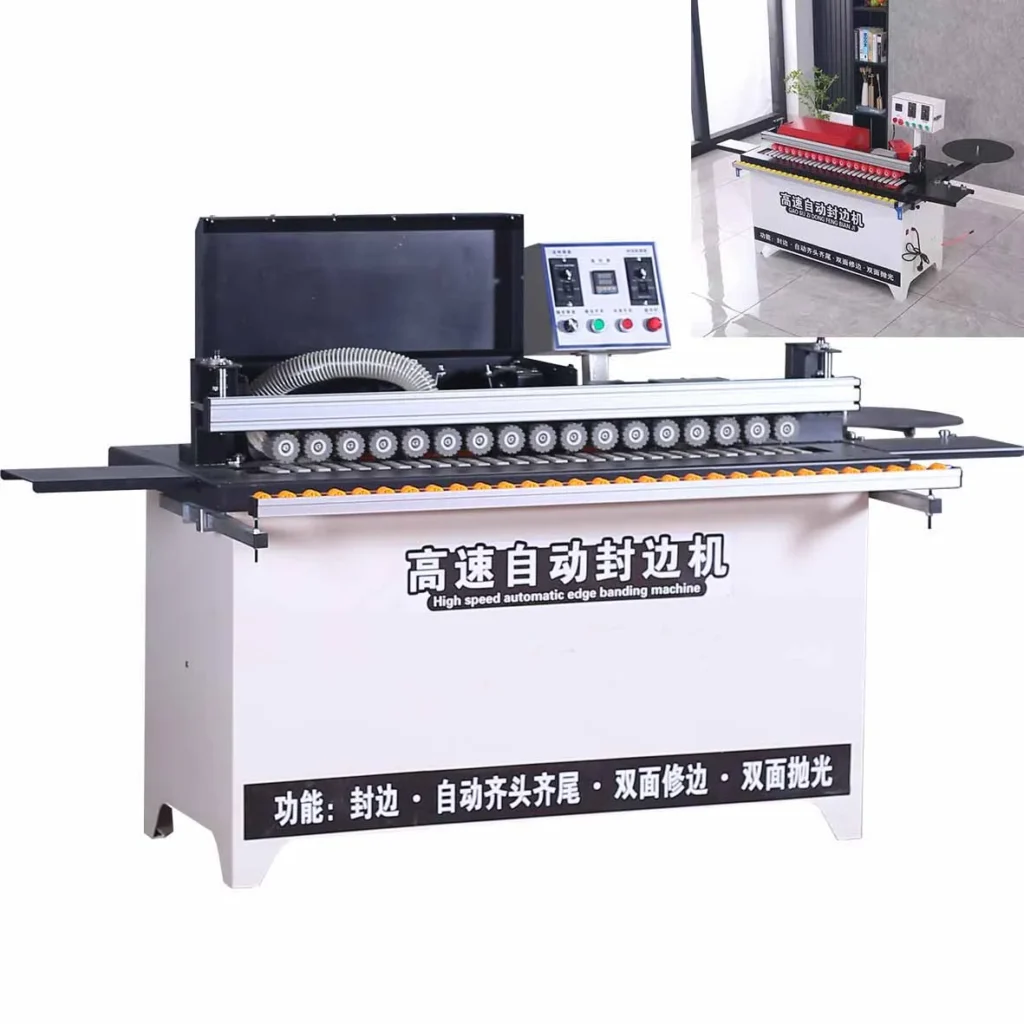
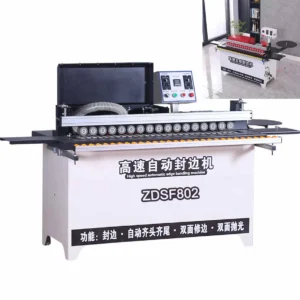
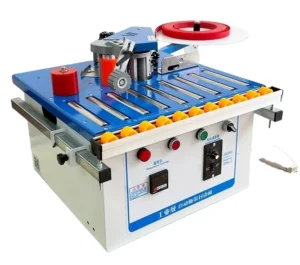
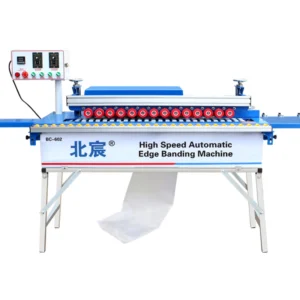
Precision-ground trimming assemblies — factory-verified edge tolerance on every 802 portable edge bander before it leaves the production floor, with OEM configuration built into the assembly workflow.
Technical Specifications
| Parameter |
Value |
| Model |
802 |
| Product Type |
Semi Automatic Portable Edge Banding Machine |
| Edge Type |
Straight line |
| Rated Voltage |
220V |
| Rated Power |
4 kW |
| Trimming Power |
800W × 2 |
| Polishing Power |
180W × 2 |
| Suction Power |
1200W |
| Heating Power |
1000W (heat-up 5–10 min) |
| Feed Speed |
0–10 m/min |
| Conveyor Belt Speed |
0–10 m/min |
| Strip Thickness Range |
0.5–2.5 mm |
| Sheet Thickness Range |
10–50 mm |
| Glue Pot Capacity |
4000 ml |
| Rated Air Pressure |
0.4–0.6 MPa |
| Pressure Beam |
One-piece integrated, double rows of pressure wheels |
| Conveyor Belt Material |
Silicone (anti-scratch) |
| Belt Breaking Method |
Pneumatically controlled |
| Trimming Configuration |
Double high-speed motors, up and down |
| Polishing Configuration |
Up and down two motors |
| Support Feature |
Extendable fluent strips for large plate stability |
| Control Panel |
Digital display of glue pot temperature, independent switches |
| Overall Dimensions |
130 × 65 × 75 cm |
| Machine Weight |
150 kg |
| Warranty |
One year |
Application Suitability
| Application |
Material or Output |
| Custom cabinet door edging |
MDF and particleboard with PVC strip |
| Small-batch furniture panel finishing |
Plywood and melamine-faced board |
| Workshop straight-line edge banding |
Solid wood panels up to 50 mm thick |
| Component edging for shelving and carcasses |
Wood-based panels with 0.5–2.5 mm PVC |
Why Voltage Confirmation Must Happen Before the Order Ships
A Semi Automatic Portable Edge Banding Machine wired for the wrong frequency will overheat the glue pot and burn out the trimming motors within the first production week.
I watched a Middle East customer spend four full days re-tuning glue temperature and pressure-wheel force because the strip material was recycled PVC, not the virgin compound we tested at the factory. The machine itself was fine; the process parameters were wrong for his actual input. That is the kind of mismatch that never shows up on a spec sheet [NEED_CITE: voltage and frequency standards by export market]. When a portable edge bander arrives with incorrect voltage, the heating element draws uneven current, the digital temperature display fluctuates, and operators blame the machine rather than the power supply.

How the 802 Is Assembled for OEM and Private-Label Buyers
Every Semi Automatic Portable Edge Banding Machine in the 802 series starts on the same assembly line, but the configuration branches early. The pressure beam is machined as a single piece, then fitted with double rows of silicone pressure wheels matched to the buyer’s panel surface sensitivity. OEM partners can specify custom logo placement on the housing, select control-panel language overlays, and choose voltage winding from 110V to 440V before the electrical cabinet is closed. This means a distributor ordering ten units for three different markets receives machines that are already differentiated at the component level, not relabeled after the fact.
Four-Stage Quality Control Inside the Factory
Incoming steel plate and aluminum extrusion are measured before they enter the machining cell. During assembly, each trimming motor is test-run under load to confirm runout stays within tolerance. The finished 802 then enters a pre-shipment verification stage where actual PVC strip is fed through the machine at production speed, and the trimmed edge is inspected for chipping or residual glue lines. Only after the factory test record is signed does the unit move to packing [NEED_CITE: CE machinery directive requirements for industrial equipment]. This sequence catches the kind of tolerance drift that would otherwise surface only when panels reach the assembly bench.
Reading the Specs That Actually Affect Edge Quality
The 4000 ml glue pot capacity means the operator can run a full morning shift without pausing to refill adhesive, which matters when the heating element must stay at a stable temperature to bond consistently. Feed speed range of 0–10 m/min lets the operator slow down for thick 2.5 mm PVC and speed up for thin veneer strips, keeping glue coverage uniform across different strip thicknesses. The double high-speed trimming motors, mounted in an up-and-down arrangement, cut the leading and trailing overhang in a single pass, so the panel exits the machine with both ends clean rather than requiring a second manual trim. Pneumatically controlled belt breaking applies consistent force to sever the strip, eliminating the ragged edge that a manual cutter leaves when the operator fatigues mid-shift. The 1200W suction motor pulls trim waste and sanding dust away from the polishing zone, keeping the silicone conveyor belt free of debris that could scratch the next panel surface.
The Hidden Cost of Skipping the Factory Sample Test
Buyers who approve a machine on spec alone often discover that their local PVC strip formulation melts at a different temperature than the standard test compound. The glue pot reads the set-point correctly, but the adhesive viscosity is wrong, producing visible glue lines along the panel edge. Pressure-wheel marks appear when the silicone compound reacts to a recycled strip’s surface texture. These issues are solvable — they require adjusted temperature profiles and pressure settings — but diagnosing them on the customer’s floor costs days of lost production [NEED_CITE: edge bonding failure modes in wood panel processing]. A sample processing test at the factory using the buyer’s own strip material prevents this entire sequence.
Why Manufacturing Depth Matters for This Machine Class
In-house machining of the pressure beam means we control flatness tolerance before assembly, rather than accepting a supplier’s off-the-shelf extrusion. Patented cutting mechanisms in the trimming station are built and inspected on the same floor where the 802 is assembled, so a tolerance issue is corrected in hours, not weeks. Voltage and language customization is handled during production, not retrofitted after the machine is complete. Pre-shipment verification includes running the buyer’s specified strip material and documenting the result. OEM partners receive full electrical schematics and private-label artwork integration as part of the standard build process, not as a surcharge.
Documentation & Verification
- CE declaration of conformity covering the 802 portable edge bander
- Electrical schematic confirming your destination voltage and frequency
- Factory test record on your PVC strip and panel thickness before dispatch
- Packing photographs showing crate blocking and moisture protection
- ISO 9001 certificate available for import clearance documentation
Installation, Commissioning & Support
- Requires a dedicated 220V circuit rated for 4 kW continuous draw with proper grounding
- Pneumatic supply must deliver 0.4–0.6 MPa clean, dry air to the belt-breaking cylinder
- Extendable fluent strips must be leveled on-site to match conveyor height for large panels
- Glue pot heat-up takes 5–10 minutes; first-run parameters logged during commissioning
- Silicone conveyor belt inspected for flatness; tracking adjusted before operator training begins
- Spare trimming blades and polishing wheels shipped with the unit for immediate replacement stock
What to Include in Your Inquiry
Provide the PVC or veneer strip specification you will actually run, including thickness range and whether the compound is virgin or recycled material. Confirm your workshop voltage and frequency so the motor winding and heating element are configured correctly at the factory. If you have existing upstream panel saws or downstream boring machines, note their feed height and throughput so the 802 is positioned to match your line without bottleneck or overcapacity.
Frequently Asked Questions
Q: How is edge banding tolerance verified during factory QC, and can I receive the test record?
A: Each 802 runs a production-speed test with your specified strip material before packing. Trimming edges are measured for chipping and residual overhang. The signed factory test record, including photographs of the finished edge, is included in the shipment documentation so you can verify tolerance without waiting for on-site commissioning.
Q: What voltage and frequency configurations are available for my destination market?
A: The 802 can be wound for voltages between 110V and 440V, matched to your local frequency. The electrical schematic and voltage confirmation document are prepared during production and shipped with the machine, ensuring your electrician can connect and certify the circuit without guesswork.
Q: What is the scope of OEM customization available on this machine?
A: OEM partners can specify logo placement on the housing, custom color on painted surfaces, control-panel language overlays, and private-label documentation. All customization is integrated during assembly, so the machine leaves the factory as a finished, branded product rather than a relabeled unit.
Q: Can I send my own PVC strip for a sample processing test before ordering?
A: Yes. Send a roll of your actual strip material to the factory, and we run it through the 802 at production feed speed. You receive video of the process and photographs of the trimmed edge, allowing you to confirm glue-line quality and pressure-wheel finish before committing to a production order.
Q: What spare parts ship with the machine, and how fast can I get replacements?
A: The 802 ships with spare trimming blades, polishing wheels, and silicone belt sections. Replacement parts are manufactured on the same production floor, so replenishment lead times are measured in days rather than months, keeping your workshop running without extended downtime.