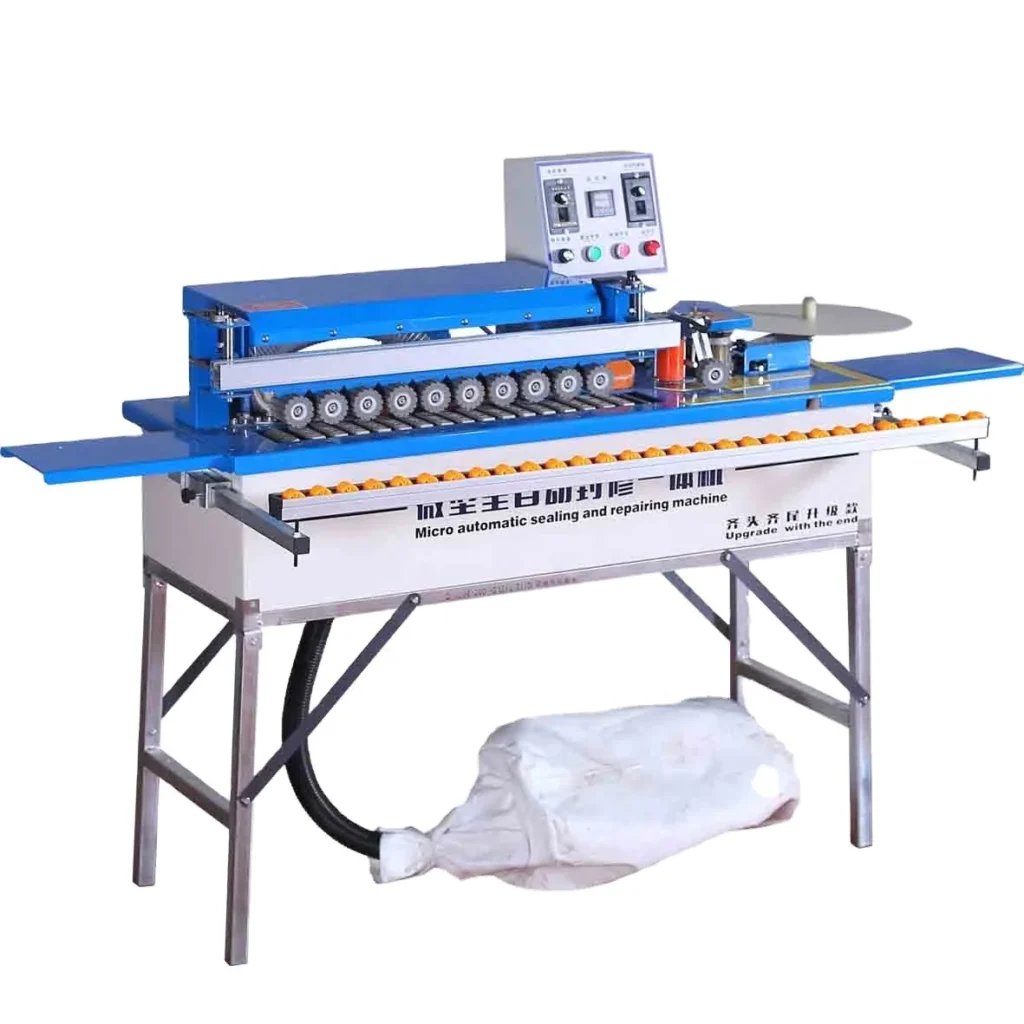
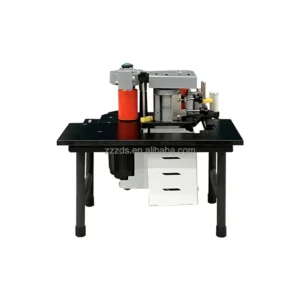
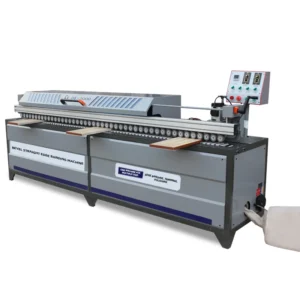
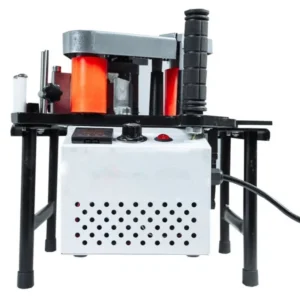
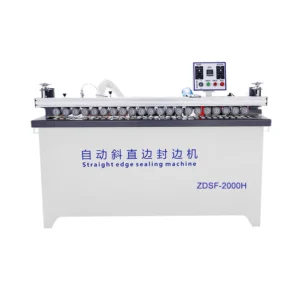
In-house manufacturing with verified component traceability — every straight-and-curved edge bander leaving our Shandong facility carries a four-stage QC record from raw steel inspection through pre-shipment electrical verification.
Technical Specifications
| Parameter |
Value |
| Product Type |
Automatic Edge Banding Machine (Straight and Curved Edge) |
| Voltage |
220V (frequency and phase to be confirmed per destination market) |
| Total Connected Load |
Suction 1200W, Belt 25W, Transmission 60W, Polishing 180W × 2, Trimming 800W × 2 |
| Conveying Speed |
0–15 m/min |
| Edging Speed |
0–6 m/min |
| Edge Height Range |
10–60 mm |
| Edge Thickness Range |
0.3–3 mm |
| Gluing Method |
Double-sided adhesive application |
| Gluing Device Rotation |
180° for curved edge banding |
| Board Feeding |
Automatic, double-row rubber pressure wheels |
| Trimming Configuration |
Up and down trimming motors with integrated dust suction |
| Polishing Configuration |
Cross polishing up and down, dual 180W motors |
| Control Panel |
Individual function controls (PLC or relay logic to be confirmed) |
| Overall Dimensions |
120 × 54 × 72 cm |
| Net Weight |
81 kg (source value — verify against manufacturer catalog) |
| Assembly State |
Partially assembled, some components require user assembly per manual |
Application Suitability
| Application |
Material or Output |
| Custom cabinet and wardrobe panel edge sealing |
MDF, particleboard, and plywood with PVC or veneer banding |
| Curved furniture component finishing |
Shaped solid wood panels and radiused MDF substrates |
| Small-to-medium joinery workshop production |
Mixed straight and curved board runs in a single shift |
| Transition from manual to semi-automated edging |
Workshops upgrading from handheld trimmers to conveyor-fed processing |
| Prototype and short-run furniture manufacturing |
Flexible batch sizes with quick banding material changeover |
Why Voltage Confirmation Must Happen Before the Quotation
An edge bander built for the wrong electrical standard is dead weight on your workshop floor until a transformer arrives.
Last year I watched a fully functional unit sit idle in a Middle Eastern factory for three weeks because the frequency mismatch was discovered only after the crate was opened. The buyer had panels stacked and waiting. That delay was entirely avoidable with one photograph of the local distribution board. When sourcing an Automatic Edge Banding Machine OEM factory, the first document exchanged should never be a price list — it should be your facility’s voltage, phase, and frequency specification in writing [NEED_CITE: voltage and frequency standards by export market].
Component Sourcing and Precision Grinding Depth
An Automatic Edge Banding Machine OEM factory that controls its own machining can hold tolerances that trading companies simply cannot guarantee. The trimming stations on this unit use proprietary cutter mechanisms that are precision-ground in-house, which directly affects how cleanly PVC and veneer banding terminates at the panel edge. When the grinding is outsourced, the factory has limited recourse if a batch of trimmers arrives with inconsistent runout. In-house production means every trimming motor mount and pressure wheel shaft is inspected before it reaches the assembly bench.
Four-Stage Quality Control from Steel to Crate
Incoming material inspection catches alloy inconsistencies before they become weak trimmer shafts. In-process checks verify that the 180° gluing device rotates without binding under load. Finished product testing runs actual MDF and particleboard panels through the full conveying speed range. Pre-shipment verification confirms that the control panel language, voltage wiring, and dust suction function all match the purchase order — not just the standard build [NEED_CITE: CE machinery directive requirements for industrial equipment].
What the Speed and Power Numbers Mean on the Shop Floor
The 0–15 m/min conveying speed range paired with independent 0–6 m/min edging speed control lets operators tune feed rate separately from banding application rate. This matters when switching between thin 0.3 mm PVC on particleboard and thicker 3 mm veneer on solid wood — the panel can move at a steady pace while the edge application slows for heavier materials. Dual 800W trimming motors provide sufficient torque for clean flush cuts on dense MDF without stalling, and the integrated dust suction at each trimming station keeps offcuts from interfering with downstream polishing. The 180° rotatable gluing device eliminates the need for a separate curved-edge machine, which is a meaningful floor-space saving for workshops running both straight cabinet sides and shaped door panels in the same production area.

The Real Cost of Skipping Factory Verification
Buying on specification sheets alone means you discover tolerance drift only when assembled cabinet doors show uneven gaps. A machine that runs fine on the test bench may behave differently after ocean freight vibration loosens unverified fasteners. Without a documented pre-shipment test on your actual panel thickness range, you are commissioning the equipment blind [NEED_CITE: edge banding tolerance impact on furniture assembly]. Workshops that skip this step often spend their first week chasing glue line issues that a factory test would have surfaced before the machine was crated.
Why Source This Equipment Directly from the Factory
In-house manufacturing means OEM branding, private-label control panel overlays, and custom voltage wiring are handled on the same assembly line — not farmed out to a third party. The 110V to 440V voltage range is configurable as a standard option, not a special engineering request. Multilingual control panels are available so operators read instructions in their working language from day one. Engineer-led configuration recommendations arrive within one working day, based on your panel dimensions and production volume rather than a generic catalog push. Factory visits are welcomed for direct inspection of precision grinding, assembly depth, and component sourcing.
Documentation & Verification
- Factory test record run on your specified panel thickness and edge banding material before dispatch
- Electrical schematic confirming voltage, phase, and frequency match your facility supply
- CE declaration of conformity and ISO 9001 certificate available on request for this model
- Operation and maintenance manual provided in your agreed language
- Spare parts list with OEM part numbers for trimming cutters, pressure wheels, and polishing pads
Installation, Commissioning & Support
- Requires a dedicated 220V circuit sized for the total connected load of all six motor groups
- Partially assembled on arrival — gluing device and dust suction ducting require field assembly per video guide
- First run calibration covers conveying speed, trimming depth, and polishing pressure on your actual panel stock
- Double-row rubber pressure wheels should be inspected weekly for wear and replaced as a matched set
- Dust suction ports must connect to a collection system rated for the 1200W suction motor output
What to Include with Your Inquiry
To receive a configuration recommendation and formal quotation, provide your primary panel materials (MDF, particleboard, plywood, or solid wood), the edge banding materials and thickness range you run most often, and a photograph of your workshop electrical panel showing voltage and frequency. If you are evaluating this as part of a larger production line, include your upstream cutting equipment model and your target daily panel throughput so the feed speed can be matched accordingly.
Frequently Asked Questions
Q: What OEM and private-label customization is available for distributors?
A: Logo placement on the machine body and control panel, custom color schemes, private-label documentation, and tailored electrical specifications are all handled on the same assembly line. Voltage is configurable from 110V to 440V, and control panel language is set to your market requirement before the machine leaves the factory.
Q: How do you confirm voltage and frequency before manufacturing begins?
A: We request a photograph of your facility distribution board and written confirmation of voltage, phase, and frequency. The electrical schematic is then built to match, and the wiring is verified during the pre-shipment test so the machine powers on correctly when it arrives at your workshop.
Q: What does the four-stage QC process cover for this edge bander?
A: Incoming inspection checks raw materials and purchased components. In-process verification covers precision grinding and assembly alignment. Finished product testing runs actual panels through the full speed range. Pre-shipment verification confirms voltage, language, dust extraction, and trimming quality against your purchase order specifications.
Q: Can I visit the factory to inspect manufacturing depth?
A: Factory visits are welcomed at our Shandong facility. You can observe precision grinding of trimming mechanisms, component sourcing verification, assembly line practices, and the pre-shipment testing process. Visits can be scheduled around your sourcing trip itinerary.
Q: What spare parts backup is available for distributor service teams?
A: A complete spare parts list with OEM part numbers ships with every machine. Distributor service teams receive technical training covering trimming motor replacement, pressure wheel adjustment, and gluing device maintenance. Ongoing parts supply is supported directly from the factory inventory.