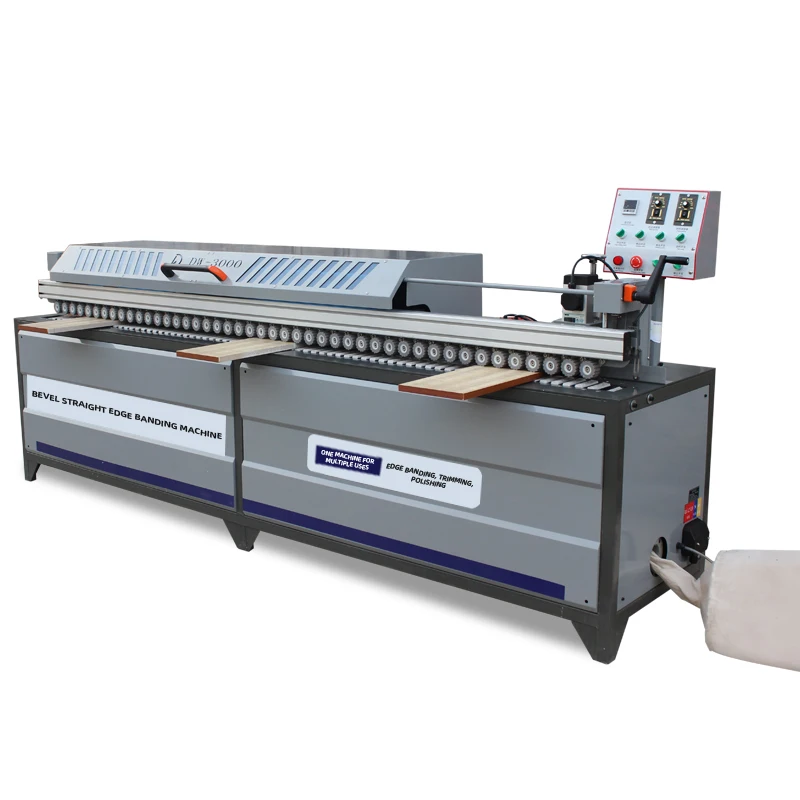
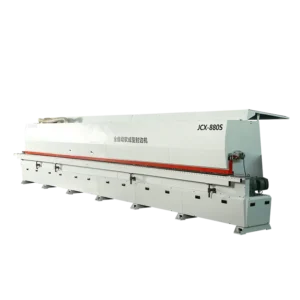
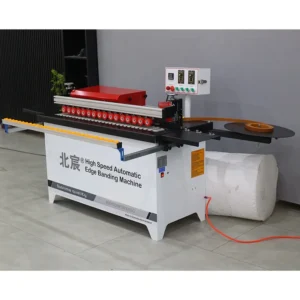
Precision-ground mechanisms — Each DW3000 edge banding machine undergoes four-stage quality verification before leaving our Ningjin facility, ensuring distributor partners receive units ready for immediate regional deployment.
Technical Specifications
| Parameter |
Value |
| Model |
DW3000 |
| Product Type |
Automatic Edge Banding Machine |
| Total Installed Power |
11 kW |
| Voltage & Frequency |
380V / 415V (frequency to be confirmed per destination market) |
| Feed Speed |
0–12 m/min |
| Panel Thickness Range |
0.3–3 mm edge banding thickness |
| Panel Height Range |
Up to 50 mm |
| Minimum Sheet Dimension |
300 mm length × 150 mm width (basis to be confirmed for panel thickness) |
| Overall Dimensions (L×W×H) |
299 × 65 × 130 cm |
| Net Weight |
430 kg |
| Pre-milling Motor |
2.2 kW |
| Trimming Motors |
2.2 kW × 2 (spindle type) |
| Polishing Motors |
0.4 kW × 2 |
| Heating System |
2.2 kW × 2 (double heat gun design) |
| Glue Pot Capacity |
4000 ml |
| Vacuum Power |
550 W |
| Air Supply Requirement |
0.5–0.7 MPa |
| Control Panel Language |
Chinese & English standard; Spanish and other languages customizable |
| Plug Options |
EU, USA, AU, UK |
| Working Stations |
Pre-milling, 30–90° oblique/straight edge banding, trimming, scraping, polishing |
| Certifications |
CE declaration available |
Application Suitability
| Application |
Material or Output |
| Cabinet door edge finishing |
MDF and particleboard with PVC or melamine banding |
| Custom wardrobe panel processing |
Plywood and laminated board with veneer edge strips |
| Office furniture component banding |
Chipboard with ABS or PP edge material |
| Retail fixture production |
Blockboard and finger-joint panels with solid wood edging |
| Joinery workshop batch runs |
Mixed substrate environments requiring quick changeover |
Why the Voltage Question Should Come Before the Price on Any DW3000 Edge Banding Machine Factory OEM Order
Unconfirmed electrical specifications account for a disproportionate share of commissioning delays on exported woodworking machinery.
When an edge bander arrives at a destination with 60 Hz mains and the motor nameplate reads 50 Hz only, the entire production floor waits while engineers scramble for replacement variable frequency drives. I once spent three weeks rebuilding an electrical cabinet overseas because the local grid frequency was never verified before shipment. The DW3000 edge banding machine factory OEM program addresses this by requiring voltage, phase, and frequency confirmation at the quotation stage — not after the crate is nailed shut [NEED_CITE: voltage and frequency standards by export market].
Distributors who skip this step frequently discover that standard 380V/50Hz configurations will not start under 415V/60Hz conditions common in parts of Southeast Asia and South America. The double heat gun system and spindle trimming motors each draw significant current; an incompatible supply causes thermal overload trips within the first hour of operation. Confirming local electrical parameters before production begins eliminates this entire failure mode.

Sourcing Depth That Distributors Can Actually Verify
The DW3000 is manufactured entirely in-house, from the pre-milling spindle housing to the pressure wheel assemblies. This means a distributor evaluating our DW3000 edge banding machine factory OEM capability can visit the precision grinding area and inspect the same components that will ship in their branded units. Private label partners gain access to the production floor, not just a showroom.
Distributors committing to a regional supply agreement need to know the factory controls its own tolerances. The pre-milling station and trimming spindle bearings are ground and inspected on-site, giving our OEM partners confidence when their end-customers ask where critical components originate.
Configuration Flexibility Without Re-Engineering Delays
Voltage selection from 380V to 415V, plug type matching the destination market, and control panel language localization are handled as standard line options rather than special engineering requests [NEED_CITE: CE machinery directive requirements for industrial equipment]. A distributor covering multiple territories can order DW3000 units for a 220V/60Hz Central American market and a 415V/50Hz Australian market on the same production schedule.
The eight adjustable pressure wheel groups on the 30–90 degree oblique edge banding station remain identical across all voltage variants, so spare parts inventory does not fragment by destination country. This keeps the distributor’s regional warehouse lean while still meeting each market’s electrical compliance requirements.
What the Spec Sheet Actually Means on the Shop Floor
The 0–12 m/min feed speed range matters most when a workshop processes thin 0.3 mm PVC on one batch and 3 mm solid wood edging on the next. Lower feed speeds give the double heat gun system adequate dwell time to melt adhesive thoroughly on thicker banding, while higher speeds handle thin melamine strips without scorching. The 2.2 kW pre-milling motor removes saw marks from the panel edge before glue application — a station that cheaper edge banders omit entirely, leaving visible glue lines on porous particleboard.
Spindle trimming motors at 2.2 kW each, rather than standard trimming cutters, produce a cleaner shear cut on the banding overhang. This directly affects downstream assembly: panels with ragged trimmed edges will not seat flush in cabinet carcass joints. The 550 W vacuum system captures trim waste at each station, preventing chip buildup on the feed track that would otherwise degrade panel positioning accuracy over a production shift.
The Hidden Cost of Skipping Pre-Shipment Electrical Verification
When a machine arrives with an incorrect voltage configuration, the buyer faces more than a rewiring bill. Commissioning schedules slip, end-customers delay progress payments, and the distributor’s service team absorbs emergency travel costs to resolve what was a preventable documentation gap [NEED_CITE: common causes of commissioning failure in exported industrial machinery]. A unit configured correctly at the factory gate eliminates the entire cascade.
Distributors who do not request electrical schematics and frequency confirmation before production also lose leverage during warranty discussions. If a variable frequency drive fails under undocumented supply conditions, the fault attribution becomes disputed. Pre-shipment verification records protect both the factory and the regional partner.
Why Distributors Commit to This Production Program
In-house manufacturing of the pre-milling and trimming assemblies means OEM lead times depend on our own machining schedule, not on third-party supplier delays.
Four-stage quality control — incoming material, in-process, finished product, and pre-shipment verification — produces a documentation trail that distributors can present directly to their end-customers during acceptance inspections.
Voltage, language, plug type, and branding customization are priced as standard options, eliminating the quotation delays that arise when factories treat every export requirement as a custom engineering project.
CE declaration of conformity and ISO 9001 certification are issued as part of the standard shipping documentation package, not as add-on requests that hold up customs clearance.
Sample machine orders are accommodated before production-run commitments, allowing distributors to run their own substrate tests before locking in volume quantities.
Documentation & Verification
- Electrical schematic confirming voltage, frequency, and plug type for your destination market
- Factory test record running your specified panel thickness and edge banding material
- CE declaration of conformity included in customs documentation package
- ISO 9001 certificate available for end-customer compliance requirements
- Spare parts list matched to your specific configuration and language
Installation, Commissioning & Support
- Requires a dedicated 380V or 415V circuit rated for the full 11 kW load plus startup inrush
- Overall 299 × 65 × 130 cm footprint needs clearance on the infeed side for panel staging
- 0.5–0.7 MPa compressed air supply must be filtered and dried before connecting to the glue system
- 4000 ml glue pot requires first-run flushing with recommended adhesive before production panels enter
- 550 W vacuum port must connect to external dust extraction matching the port diameter specified in the manual
- Spindle trimming bearings require lubrication checks at intervals stated in the maintenance schedule
What We Need to Prepare Your Quotation
To configure a DW3000 for your market, please provide your local voltage and frequency, the plug type required by your end-customers, and the control panel language their operators will read. Share the primary panel substrates and edge banding materials your territory processes most often so we can set up a factory sample test before you commit to a production run. If you are evaluating us as an OEM partner, let us know your branding specifications and target territory so we can sequence your order alongside compatible builds.
Frequently Asked Questions
Q: What can be customized under the OEM program and what remains fixed?
A: Logo placement, machine color, control panel language, voltage, frequency, and plug type are all configurable per destination market. The core mechanical architecture — pre-milling station, spindle trimming, double heat gun system, and pressure wheel groups — remains consistent across all variants to maintain spare parts commonality.
Q: Can I order a single sample unit before committing to a distributor volume agreement?
A: Yes. Sample machines are built on the same production line as volume orders and undergo identical four-stage QC. You can specify your exact voltage, language, and substrate requirements for the sample so your evaluation reflects what your end-customers will receive.
Q: How are OEM orders sequenced against standard production builds?
A: OEM units with custom voltage and branding are scheduled alongside compatible base configurations to minimize changeover time. Typical multi-week lead times apply, and we provide a production timeline at the order confirmation stage so you can plan your import logistics.
Q: What documentation ships with each unit for customs and end-customer handover?
A: Each machine ships with a CE declaration, ISO 9001 certificate copy, electrical schematic, factory test record, operation manual in the agreed language, and a matched spare parts list. Additional documentation for specific import regulations can be arranged during the quotation stage.
Q: What technical support is available for our regional service team?
A: Distributor partners receive technical training materials covering the spindle trimming system, pressure wheel adjustment, and electrical troubleshooting. Spare parts lists are cross-referenced to your specific configuration so your warehouse stocks the correct components for the units deployed in your territory.