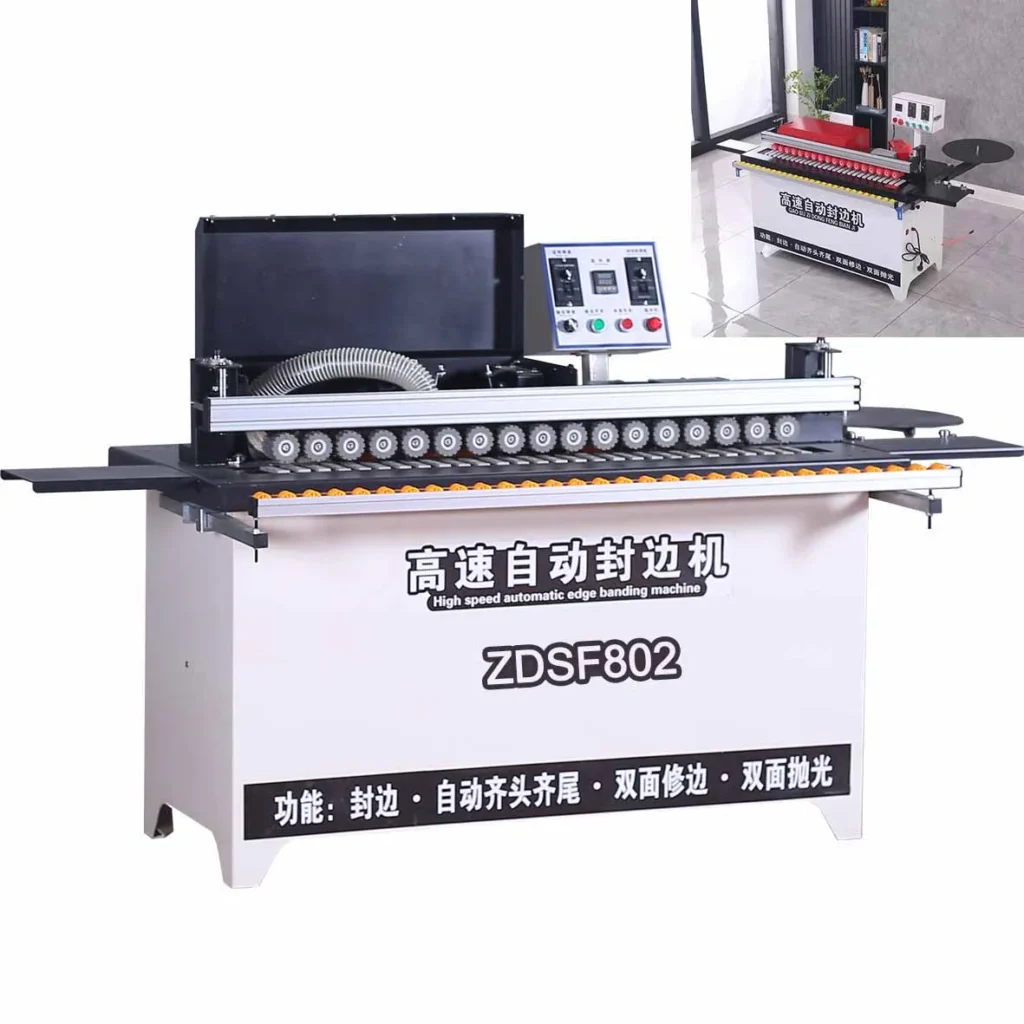
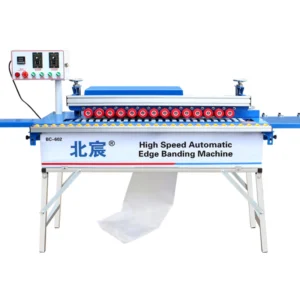
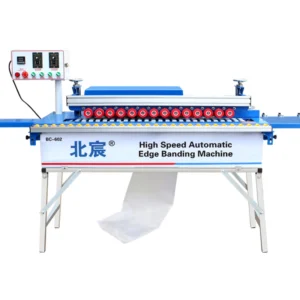
In-house manufacturing — The ZDSF802 automatic edge banding machine is built on our shop floor with proprietary cutting mechanisms, four-stage QC, and full OEM configuration from voltage to control panel language.
Technical Specifications
| Parameter |
Value |
| Model |
ZDSF802 |
| Product Type |
Automatic Edge Banding Machine |
| Edge Type |
Straight line |
| Rated Voltage |
220V (confirm frequency and phase with local supply) |
| Rated Power |
4 kW |
| Trimming Power |
800 W × 2 |
| Polishing Power |
180 W × 2 |
| Suction Power |
1200 W |
| Heating Power |
1000 W (heat-up time 5–10 min) |
| Strip Thickness Range |
0.5–2.5 mm |
| Sheet Thickness Range |
10–50 mm |
| Feed Speed |
0–10 m/min (basis not stated in source — confirm continuous or intermittent) |
| Glue Pot Capacity |
4000 ml |
| Gluing Method |
Double-sided gluing |
| Rated Air Pressure |
0.4–0.6 MPa |
| Pressure Beam |
Integrated, double-row pressure wheels, silicone conveyor belt |
| Belt Breaking Method |
Pneumatically controlled |
| Extendable Support |
Fluent strips for large plate stability |
| Overall Dimensions |
130 × 65 × 75 cm |
| Machine Weight |
150 kg |
| Control Panel |
Digital display of glue pot temperature, independent switches |
Application Suitability
| Application |
Material or Output |
| Small-scale cabinet making |
MDF and particleboard with PVC edge banding |
| Joinery workshop straight-edge processing |
Plywood panels with veneer edge banding |
| Custom furniture batch production |
Solid wood panels with PVC or veneer strips |
| Transition from manual to semi-automated banding |
Board thickness 10–50 mm, strip thickness 0.5–2.5 mm |
Why Voltage Confirmation Must Happen Before the Order Is Placed
Every ZDSF802 automatic edge banding machine ships with a signed voltage and frequency confirmation matched to the buyer’s workshop supply.
I remember a 380V edge bander we sent to a site running 415V mains. The transformer took over three weeks to arrive, and the customer’s entire workshop sat idle waiting for that one machine to power up. That kind of delay does not show up in any spec sheet, but it costs real money on a factory floor. [NEED_CITE: voltage and frequency standards by export market]
Machines quoted without confirming local electrical conditions arrive as dead weight. The ZDSF802 is configurable across a wide voltage range, and we treat the electrical schematic review as a mandatory step — not an afterthought.

How the ZDSF802 Is Built on the Factory Floor
The frame and pressure beam are machined and assembled in our own facility, which means tolerance stack-up is controlled from the first weld to the final belt tension check. The integrated pressure beam uses double-row pressure wheels with a silicone conveyor belt to reduce surface scratching on finished panels during the feed cycle.
Pneumatic belt breaking replaces manual end-trimming intervention. Each cycle triggers a controlled pneumatic cut, so the operator does not need to reach in and snap the banding strip by hand — a step that introduces inconsistency and fatigue over a long shift.
What OEM and Private-Label Partners Get from This Platform
Distributors evaluating manufacturing depth will find that the ZDSF802 supports private-label branding across the machine body, control panel, and documentation package. Logo placement, color scheme, and panel language are all configurable at the order level rather than as aftermarket modifications. [NEED_CITE: CE machinery directive requirements for industrial equipment]
The four-stage quality control process — incoming material inspection, in-process checks, finished product testing, and pre-shipment verification — applies to every unit regardless of branding. OEM partners receive the same factory test records and electrical schematics that accompany our own-brand machines, so your service team has full documentation to support field installations.
Reading the Specs That Actually Affect Panel Quality
The 4000 ml glue pot capacity is significant for workshops running multi-panel batches. A smaller pot forces the operator to stop and refill mid-run, which introduces temperature fluctuation and uneven glue application across the batch. With a 4L pot and 1000 W heating element, the ZDSF802 maintains stable melt temperature through extended runs.
The 10–50 mm sheet thickness range covers standard MDF, particleboard, and plywood used in cabinet and furniture production. Panels outside this range may not feed cleanly through the double-row pressure wheel system, so it is worth confirming your thinnest and thickest stock before ordering.
The 0.4–0.6 MPa air pressure requirement drives the pneumatic belt breaking and pressure beam actuation. Workshops with undersized compressors may experience inconsistent trimming cycles. We recommend verifying that your existing air supply can sustain this pressure under continuous operation alongside other pneumatic tools on the floor.
The Cost of Skipping Configuration Details at Order Time
A machine that arrives with the wrong voltage is the obvious failure, but subtler mismatches cause ongoing production headaches. Control panels in a language the operator cannot read mean every parameter adjustment requires a phone call or a translated sticky note on the display. Feed speed settings that are not matched to your panel material and edge strip thickness result in either glue starvation at high speed or burn marks at low speed. [NEED_CITE: common causes of edge banding adhesion failure in panel processing]
Single machines purchased without considering upstream and downstream equipment can create bottlenecks. If your sliding table saw outputs panels faster than the ZDSF802 can edge-band them at its rated feed speed, work-in-progress piles up on the floor — a problem that does not appear until the first week of production.
Why Sourcing This Machine Directly from the Factory Matters
Proprietary cutting mechanisms are machined and inspected in-house, not outsourced to a third-party integrator. This gives us control over the trimming tolerance that determines whether your panels assemble cleanly or require rework at the joinery bench.
Voltage, language, and specification customization are treated as standard order parameters, not special requests. Every ZDSF802 leaves the factory with a confirmed electrical schematic, an operation manual in the agreed language, and a pre-shipment test record run on material matching your specification.
Our facility holds ISO 9001 and CE certification, and we welcome factory visits for buyers who want to inspect the assembly line and QC stations before placing an order. Engineer-led configuration recommendations are provided with a formal quotation, so you have a documented basis for comparing this machine against alternatives.
Documentation & Verification
- CE declaration of conformity covering the ZDSF802 automatic edge banding machine
- ISO 9001 certificate for the manufacturing quality management system
- Electrical schematic with voltage and frequency confirmed against your site supply
- Factory test record on your specified panel material and thickness range before dispatch
- Operation and maintenance manual in the agreed language with illustrated spare parts list
Installation, Commissioning & Support
- Requires a dedicated circuit matching the confirmed voltage rating and 4 kW total power draw
- Air compressor must sustain 0.4–0.6 MPa at the machine inlet under continuous cycling
- Overall footprint of 130 × 65 × 75 cm fits standard workshop bays; confirm access door clearance for delivery
- Extendable fluent strips require additional lateral space when processing large-format panels
- Glue pot heat-up takes 5–10 minutes from cold start; factor this into daily shift startup routines
- Pneumatic belt breaking mechanism should be inspected for seal condition during quarterly maintenance
What to Include in Your Inquiry
Provide your panel material types, thickness range, and the edge banding strip specifications you run most frequently. Include your workshop voltage, phase, and frequency so we can confirm the electrical configuration before quoting.
Let us know your typical batch volumes and whether the ZDSF802 will operate as a standalone station or within a larger production line. If you require OEM branding or a specific control panel language, include those details so the engineer-led configuration proposal covers your full requirement.
Frequently Asked Questions
Q: What OEM and private-label customization is available for the ZDSF802?
A: Logo placement on the machine body, custom color schemes, multilingual control panels, and documentation packages in the buyer’s language are all configurable at the order level. Voltage is matched to your local supply from 110V to 440V. Each customization is documented in the formal quotation and confirmed before production begins.
Q: How is trimming tolerance verified before the machine ships?
A: Every ZDSF802 undergoes a pre-shipment test run using panel material matching the buyer’s specification. The factory test record documents trimming results, glue adhesion, and feed stability across multiple cycles. Buyers may request sample panels from the test run or arrange a factory visit to witness the verification in person.
Q: What is the typical lead time from order confirmation to dispatch?
A: Lead time depends on the level of OEM customization and current production scheduling. Standard configurations with voltage and language customization follow typical multi-week lead times. We provide a confirmed dispatch date in the order acknowledgment so you can plan workshop installation around a known timeline.
Q: Which spare parts are included, and what should I order for the first year?
A: Each machine ships with a standard spare parts list documented in the operation manual. Wear items such as pressure wheel surfaces, trimming blades, and pneumatic seals are the most common first-year replacements. We recommend discussing your expected annual running hours with our engineering team to size a spare parts package accordingly.