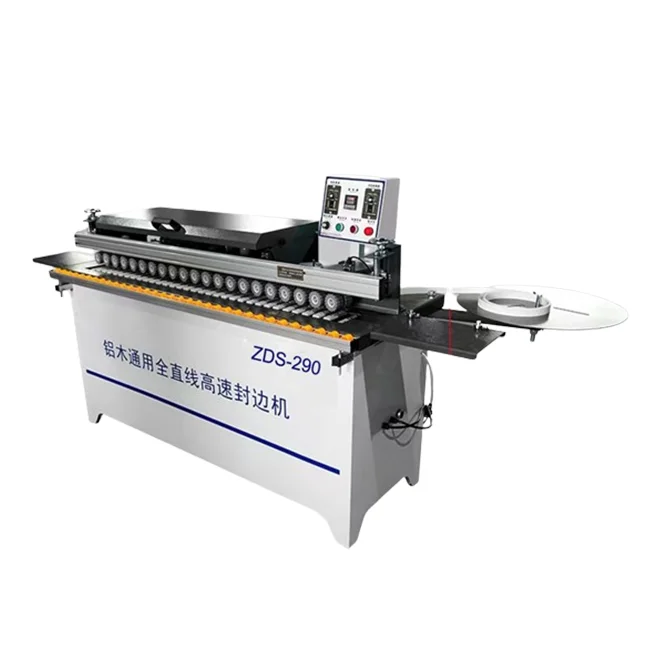
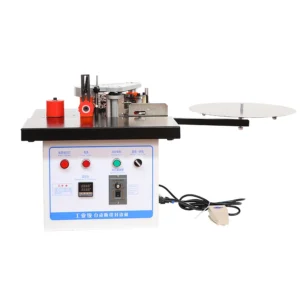
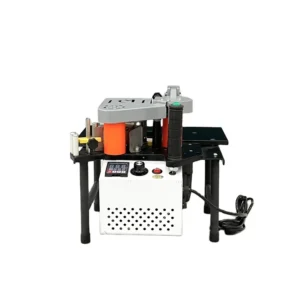
Precision-ground components — every ZDS290 frame undergoes multi-stage inspection before assembly, ensuring the thickened aluminum alloy pressure beam seats true and holds clamping consistency across the full 10-50mm panel range.
Technical Specifications
| Parameter |
Value |
| Model |
ZDS290 |
| Product Type |
Aluminum-Wood Universal Edge Banding Machine |
| Rated Voltage |
220V (voltage configurable from 110V to 440V on request) |
| Rated Power |
4165W |
| Edge Banding Speed |
6m/min (basis not stated in source — confirm board format, material and thickness) |
| Conveying Motor Power |
180W |
| Strip Thickness Range |
0.5-2.5mm |
| Sheet Thickness Range |
10-50mm |
| Rated Air Pressure |
0.6-0.8MPa |
| Machine Size (L×W×H) |
150×57×96cm |
| Glue Pot Capacity |
1000ml |
| Glue Pot Heating Power |
800W (5-10min heat-up) |
| Trimming Motor Power |
800W×2 |
| Polishing Motor Power |
180W×2 |
| Vacuuming Power |
1200W |
| Pressure Beam |
Integrated thickened aluminum alloy |
| Pressure Wheel |
Double-row inclined |
| Board Thickness Adjustment |
Hand-crank wheel with digital display |
| Glue Application |
Imitation glue pot with concave-convex gum wheel |
| Key Features |
Secondary scraping and cleaning included; partially assembled with KD packing for spare parts |
Application Suitability
| Application |
Material or Output |
| Furniture panel edge banding |
MDF and particleboard with PVC edge strips |
| Cabinet component finishing |
Plywood panels with veneer edge banding |
| Small workshop panel processing |
Solid wood panels up to 50mm thickness |
| Joinery startup production |
Board stock from 10mm minimum through standard sheet sizes |
What a Missing Voltage Confirmation Actually Costs Your Workshop
The ZDS290 edge banding machine OEM factory locks voltage and frequency in writing before the first weld is laid.
I spent years on the assembly floor watching machines get crated for export. Last year, a unit shipped to a Middle East client arrived and could not power on — the local supply was a frequency mismatch nobody had asked about. The customer sat idle for weeks waiting for transformer retrofitting. Since then, I do not release a machine from the Ningjin line without a photo of the buyer’s distribution board on file [NEED_CITE: voltage and frequency standards by export market]. When a ZDS290 edge banding machine OEM factory skips this step, the fault is never the machine itself. It is the paperwork gap between quotation and production.

How the Pressure Beam Geometry Shapes Edge Adhesion
The integrated thickened aluminum alloy pressure beam on the ZDS290 edge banding machine OEM factory output is not a cosmetic choice. Aluminum dissipates heat away from the glue line faster than steel, which matters when the 800W glue pot maintains temperature through a long production run. The beam mass also resists deflection when clamping 50mm solid wood panels, keeping strip contact uniform from the leading edge to the trailing tail of every board.
Why the Concave-Convex Gum Wheel Matters for Distributor Reputation
When your customers complain about visible glue lines on veneer banding, the root cause is often uneven adhesive distribution at the application wheel. The proprietary concave-convex gum wheel profile meters glue across the strip width rather than flooding the center and starving the edges. This design originated on our production floor and carries through to every private-label unit leaving the facility [NEED_CITE: edge banding adhesive distribution methods for veneer and PVC strips]. For distributors, that translates to fewer callback visits and less time troubleshooting finish quality over the phone.
Reading the Specs That Determine Downstream Assembly Fit
The 10-50mm sheet thickness range paired with a hand-crank digital display means operators adjust clamping height without guesswork — critical when a batch mixes 18mm MDF with 25mm plywood for the same cabinet run. The double-row inclined pressure wheels push the strip against the panel edge at a slight angle, improving contact on the lower portion of the strip where gravity works against adhesion. Two 800W trimming motors handle flush cutting at the feed rate without bogging down, while the secondary scraping station removes the micro-ridge that trimming leaves behind. That scraping step is what separates a visible arris from a clean transition the customer can feel with a fingertip.
The Downtime Pattern Behind Single-Machine Purchases
Workshops that buy one edge bander in isolation often discover the feed height does not match their existing panel saw output, or the air pressure requirement exceeds what their compressor delivers [NEED_CITE: compressed air system sizing for woodworking machinery]. The 0.6-0.8MPa rated air pressure on this unit is non-negotiable for consistent pressure wheel engagement. When a buyer sources machines piecemeal from different factories without verifying interface specifications, the first week of production becomes a lesson in mismatched tolerances and improvised plumbing.
What Manufacturing Depth Means for Your Private-Label Program
In-house production from frame welding through final QC means OEM specifications are baked into the build sequence, not bolted on afterward. Four-stage inspection covers incoming material, in-process assembly, finished product and pre-shipment verification before any crate is sealed. The patented cutting mechanism and precision-ground components are produced under the same roof, so tolerance claims are verifiable during a factory visit rather than only on paper. Voltage customization from 110V to 440V, multilingual control panels and custom logo application are handled as standard configuration steps, not special requests that add weeks to lead time.
Documentation & Verification
- CE declaration of conformity matching ZDS290 electrical and mechanical safety requirements
- ISO 9001 certificate covering the manufacturing process from frame fabrication to dispatch
- Electrical schematic with confirmed voltage and frequency for the buyer’s target market
- Factory test record documenting performance across the 10-50mm panel thickness range
- Operation and maintenance manual produced in the agreed language with full spare parts list
Installation, Commissioning & Support
- 150×57×96cm footprint requires a level concrete pad with clearance for the 150cm infeed side
- Dedicated circuit matching the confirmed voltage, rated for 4165W continuous draw plus startup surge
- Partially assembled delivery means KD-packed spare components are staged for final fitting on arrival
- Hand-crank digital display calibrated during commissioning to verify panel thickness readings against gauge blocks
- 800W glue pot heat-up cycle validated at ambient workshop temperature before operator training begins
- Secondary scraping station adjusted to the buyer’s preferred strip thickness within the 0.5-2.5mm range
What to Include with Your Configuration Inquiry
Provide the panel materials you process most often — MDF density, plywood grade, solid wood species — along with typical sheet dimensions and the edge strip materials in your current inventory. Confirm your workshop supply voltage and frequency with a photo of the main distribution board. If you are evaluating this machine for private-label distribution, specify the control panel language, branding requirements and target market certifications so the engineering team can prepare a configuration proposal that accounts for all three.
Frequently Asked Questions
Q: What OEM and private label customization is available for the ZDS290?
A: Custom logo application on the machine body and control panel, voltage configuration from 110V to 440V matched to your market, and operation manuals translated into the required language. Private-label partners can specify packaging markings and documentation branding. All customization is integrated into the production sequence rather than applied after assembly.
Q: How is voltage and frequency confirmed before production to match our market?
A: Before the build begins, we request a photo or specification sheet of your workshop’s electrical distribution board. The engineering team cross-references local voltage and frequency standards, then issues a formal confirmation document. The electrical schematic shipped with the machine reflects that confirmed configuration.
Q: Can we visit the Ningjin factory to inspect manufacturing and QC processes?
A: Factory visits are welcomed at any stage. Distributors can observe precision grinding stations, frame assembly, the four-stage QC sequence and pre-shipment testing. Visits are scheduled around production activity so you see representative workflow rather than a staged demonstration.
Q: What spare parts backup and technical training do you provide for distributor service teams?
A: A full spare parts list ships with every unit, covering wear items like gum wheels, trimming cutters and pressure wheel bearings. Distributor service teams receive operation and maintenance documentation in the agreed language. Replacement parts are available for direct reorder from the factory with dispatch lead times quoted at order.
Q: What is the lead time for OEM orders with custom specifications?
A: Lead times depend on the scope of customization and current production scheduling. Voltage reconfiguration, multilingual panels and private-label branding are handled as standard options within the typical multi-week build cycle. A formal timeline is provided with the quotation once all specifications are confirmed.