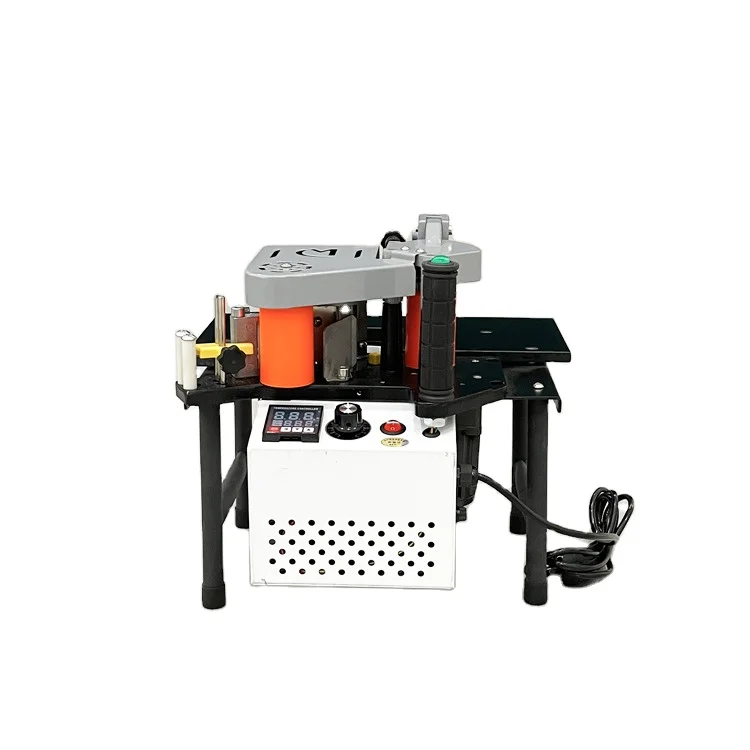
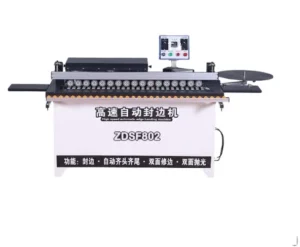
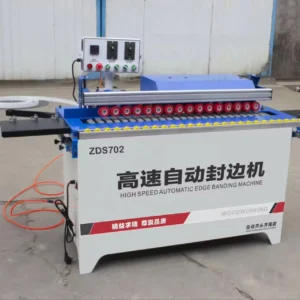
Precision-ground assembly — Every Portable Edge Banding Machine leaving our Ningjin line carries a factory test record verifying its 0.3–3 mm edge thickness range on your chosen banding material before crating.
Technical Specifications
| Parameter |
Value |
| Product Type |
Portable Edge Banding Machine |
| Voltage |
220V |
| Rated Power |
1000W |
| Plate Shape Compatibility |
Curved & Straight plates |
| Edge Thickness Range |
0.3–3 mm |
| Board Thickness Range |
7–60 mm |
| Gluing Method |
Double-sided gluing |
| Glue Pot Capacity |
800 ml |
| Net Weight |
14 kg |
| Overall Dimensions (L×W×H) |
440×410×450 mm |
| Assembly State |
Portable / Handheld |
| Plug Options |
EU / AU / UK / USA / CN |
| Feed Speed |
basis not stated in source |
| Control System |
basis not stated in source |
| Certification |
basis not stated in source |
Application Suitability
| Application |
Material or Output |
| Small-workshop custom furniture edging |
MDF, particleboard, plywood panels with PVC or veneer banding |
| On-site joinery repair and supplemental processing |
Solid wood panels, curved cabinet components |
| Low-volume production runs |
Straight and curved edge profiles across mixed board stocks |
| Prototype and sample preparation |
Short-run edge banding before committing to full-line automation |
Why Voltage Verification Matters More Than the Quoted Price
Confirming local supply voltage and plug type before production prevents the most common portable edge banding machine failure we see in the field.
A few years back I watched a distributor lose three weeks of a customer’s production because a 220V unit was shipped to a 110V-only workshop without anyone asking the site electrician. The control board burned on first power-up, and the replacement air-freight cost more than the machine itself. That portable edge banding machine sat on a pallet while the factory scrambled for a step-up transformer that never quite matched the original frequency spec [NEED_CITE: voltage and frequency standards by export market]. Every unit we build now ships with a signed voltage confirmation sheet matching the destination country’s grid, and we will not release an order until that document is countersigned by the buyer or their local agent.
What OEM Partners Actually Receive
When a distributor asks us to produce a private-label portable edge banding machine, the customization goes beyond a sticker on the housing. We adjust the plug mold to the destination territory, match the control panel language to the operator’s working language, and print the OEM logo on both the machine body and the packing carton. The electrical schematic that accompanies each shipment carries the OEM partner’s own part numbering so their service team can trace components without calling our factory for every warranty question.
Building Depth Behind a Compact Footprint
The 14 kg net weight and 440×410×450 mm envelope make this unit easy to ship, but the internal assembly follows the same precision-grinding discipline as our full-size automatic edge banders. The glue pot seat is machined flat within tolerance so the 800 ml reservoir heats evenly, preventing the cold spots that cause inconsistent adhesive flow on curved profiles. Every batch of portable edge banding machine units passes through our four-stage QC — incoming material inspection, in-process assembly check, finished-product functional test, and a pre-shipment run on actual panel stock [NEED_CITE: CE machinery directive requirements for industrial equipment]. Distributors who have visited the line report that seeing the QC checkpoints in person changes how they position the product in their own catalogues.
Reading the Specification Sheet for Production Impact
The 7–60 mm board thickness range means this portable edge banding machine handles everything from thin drawer sides to thick shelving stock without requiring spacer swaps mid-job, which matters when a small workshop runs mixed orders through a single shift. Double-sided gluing applies adhesive to both the panel edge and the banding material simultaneously, a detail that becomes visible when you examine the bond line on a cross-cut sample — single-sided systems often leave dry patches on curved profiles where the banding pulls away from the glue roller. The 0.3–3 mm edge thickness range covers standard PVC, melamine, and wood veneer bandings, though operators working with thicker solid-wood lipping will need to step up to a bench-mounted model. Because the feed method is manual on this class of machine, consistent operator technique directly affects edge alignment, and we include a setup guide showing the correct hand pressure and travel speed for both straight and curved workpieces.

The Hidden Cost of Skipping Pre-Shipment Verification
Distributors who accept a portable edge banding machine without requesting a pre-shipment test on their specific panel material often discover bond failures only after the unit has reached the end user. Glue temperature that works on MDF may scorch veneer, and a thermostat setting that seals PVC cleanly can leave visible starved joints on particleboard with an open surface structure. These issues are not defects in the machine — they are mismatches between the factory-default settings and the buyer’s actual material stack. Our pre-shipment verification run uses the distributor’s own sample boards whenever they provide them, and we photograph the bond-line cross-section before crating [NEED_CITE: woodworking adhesive performance across substrate densities].
Why Sourcing This Unit Through Our Factory Works for Distributors
Our Ningjin facility runs the same four-stage QC on a 14 kg portable unit as it does on a fully automatic edge banding line, so your service team encounters consistent build quality across the entire catalogue you import from us. Voltage, plug type, and control language are confirmed per order, eliminating the transformer and manual-translation headaches that delay commissioning. OEM branding extends to packaging and electrical documentation, letting your company present a coherent product family to regional resellers. We hold spare glue pots, thermostats, and feed rollers in stock for this model, so distributors stocking the portable edge banding machine can fulfil warranty and repair requests without waiting on a production batch. Factory visits are open to any distributor evaluating a new supply partner, and we will run your sample panels on the assembly line during the inspection.
Documentation & Verification
- CE declaration of conformity issued per unit with matching serial number
- Electrical schematic showing confirmed voltage and plug type for your market
- Factory test record with photographs taken on your specified board thickness range
- ISO 9001 certificate covering the production line that assembled your order
- Packing photographs documenting crating condition before container loading
Installation, Commissioning & Support
- Single-phase 220V supply with a dedicated 10 A circuit for the 1000W rated power draw
- Place the 440×410×450 mm unit on a flat bench; no floor anchoring or foundation required
- First power-up includes thermostat calibration on your actual PVC or veneer banding stock
- Operator training covers hand-feed technique for both curved and straight plate profiles
- Spare glue pots and heating elements stocked for distributor-level same-week dispatch
- Monthly glue pot cleaning cycle maintains consistent adhesive flow across the 800 ml reservoir
What We Need to Quote Your Configuration Accurately
Send us your destination market’s voltage and frequency, the plug type your end users expect, and the primary panel materials and edge banding types you plan to stock alongside this unit. If you are evaluating this portable edge banding machine as part of a broader private-label programme, include your branding files and preferred packaging language so we can prepare a complete OEM proposal within one working day.
Frequently Asked Questions
Q: What OEM and private-label options are available for this portable edge banding machine?
A: We apply your logo to the machine housing and carton, match the plug to your territory, set the control panel to your chosen language, and issue electrical schematics under your part numbering. Minimum order quantities are flexible — from a single evaluation unit to full container loads for regional stocking.
Q: How do you verify edge banding tolerance before the machine ships?
A: Each unit runs a test piece on actual board stock at our pre-shipment QC station. We measure the bond line on a cross-cut sample, photograph the result, and include the test record in the shipping documentation so you can confirm edge thickness and adhesion quality before the crate leaves the factory.
Q: What documentation comes with the machine for customs clearance?
A: Every shipment includes a CE declaration of conformity matching the unit serial number, an ISO 9001 certificate for the producing facility, a commercial invoice, a packing list, and the electrical schematic confirming voltage and plug type. Additional export documents are prepared to match your destination country’s import requirements.
Q: Can I visit the factory to inspect the production line and QC process?
A: Factory visits are welcome at any stage. You can observe precision grinding, assembly, four-stage QC checkpoints, and a live test run on your sample panels. We arrange airport pickup from Jinan and provide a full-day inspection itinerary covering component sourcing through final packing.
Q: How is spare parts supply handled for distributors stocking this model?
A: We maintain inventory of high-wear components — glue pots, thermostats, feed rollers, and heating elements — ready for same-week dispatch. Distributors receive a recommended spare parts list based on projected field volume, and we consolidate parts shipments with your next machine order to reduce freight cost.