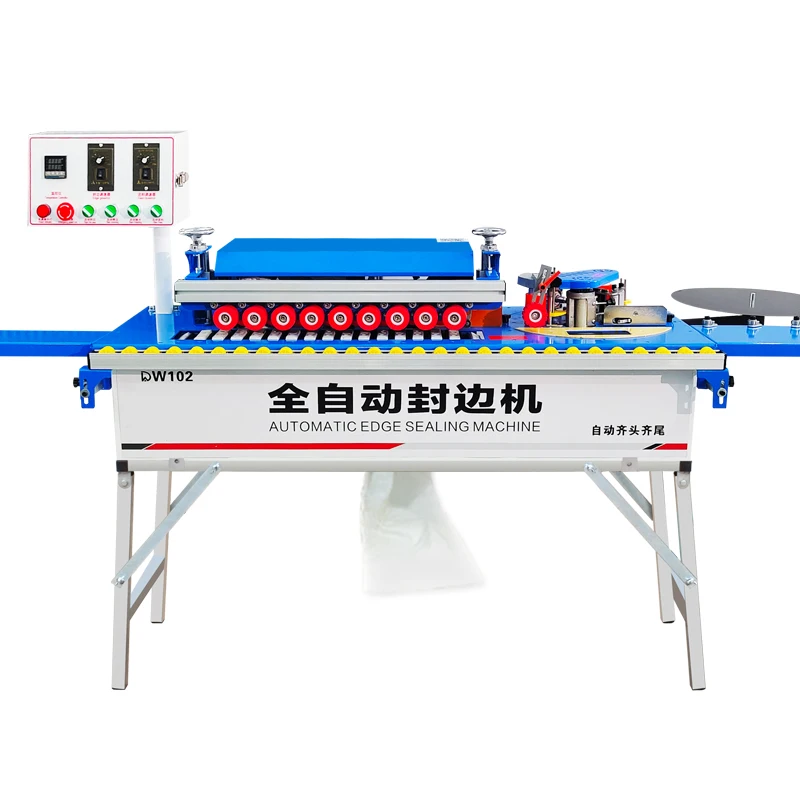
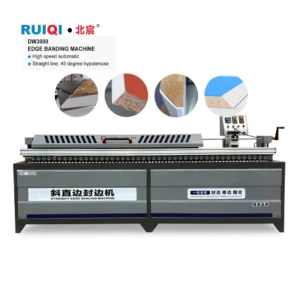
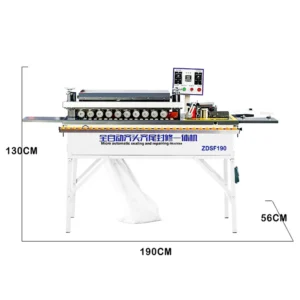
In-house OEM manufacturing — the DW102 is assembled under one roof with private-label scope covering nameplate, control language, and packaging from the first unit onward.
Technical Specifications
| Parameter |
Value |
| Model |
DW102 |
| Product Type |
Automatic Edge Banding Machine |
| Total Power |
3800 W |
| Voltage |
220 V / 380 V / customization |
| Trimming Power |
650 W × 2 |
| Polishing Power |
180 W × 2 |
| Vacuum Power |
1200 W |
| Edge Power |
20 W |
| Transmission Power |
60 W |
| Glue Pot Capacity |
1000 ml |
| Edge Banding Thickness |
0.3 – 3 mm |
| Edge Banding Height |
0 – 50 mm |
| Minimum Sheet Length |
250 mm |
| Minimum Sheet Width |
50 mm |
| Air Source Pressure |
0.5 – 0.8 MPa |
| Overall Dimensions (L × W × H) |
1280 × 470 × 690 mm |
| Net Weight |
75 kg |
| Language Options |
Chinese, English; customizable to Spanish, French, or other languages |
| Plug Options |
EU, USA, AU, UK |
| Key Features |
Curved and straight edge banding, edge trimming, polishing, automatic head and tail cutting, vacuum feed, pre-milling and corner rounding |
Application Suitability
| Application |
Material or Output |
| Cabinet door edge finishing |
MDF and melamine-faced particleboard with PVC edge banding 0.4 – 2 mm |
| Custom furniture panel edging |
Plywood and blockboard panels up to 50 mm height |
| Polymer door profile banding |
Polymer door substrates with straight and curved contours |
| Workshop-scale batch production |
Small to mid-size furniture runs requiring curved and straight edge trimming in a single pass |
Why the Voltage Question Must Come Before the Quotation
Confirming frequency and plug standard before production starts prevents weeks of on-site rewiring.
I spent years on the assembly floor in Shandong before moving into technical coordination. Last year a distributor ordered an edge bander and the machine arrived with a 380 V nameplate while the workshop ran 220 V single-phase. The entire line sat idle for three weeks waiting for an electrical retrofit. That failure had nothing to do with the machine itself — it came from a specification gap at the order stage. Every DW102 edge banding machine OEM factory order now locks voltage, frequency, and plug type before a single component is pulled from stock [NEED_CITE: voltage and frequency standards by export market].
Component Traceability Under One Roof
Sourcing the DW102 edge banding machine OEM factory build means every sub-assembly — from the 650 W trimming motors to the 1200 W vacuum unit — is fitted and tested on the same line where branding is applied. Distributors gain a single point of accountability rather than coordinating between a frame builder, a motor supplier, and a control integrator. This matters when a warranty claim arises mid-season and the buyer needs one entity to trace the fault back through the bill of materials.
Private-Label Scope From Unit One
Private-label capability typically demands volume commitments that small and mid-size importers cannot meet on a first order. With the DW102, OEM branding covers the nameplate, logo placement on the machine body, control panel language, and export carton artwork from the very first unit [NEED_CITE: CE machinery directive requirements for industrial equipment]. A distributor entering a new territory can test market response without carrying dead stock of unbranded inventory. The control panel language — whether Spanish for Latin America, French for West Africa, or another agreed language — is flashed before dispatch, not patched after arrival.
Reading the Specs That Actually Shape Output
The 650 W × 2 trimming motors define the edge finish quality far more than any other parameter on this machine. Higher wattage at the trim station means the cutters maintain rotational speed through dense MDF and particleboard without stalling, which directly affects whether the trimmed edge shows chatter marks or comes off clean. The 0.3 – 3 mm edge banding thickness range covers standard PVC stock through thicker solid-wood veneer strips, but operators must match feed speed to thickness — pushing 3 mm stock at maximum feed rate risks incomplete adhesive activation. The 1000 ml glue pot capacity is sized for continuous short-run work; for full-shift production the operator should schedule a mid-shift refill rather than letting the pot run dry and scorch residual adhesive. A 0.5 – 0.8 MPa air supply is required across the pneumatic actuators that control head-and-tail cutting and pressure rollers — a compressor that dips below 0.5 MPa will cause inconsistent pressure on curved sections.

The Hidden Cost of Skipping Pre-Shipment Electrical Verification
When an edge bander arrives with the wrong voltage configuration, the consequences extend beyond a rewiring bill. The local electrician may not be familiar with the machine’s control logic, leading to miswired safety interlocks that surface only when an operator triggers an emergency stop. Pneumatic valves rated for one frequency may cycle at the wrong speed under another, causing the head-and-tail cutter to miss its timing window on short panels. I have seen machines of this class sit in a container yard for weeks while the importer argues with a freight forwarder over who should have caught the discrepancy [NEED_CITE: international machinery import compliance procedures].
Why Distributors Source This Build Here
In-house manufacturing means the DW102 is not assembled from catalogued sub-kits — the frame, feed mechanism, and trimming stations are machined and fitted on the same floor, giving OEM partners a verifiable build trail. Four-stage quality control runs from incoming material inspection through in-process checks, finished-product testing, and a pre-shipment verification that includes running actual edge banding stock through the machine. Voltage and plug customization is handled as a standard production step rather than a post-assembly modification, reducing the risk of field failures. The patented cutting mechanisms used across the product family carry documented tolerance data that distributors can present to their own customers. An engineer-led configuration review is completed before the formal quotation, so the machine that ships matches the buyer’s substrate and panel size range.
Documentation & Verification
- Electrical schematic matched to ordered voltage and frequency before manufacturing begins
- Factory test record showing edge banding results on your specified panel material and thickness
- Operation and maintenance manual delivered in the language agreed at order confirmation
- Spare parts list with part numbers for trimming blades, polishing wheels, and glue pot elements
- CE declaration of conformity and ISO 9001 certificate for customs and market entry
- Packing photographs documenting machine condition and crate configuration before dispatch
Installation, Commissioning & Support
- Footprint of 1280 × 470 mm requires a level floor with clearance on both sides for panel feeding
- Dedicated circuit matching confirmed voltage — 220 V single-phase or 380 V three-phase as ordered
- Machine ships fully assembled at 75 kg; two personnel can position it without a forklift
- First-run commissioning includes setting pneumatic pressure between 0.5 and 0.8 MPa at the source regulator
- Operator training covers glue pot refill procedure and the 1000 ml capacity work-cycle window
- Consumable spare parts include trimming blades and polishing wheels matched to your edge banding material
What to Include in Your Inquiry
Send your target panel material — MDF, particleboard, plywood, or polymer — along with the thickness range you run most frequently. Specify the local voltage and frequency so the electrical schematic can be drafted before production. Indicate whether you need curved-edge capability, the preferred control panel language, and any OEM branding elements such as logo placement or custom carton artwork.
Frequently Asked Questions
Q: What is the OEM and private label scope for the DW102?
A: Customization covers the machine nameplate, logo on the body, control panel language, and export packaging artwork. There is no high-volume threshold — a single unit can carry full OEM branding. The exact placement of logos and the language flashed to the control screen are confirmed during the specification review before manufacturing begins.
Q: How is voltage and plug configuration confirmed before production?
A: The order process includes a specification and voltage confirmation step where the buyer signs off on voltage, frequency, and plug type. An electrical schematic reflecting those values is delivered before production starts. This eliminates the mismatch that leaves machines unusable on arrival.
Q: What quality control stages does the DW102 pass through?
A: The machine moves through four stages: incoming material inspection, in-process assembly checks, finished-product functional testing, and a pre-shipment verification. During pre-shipment, actual edge banding material is run through the machine and documented in a factory test record available to the buyer.
Q: Can I visit the factory or request a sample processing test?
A: Factory visits are welcomed for distributors evaluating manufacturing depth. If travel is not practical, a sample processing test can be arranged — send your panel stock and edge banding material, and the test results are recorded and shared before you commit to a production order.
Q: What spare parts and technical documentation are included with OEM orders?
A: Each shipment includes a spare parts list, an operation manual in the agreed language, the confirmed electrical schematic, and customs documentation support. Consumable items such as trimming blades and polishing wheels are listed with part numbers so reorder lead times can be planned in advance.