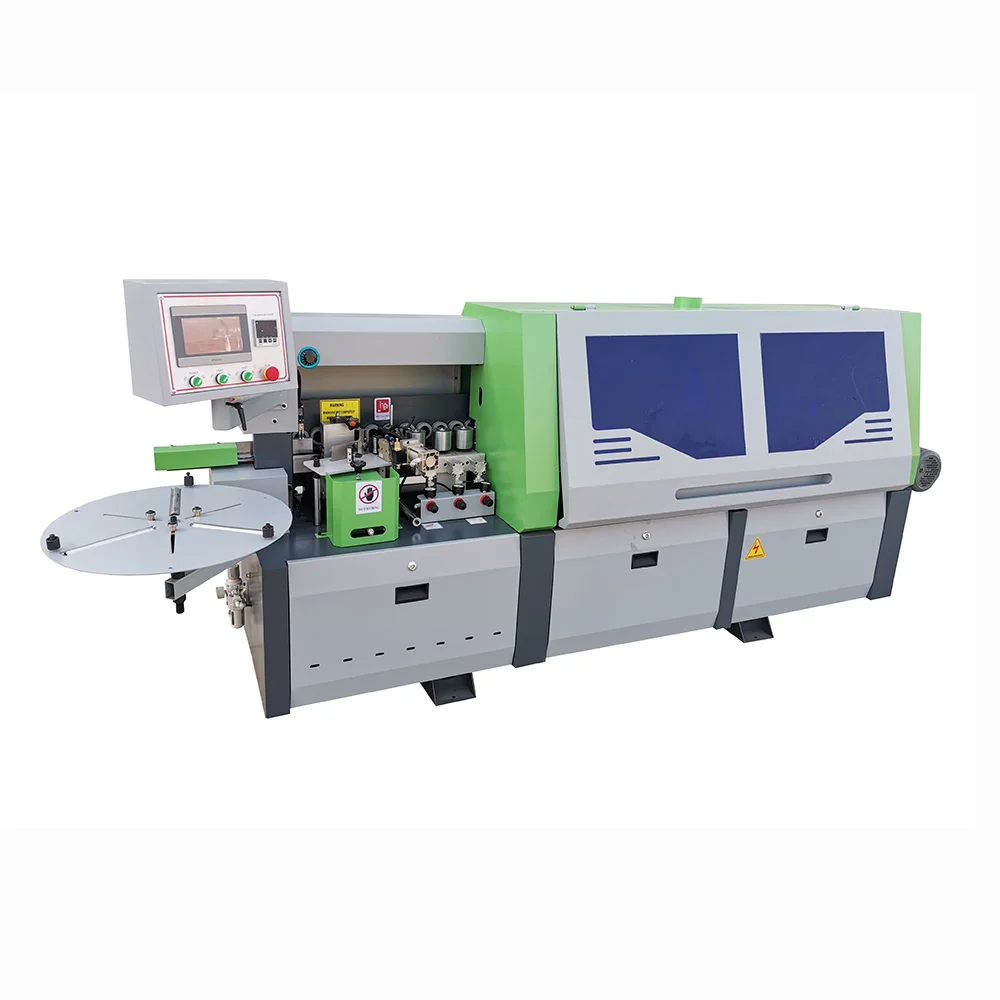
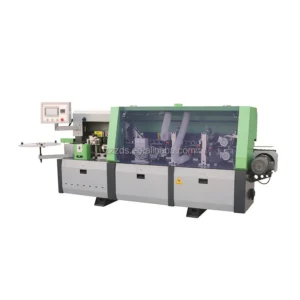
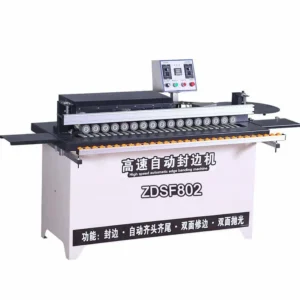
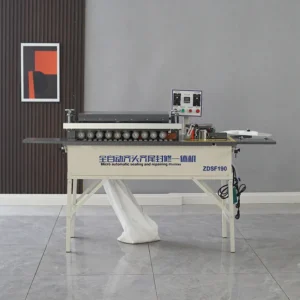
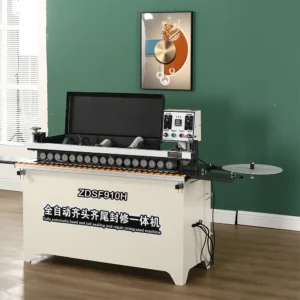
In-house manufacturing depth — every ZDS280D automatic edge bander is built on a 14 mm high-strength steel frame and shipped with documented four-stage QC records, supporting full OEM and private label runs.
Technical Specifications
| Parameter |
Value |
| Model |
ZDS280D |
| Product Type |
Automatic Edge Bander Machine |
| Main Functions |
Gluing, End trimming, Fine trimming, Scraping, Buffing |
| Working Pressure |
0.6 MPa |
| Panel Thickness Range |
10–60 mm |
| Edge Thickness Range |
0.4–3 mm |
| Feed Speed |
16 m/min |
| Min. Panel Width |
60 mm |
| Min. Panel Length |
150 mm |
| Rated Power |
7.5 kW |
| Voltage & Frequency |
380V, 3-phase (frequency to confirm: 50Hz/60Hz) |
| Net Weight |
700 kg |
| Overall Dimensions (L×W×H) |
3100 × 700 × 1400 mm |
| Frame Construction |
14 mm national standard high-strength steel plate, frame-type fuselage, high-temperature quenching |
| Conveyor Guide Rail Material |
HT260 |
| Conveying Motor |
Customized Taiwan brand with thermal protection |
| Head Guide Rail |
Taiwan brand |
| Pneumatic System |
German Festo or Taiwan AirTAC cylinders and safety valve, AirTAC magnetic switch |
| Electrical Components |
Delixi / Chint air switches and contactors, Japanese Omron travel switches |
| Control System |
Control panel (PLC/CNC type to confirm) |
| Warranty |
1 year |
Application Suitability
| Application |
Material or Output |
| Panel furniture edge banding |
PVC edge banding on melamine-faced MDF and particleboard |
| Custom cabinet door production |
0.4–3 mm PVC and veneer strips on plywood substrates |
| Joinery workshop panel finishing |
Solid wood panels and composite boards requiring scraping and buffing |
| OEM batch runs for distributors |
Pre-configured edge banding output with private label branding |
Why Voltage Confirmation Must Happen Before Production Starts
An automatic edge bander machine quoted without locked-in frequency specs can arrive with motors running at the wrong speed, causing trimming tools to chatter and PVC edges to tear.
I have seen this exact situation unfold at a project site in the Gulf region. The local supply was 60 Hz, but the frequency confirmation step was skipped during ordering. The conveyor motor ran faster than designed, the trimming cutters could not hold a consistent depth, and every panel coming off the line showed visible scoring along the edge band. A step-down transformer had to be air-freighted in, which stalled the entire installation by several weeks. Since that incident, I treat the electrical confirmation sheet as a non-negotiable gate before any machine leaves the factory floor [NEED_CITE: voltage and frequency standards by export market].

Frame Rigidity and Its Role in Edge Quality
The ZDS280D is welded from 14 mm high-strength steel plate and subjected to high-temperature quenching after welding. This process relieves residual stress in the frame, which matters because an edge bander operates under continuous vibration at 16 m/min feed speed. If the frame flexes even slightly under load, the pressure roller alignment drifts, and glue application becomes uneven across the panel edge.
For an OEM partner evaluating this automatic edge bander machine for private label distribution, the frame specification directly determines long-term edge consistency across different installation environments.
Pneumatic Precision Across Trimming and Scraping Stations
The pneumatic circuit uses Festo or AirTAC cylinders paired with high-sensitivity magnetic switches. Each trimming and scraping station relies on precise air pressure to maintain cutter contact with the edge band. Inconsistent cylinder response causes either insufficient material removal — leaving a visible lip — or overcutting that damages the panel surface.
The five-station sequence (gluing, end trimming, fine trimming, scraping, buffing) demands that each pneumatic actuator responds within a tight timing window. A delayed cylinder on the scraping station, for example, means the buffing wheel encounters an unscraped surface, producing a rough finish that fails visual inspection [NEED_CITE: pneumatic actuator response tolerances in edge banding equipment].
Reading the Specification Sheet Against Your Production Needs
The 10–60 mm panel thickness range covers most furniture-grade MDF, particleboard, and plywood panels used in cabinet and shelving production. When your typical stock sits around 18 mm, the machine operates well within its capacity envelope, which reduces wear on the pressure roller and conveyor guide rails.
The HT260 conveyor guide rail material is a high-strength grey cast iron chosen for its vibration-damping properties. At 16 m/min, the rail must keep the panel perfectly level as it passes through five sequential stations. Any deviation translates directly into tolerance errors that compound during downstream assembly — a 0.5 mm edge band overhang might seem minor until dozens of cabinet carcasses fail to align on the assembly bench.
The 0.6 MPa working pressure requirement is standard for this class of machine. Confirming your workshop compressor can sustain this pressure continuously, rather than only at peak output, prevents quality drop-offs during extended production runs.
The Hidden Cost of Skipping Component Verification
When sourcing an automatic edge bander machine from an overseas factory, buyers sometimes focus on the headline functions and overlook the component brands inside the cabinet. A machine listed with generic contactors and unbranded travel switches may perform adequately during the factory test, but when a travel switch fails six months into production, sourcing a replacement locally becomes a multi-week search. The ZDS280D uses Delixi and Chint electrical components alongside Japanese Omron travel switches — brands with established distribution networks in most industrial markets [NEED_CITE: global availability of industrial electrical components].
Why Procurement Through This Facility Makes Sense
In-house manufacturing means the frame welding, quenching treatment, and final assembly all happen under one roof. You are not buying a rebranded machine assembled from sourced sub-assemblies with unclear provenance.
The four-stage QC process — incoming material inspection, in-process checks, finished product testing, and pre-shipment verification — generates documentation at each gate. Buyers receive the test records before the crate is sealed.
OEM and private label customization covers logo placement, voltage configuration, and control panel language. A single product family allows a distributor to offer entry-level through full-function models under one brand umbrella.
Factory visits are welcomed at any stage. Inspecting the welding quality, quenching furnace, and assembly line in person provides verification that photographs cannot deliver.
Documentation & Verification
- CE declaration of conformity matched to ZDS280D model specifications
- ISO 9001 certificate covering manufacturing process and QC stages
- Factory test record showing edge banding output on your specified panel thickness
- Electrical schematic confirming voltage, frequency, and circuit protection layout
- Operation and maintenance manual in your agreed language with spare parts list
- Pre-shipment photographs documenting packing condition and accessory completeness
Installation, Commissioning & Support
- Floor space requires minimum 3.5 × 1.5 m clearance with level concrete foundation for the 3100 × 700 mm footprint
- Dedicated 3-phase circuit rated for 7.5 kW with voltage and frequency confirmed before dispatch
- Machine ships fully assembled; repositioning requires standard forklift capacity for the 700 kg net weight
- First-run calibration covers conveyor speed, glue temperature, and trimming depth across all five stations
- Omron travel switch positions and AirTAC magnetic switch sensitivity verified during commissioning
- Spare parts list covers wear items including trimming cutters, buffing wheels, and conveyor belt segments
What to Prepare Before Requesting a Quotation
Provide the panel substrates you process most frequently along with their typical thickness range, so the machine configuration can be matched to your actual workload rather than a generic setup. Confirm your local voltage and frequency — both values, not just voltage — along with your preferred control panel language. If you are evaluating this machine for OEM or private label distribution, specify your branding requirements and target market so the quotation reflects the correct certification and documentation package.
Frequently Asked Questions
Q: Can I visit the factory to inspect the ZDS280D manufacturing process?
A: Factory visits are welcome at any production stage. You can inspect frame welding, the high-temperature quenching process, and the assembly line directly. We recommend scheduling the visit to coincide with the pre-shipment test of your specific machine, so you can observe the four-stage QC verification in person and review edge quality output on your chosen panel material.
Q: What OEM and private label options are available for the ZDS280D?
A: Customization covers logo placement on the machine body, voltage and frequency configuration from 110V to 440V, and control panel language selection. OEM partners can specify private label documentation, branded packaging, and a tailored spare parts package. The ZDS280D sits within a broader product family, allowing distributors to offer multiple tiers under a single brand identity.
Q: How is the four-stage QC process documented before shipment?
A: Each QC stage — incoming material inspection, in-process checks, finished product testing, and pre-shipment verification — generates a written record. These documents are compiled and shared with the buyer before the machine is crated. The pre-shipment test includes running sample panels through all five stations, and the edge quality results are recorded alongside the factory test report.
Q: Are the pneumatic and electrical components globally serviceable?
A: The ZDS280D uses Festo or AirTAC pneumatic cylinders, Delixi and Chint electrical components, and Omron travel switches. These brands maintain distribution and service networks across most industrial markets. Before shipment, the electrical schematic confirms all component specifications so your local maintenance team can source replacements without delays.
Q: What is the typical lead time for an OEM order with custom specifications?
A: Lead time depends on the level of customization required and current production scheduling. Standard configuration orders follow typical multi-week lead times, while OEM orders requiring custom voltage, language panels, and branded documentation may extend the timeline. A formal schedule is provided with the quotation once all specifications are confirmed and signed off.