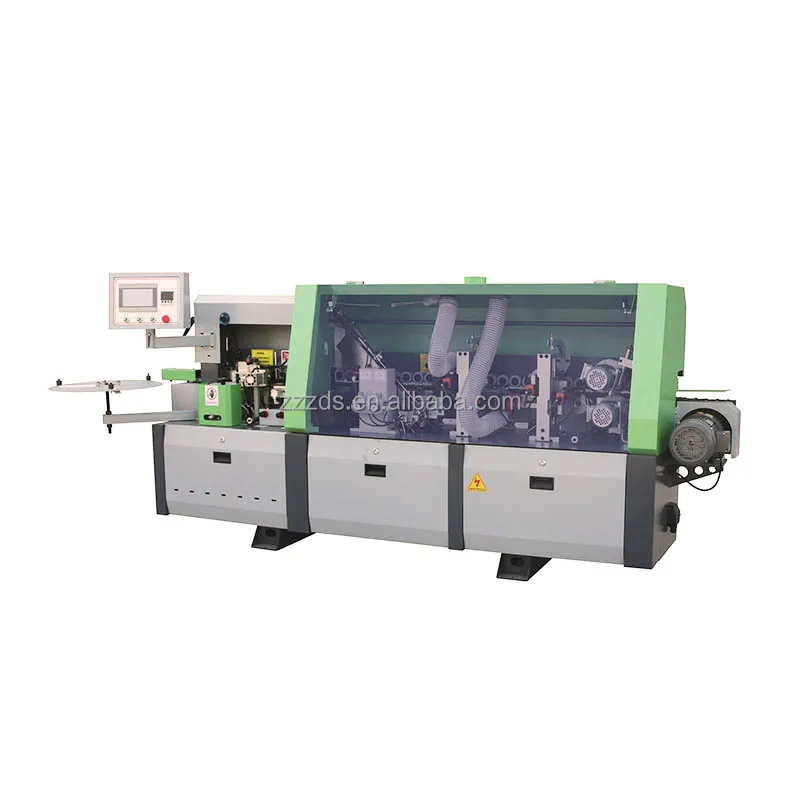
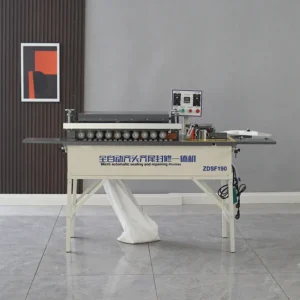
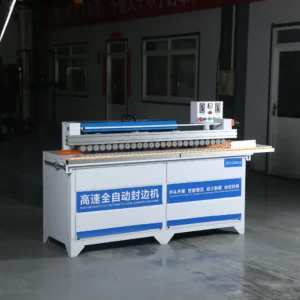
Precision-Built for OEM Partners — Every ZDS280D edge banding machine leaves the factory with a verified electrical schematic and destination-market voltage confirmation, eliminating the costly mismatches that stall commissioning on arrival.
Technical Specifications
| Parameter |
Value |
| Model |
ZDS280D |
| Product Type |
Automatic Edge Banding Machine |
| Main Functions |
Gluing, End Trimming, Fine Trimming, Scraping, Buffing |
| Panel Thickness Range |
10–60 mm |
| Edge Thickness Range |
0.4–3 mm |
| Feed Speed |
16 m/min |
| Min. Panel Width |
60 mm |
| Min. Panel Length |
150 mm |
| Working Pressure |
0.6 MPa |
| Voltage & Frequency |
380V / 3-Phase (frequency to be confirmed per destination market) |
| Rated Power |
7.5 kW |
| Net Weight |
700 kg |
| Overall Dimensions (L×W×H) |
3100 × 700 × 1400 mm |
| Machine Frame |
14 mm national standard high-strength steel plate, high-temperature quenched |
| Conveyor Guide Rail |
HT260 grade |
| Conveying Motor |
Taiwan brand with thermal protection |
| Pneumatic Components |
German Festo or Taiwan AirTAC cylinders, AirTAC magnetic switches |
| Electrical Components |
Delixi/Chint breakers and contactors, Japanese Omron travel switches |
| Control System |
Conventional electrical control panel |
| Certification Standards |
CE, ISO 9001 |
| Warranty |
1 year |
Application Suitability
| Application |
Material or Output |
| Cabinet and wardrobe panel edging |
MDF, particleboard, plywood with PVC or veneer banding |
| Custom furniture component finishing |
Solid wood panels up to 60 mm thickness |
| Mid-volume joinery workshop production |
Laminated board and melamine-faced chipboard |
| Contract furniture manufacturing |
High-pressure laminate and melamine edge strips (0.4–3 mm) |
| Panel sizing and edge finishing line integration |
Feeds into downstream boring or CNC stations |
Why the Voltage Question Should Come Before the Price
A machine wired for the wrong frequency will burn out its motors within weeks, and no amount of warranty coverage makes up for the downtime.
I have watched importers take delivery of an Automatic Edge Banding Machine only to discover the control transformer was wound for 50 Hz when their workshop runs on 60 Hz. The motors overheat, the conveyor belt drifts from its set feed speed, and the trimming units chatter against the panel edge. By the time the local electrician rewires the cabinet, the commissioning schedule has collapsed and the distributor’s reputation takes the hit [NEED_CITE: voltage and frequency standards by export market]. Every ZDS280D ships with a confirmed electrical schematic matched to the buyer’s destination grid before the first panel is cut for the frame.

Frame Rigidity That Holds Tolerance Under Continuous Run Conditions
The ZDS280D is built on a 14 mm high-strength steel plate frame that undergoes high-temperature quenching after welding. This stress-relief process is what keeps the machine body from warping under months of continuous vibration and thermal cycling. For an Edge Banding Machine OEM factory, frame stability directly determines whether trimming and scraping units maintain their alignment over production runs spanning hundreds of panels per shift. A frame that deflects even fractionally will push the fine trimming cutter off its set path, leaving a visible step on the panel edge that shows up under finishing-room lighting.
Component Traceability for Distributor Accountability
Regional distributors need to answer two questions from their end customers: where did the critical components come from, and what happens when they need replacing. The ZDS280D addresses both. The pneumatic system uses German Festo or Taiwan AirTAC cylinders with documented part numbers that local suppliers can source independently. The conveyor drive relies on a Taiwan-brand motor with a built-in thermal protection circuit, and the guide rails are cast from HT260 grade iron — a specification that maps to internationally recognized material standards [NEED_CITE: international material grade equivalency for cast iron guide rails]. When a distributor’s service team opens the electrical cabinet, they find Delixi or Chint breakers and Japanese Omron travel switches — components with global distribution networks rather than proprietary parts that only the factory can supply.
How Feed Speed, Panel Range, and Trimming Stages Interact on the Shop Floor
The 16 m/min feed speed on the ZDS280D is calibrated against a 10–60 mm panel thickness range and a five-function processing sequence. At this feed rate, the glue roller has sufficient contact time to achieve full coverage on standard PVC edge banding, while the end trimming and fine trimming units have enough dwell distance to clean up the overhang without secondary passes. The HT260 conveyor guide rail provides the flatness needed to keep panels level through the scraping and buffing zones. If the workshop processes primarily thin melamine strips on 18 mm particleboard, the operator can dial in lighter trimming pressure and higher relative speed. Thicker veneer banding on solid wood panels demands the opposite — slower effective feed and heavier scraping engagement to remove the adhesive residue without gouging the wood grain.
The Hidden Cost of Underspecifying Pneumatic Components
A marginal cylinder in the trimming station may hold pressure during the factory acceptance test but begins to lag under the rapid cycling of a real production shift. The trimming blade arrives a fraction of a second late, leaves a burr on the panel end, and the operator compensates by reducing feed speed — cutting throughput without realizing the root cause. Magnetic switches that drift out of calibration compound the problem, sending inconsistent signals to the control panel [NEED_CITE: pneumatic system reliability standards in woodworking machinery]. The ZDS280D specification calls for AirTAC magnetic switches and Festo or AirTAC safety valves precisely because these components maintain their response timing across the temperature swings typical in unheated workshops during winter months.
What This Automatic Edge Banding Machine Manufacturer Builds Into Every Unit
In-house frame fabrication with high-temperature quenching treatment means the structural base is manufactured and inspected under one roof, not outsourced and bolted together from sub-supplier weldments. The four-stage quality control sequence — incoming material inspection, in-process verification, finished assembly testing, and pre-shipment validation — is applied to every ZDS280D regardless of order quantity. Voltage configuration ranges from 110V to 440V and is confirmed against the buyer’s local grid specification before production begins, with a signed electrical schematic included in the documentation package. OEM partners receive private-label nameplates, custom control panel language, and the option to specify color and finish to match their existing product range. An engineer-led configuration proposal with a formal quotation is delivered within 24 hours of inquiry, covering specification confirmation and destination-market compliance.
Documentation & Verification
- CE declaration of conformity referencing applicable machinery directive clauses
- ISO 9001 certificate covering manufacturing and quality management scope
- Electrical schematic with voltage and frequency confirmed for destination market
- Factory test record on buyer-supplied or specified panel thickness and banding material
- Operation and maintenance manual produced in the buyer’s agreed language
- Spare parts list with manufacturer part numbers for locally serviceable components
Installation, Commissioning & Support
- Floor space allocation based on 3100 × 700 mm footprint with operator clearance on three sides
- Dedicated 380V three-phase circuit rated for the 7.5 kW total load with local isolation switch
- Machine arrives fully assembled; leveling on precision-adjusted feet before conveyor alignment check
- First-run parameter setting covering glue temperature, trimming depth, and feed speed calibration
- Operator training covering control panel functions, banding changeover, and daily guide rail lubrication
- Spare parts kit with consumable cutters and scraper blades included at dispatch
Preparing a Production-Ready Inquiry
To move from general interest to a firm configuration proposal, share the panel materials and thickness range you process most frequently, the edge banding materials and widths in regular use, and your local voltage and frequency standard. If you are evaluating the ZDS280D as part of a larger line, note the upstream saw capacity and downstream boring station feed height so that conveyor alignment can be specified at quotation stage.
Frequently Asked Questions
Q: What OEM customization options are available for distributor branding?
A: The ZDS280D supports private-label nameplates, custom logo application on the machine body, and control panel text in the buyer’s preferred language. Color and finish can be specified to match an existing product range. These options apply from single-unit sample orders through full production runs, with all branding details confirmed before the frame enters final assembly.
Q: How does the factory verify voltage configuration before shipment?
A: Before production starts, the buyer confirms local voltage and frequency. The factory produces an electrical schematic reflecting those specifications, which is signed off and included with the machine documentation. The control cabinet is wired and tested at the specified voltage during the pre-shipment inspection to confirm motor rotation, heating element function, and control logic under the correct electrical conditions.
Q: Can we send our own panel and banding materials for a factory test run?
A: Yes. Buyers are encouraged to ship representative samples of their most-used panel substrates and edge banding materials. The factory runs the ZDS280D on those materials and records trimming quality, glue line appearance, and feed behavior. The test record accompanies the machine, giving the distributor a verified baseline for commissioning at the end customer’s site.
Q: Which components can be sourced locally rather than ordered from the factory?
A: The pneumatic cylinders (Festo or AirTAC), electrical breakers and contactors (Delixi/Chint), Omron travel switches, and the conveyor motor are all specified using internationally distributed brands with documented part numbers. The spare parts list provided at shipment identifies each component by manufacturer code, allowing the distributor’s service team to source replacements through their existing industrial supply channels.
Q: What technical training is provided to the distributor’s service team?
A: The operation and maintenance manual covers assembly diagrams, adjustment procedures, and a preventive maintenance schedule specific to the ZDS280D. For distributors placing initial orders, the factory can arrange a training session covering conveyor alignment, trimming unit calibration, and pneumatic system diagnostics, either at the factory during a pre-shipment visit or via remote video guidance at commissioning.