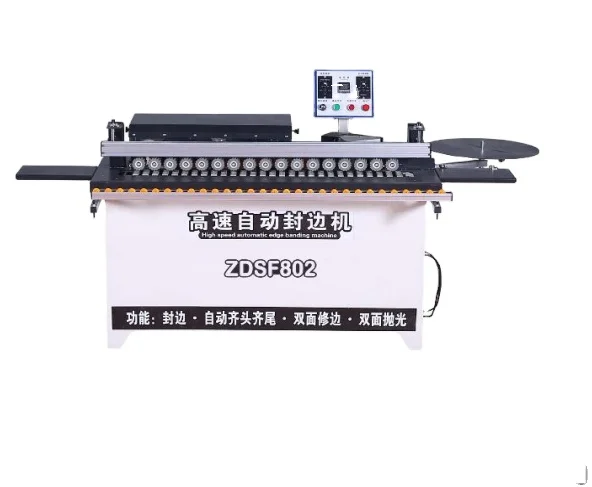
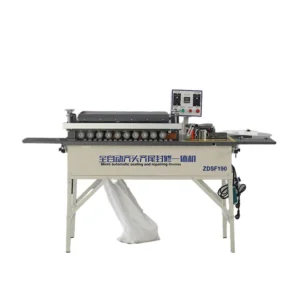
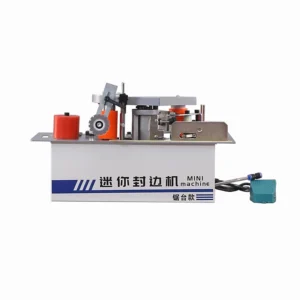
In-house precision manufacturing — every Model 802 automatic edge banding machine is built on our own grinding stations with patented cutting mechanisms and verified before it leaves the factory floor.
Technical Specifications
| Parameter |
Value |
| Product Type |
Automatic Edge Banding Machine |
| Function Sequence |
Automatic plate feeding, end cutting, upper and lower polishing, head and tail trimming, integrated dust collector |
| Edge Type |
Straight line |
| Rated Voltage |
220V (frequency and phase to be confirmed for target market) |
| Rated Power |
4 kW |
| Trimming Power |
800W × 2 |
| Polishing Power |
180W × 2 |
| Suction Power |
1200W |
| Heating Power |
1000W (heat-up time 5–10 min) |
| Glue Pot Capacity |
4000 ml |
| Feed Speed |
0–10 m/min |
| Conveyor Belt Speed |
0–10 m/min |
| Strip Thickness Range |
0.5–2.5 mm |
| Sheet Thickness Range |
10–50 mm |
| Rated Air Pressure |
0.4–0.6 MPa |
| Overall Dimensions (L×W×H) |
130 × 65 × 75 cm |
| Machine Weight |
150 kg |
| Control Panel |
Digital display of glue pot temperature, independent switches |
| Pressure Beam |
One-piece pressure beam, double rows of pressure wheels |
| Conveyor Belt Material |
Silicone |
| Belt Breaking Method |
Pneumatically controlled |
| Support System |
Fluent strip extensions for large plate stability |
Application Suitability
| Application |
Material or Output |
| Custom furniture panel edging |
MDF and particleboard with PVC or melamine strip |
| Cabinet door and carcass production |
Plywood panels with veneer or ABS edge banding |
| Small-batch joinery components |
Solid wood panels requiring straight-line edge finishing |
| Workshop-scale shelving and storage units |
Laminated boards up to 50 mm thickness |
Why the Voltage Question Must Come Before the Quotation
A machine rated for the wrong voltage will not run, regardless of how well it was built.
I spent three weeks in a Mexican workshop watching a brand-new edge bander sit idle because the factory ordered at 220V/60Hz while the shop floor ran 440V three-phase. The glue pot would not heat, the trimming motors would not start, and no amount of on-site rewiring could fix a fundamental mismatch. Every automatic edge banding machine factory shipment now requires a signed voltage confirmation sheet before the control cabinet is closed [NEED_CITE: voltage and frequency standards by export market]. This is not a paperwork exercise — it is the single most common reason a machine arrives and cannot be commissioned.

Component Sourcing That You Can Audit
When an OEM partner or regional distributor evaluates an automatic edge banding machine factory, the first question is always about depth of manufacturing. The Model 802 is assembled from components we source, grind, and inspect in-house — the trimming spindles, pressure beam, and conveyor frame are not bought as sub-assemblies from a third party and bolted together. This matters because when a distributor needs to offer spare parts to their own service network, they need to know exactly which bearing sits in which housing and where the tolerance stack originates.
Four-Stage QC From Incoming Steel to Pre-Shipment Test
The quality process covers incoming material inspection, in-process checks during grinding and assembly, finished-product functional testing, and a full pre-shipment verification run. Each stage generates its own record. For OEM partners placing their own brand on the machine, this documentation trail becomes part of their compliance file — it is the difference between a trading company that cannot answer a technical query and a manufacturing partner that can trace every critical dimension [NEED_CITE: CE machinery directive requirements for industrial equipment].
Reading the Specs That Actually Matter on the Shop Floor
The 4 kW rated power figure tells you the machine can sustain continuous trimming and polishing without thermal cutout, but what matters more in daily production is how that power is distributed. The 800W × 2 trimming motors provide sufficient torque to clean-cut PVC and ABS edging at the full 10 m/min feed speed without chipping. The 4000 ml glue pot capacity means fewer refill interruptions during a batch run — a smaller pot forces the operator to stop mid-panel when the adhesive level drops below the roller pickup point. The one-piece pressure beam with double rows of pressure wheels keeps the panel flat against the silicone conveyor belt, which is the single biggest factor in achieving a consistent glue line across the full 10–50 mm sheet thickness range. The digital temperature display on the glue pot lets the operator verify that the adhesive is within its working window before the first panel enters the feed zone.
What Happens When Specifications Are Assumed Rather Than Confirmed
A distributor once ordered a batch of edge banders for resale across Central America without specifying control panel language. The machines arrived with Chinese-only displays, and the local technicians could not navigate the temperature settings or fault codes. The panels were held at customs for re-labeling while the distributor paid for emergency translation stickers. Similar issues arise when feed speed and air pressure requirements are not matched to the buyer’s existing compressor capacity — a 0.4–0.6 MPa requirement means nothing if the workshop’s compressor only delivers 0.3 MPa at the point of use [NEED_CITE: compressed air supply requirements for pneumatic woodworking machinery].
Manufacturing Depth You Can Verify On-Site
The factory operates its own precision grinding stations for critical components, which means tolerance claims can be checked against actual machined surfaces rather than supplier datasheets. Patented cutting mechanisms are designed and produced in-house, so the trimming geometry is matched to the feed speed and panel thickness range of this specific machine family. Voltage customization from 110V to 440V and multilingual control panels are handled as standard configuration options, not special requests that add weeks to lead time. Every unit ships with a factory test record that documents the actual run on the buyer’s specified panel thickness, and the pre-shipment verification includes photographic evidence of the packing and crating. OEM branding, color matching, and private-label packaging are integrated into the production schedule rather than applied as an afterthought.
Documentation & Verification
- CE declaration of conformity matched to the machine’s rated power and voltage configuration
- ISO 9001 certificate covering the manufacturing and quality control process
- Factory test record documenting a run on your specified sheet thickness and edge strip material
- Electrical schematic with confirmed voltage, frequency, and phase for your target market
- Operation and maintenance manual in your agreed language with illustrated spare parts list
- Packing photographs and customs documentation support for export clearance
Installation, Commissioning & Support
- Requires a level concrete floor with minimum 2.5 m clearance for the 130 cm machine length plus plate infeed zone
- Dedicated electrical circuit matching confirmed voltage and phase, separate from other heavy-draw equipment
- Arrives partially assembled; pressure beam and support extensions require on-site alignment to the silicone conveyor
- First-run commissioning includes glue pot temperature calibration and trimming head adjustment to your strip thickness
- Pneumatic supply must deliver 0.4–0.6 MPa at the machine inlet with a dedicated filter-regulator unit
- Spare trimming cutters and polishing wheels included; replenishment schedule based on your daily running hours
Preparing Your Inquiry for an Accurate Configuration
To receive a formal quotation with the correct electrical and mechanical configuration, provide your target panel materials and thickness range, the edge strip types you plan to run, and your workshop’s available voltage and phase. Let us know the control panel language your operators require and whether you need OEM branding on the machine body and packaging. If you are evaluating this unit as part of a larger line, share your upstream saw and downstream boring equipment so feed height and throughput can be matched.
Frequently Asked Questions
Q: What OEM and private-label customization options are available for this machine?
A: Logo application on the machine body, custom color for the frame and guards, control panel language selection, and branded packaging are all handled within the standard production flow. Voltage is configured from 110V to 440V based on your confirmed market requirements, and the electrical schematic is updated to match.
Q: How is manufacturing quality verified before the machine ships?
A: The four-stage process covers incoming material inspection, in-process checks during grinding and assembly, finished-product functional testing, and a pre-shipment verification run on your specified panel thickness. Each stage produces a documented record that is included in the delivery package.
Q: Can I visit the factory to audit the manufacturing process?
A: Factory visits are welcome and can be arranged to cover component sourcing, precision grinding stations, assembly lines, and the QC inspection area. A virtual tour with live video walk-through is also available for partners who cannot travel before placing an initial order.
Q: What documentation comes with the machine for customs and compliance?
A: Every shipment includes the CE declaration of conformity, ISO 9001 certificate, factory test record, electrical schematic with confirmed voltage, operation manual in your language, spare parts list, and packing photographs. Additional customs documentation support is provided as needed for your destination market.
Q: How is spare parts supply and technical training handled for distributor teams?
A: A spare parts list with part numbers and illustrations is included in the manual. Distributor service teams can receive technical training on maintenance procedures, fault diagnosis, and adjustment protocols either at the factory or via remote video sessions after delivery.