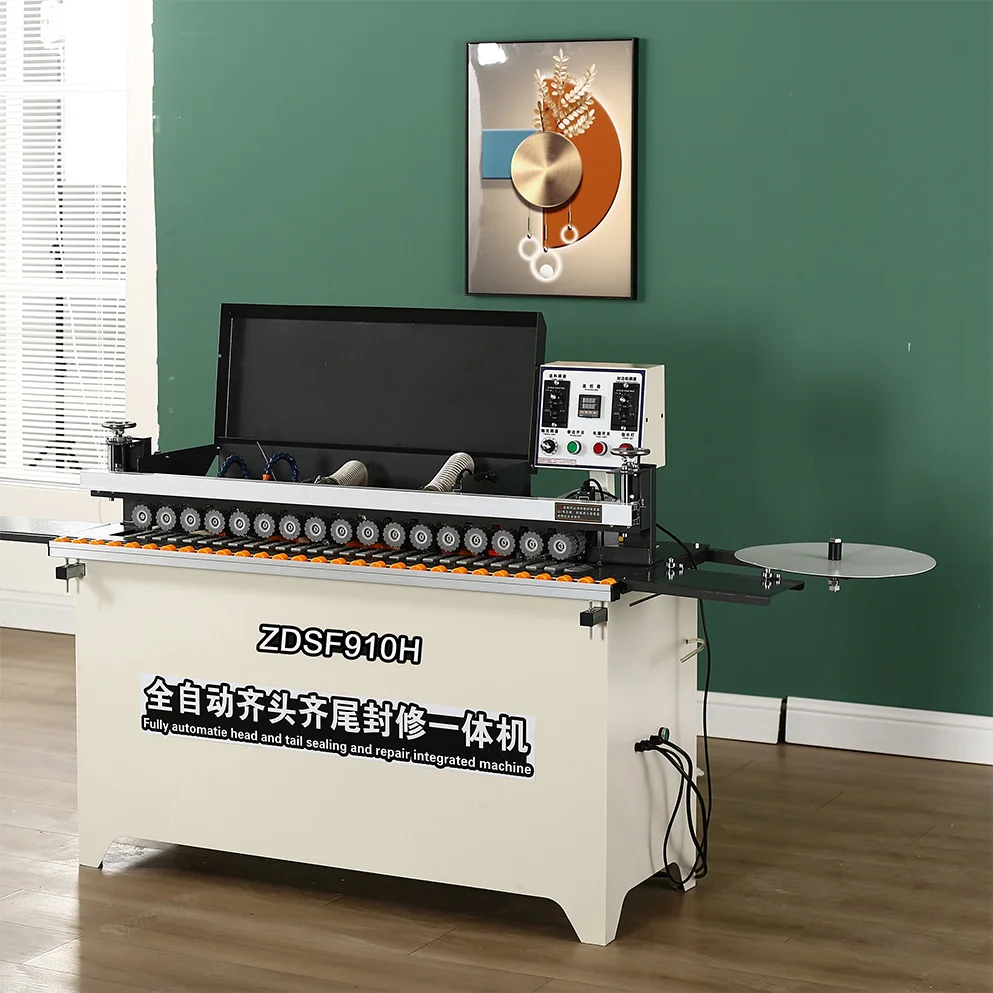
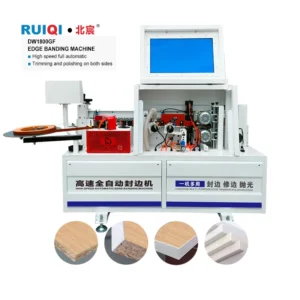
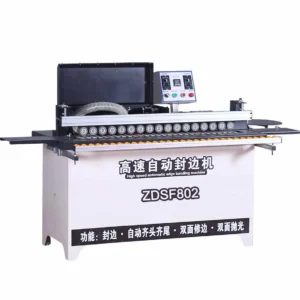
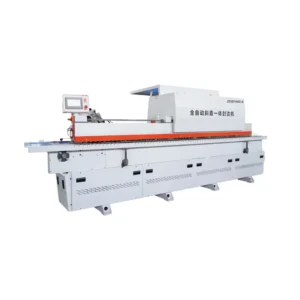
In-House Precision Manufacturing — Every 910H small automatic edge banding machine undergoes four-stage quality control from raw material intake to pre-shipment verification, with tolerance checked against actual test panels before dispatch.
Technical Specifications
| Parameter |
Value |
| Model |
910H |
| Product Type |
Small Automatic Edge Banding Machine (Curved and Straight) |
| Edge Type Compatibility |
Both curved and straight profiles |
| Function Sequence |
Automatic plate feeding, double-sided gluing, upper and lower polishing, automatic head and tail trimming |
| Sheet Thickness Range |
10–50 mm |
| Edge Strip Thickness Range |
0.5–2.5 mm |
| Rated Power |
4 kW |
| Voltage & Frequency |
220V 50Hz (other voltages available upon request) |
| Heating Power |
800 W |
| Trimming Power |
800 W × 2 |
| Polishing Power |
180 W × 2 |
| Suction Power |
1200 W |
| Belt Power |
25 W |
| Transmission Power |
120 W |
| Rated Air Pressure |
0.4–0.6 MPa |
| Glue Pot Capacity |
1000 ml |
| Feed Mechanism |
Double-row rubber pressure wheels, automatic plate feeding |
| Pressure Beam |
Adjustable aluminum alloy |
| Trimming Cutter |
4-edge arc-shaped alloy cutter head with 2 high-speed motors |
| Curved/Straight Switch |
Rotating 180 degrees for curved edge banding |
| Edge Strip Cutting |
Pneumatically controlled |
| Dust Extraction Port |
Large-diameter vacuum device integrated |
| Overall Dimensions (L×W×H) |
1300 × 560 × 1090 mm |
| Net Weight |
140 kg |
| Control Panel |
Multi-function button operation |
| Assembly State |
Partially assembled (final assembly per user manual or video guide) |
Application Suitability
| Application |
Material or Output |
| Custom cabinet door edging |
MDF and plywood panels with PVC or veneer edge banding on curved profiles |
| Small-batch furniture workshop production |
Particleboard shelving and carcass panels up to 50 mm thick |
| Joinery startup transitioning from manual edge work |
Solid wood panels with 0.5–2.5 mm strip thickness |
| Prototype and sample panel preparation |
Mixed substrate test runs on curved and straight geometries |
| Regional distributor stock for entry-level segment |
Compact footprint units suitable for workshops with limited floor space |
Why the Voltage Question Should Come Before the Machine Order
When a compact edge bander arrives at a workshop and the voltage does not match the local grid, the machine sits idle while an electrician reconfigures the supply — sometimes for weeks. Confirming voltage and frequency in the technical attachment before production begins eliminates this delay entirely. I learned this the hard way after shipping a double-head unit to a cabinet factory in Southeast Asia where the workshop only had 380V three-phase available, and the machine was wired for 440V. The small automatic edge banding machine factory process now builds voltage confirmation into every quotation stage [NEED_CITE: voltage and frequency standards by export market]. A 4 kW unit like the 910H draws meaningful current, and mismatched supply can damage heating elements and trimming motors before the first panel is ever edged.

Component Sourcing and Assembly Depth
Distributors evaluating an OEM curved straight edge bander need to understand what is built in-house versus sourced externally. The 910H uses precision-ground components across its feed mechanism, pressure beam, and trimming assemblies, with proprietary cutting mechanisms developed internally. This manufacturing depth means that when a distributor requests a specification change — whether it is a different control panel language or a modified glue pot configuration — the modification happens on the factory floor rather than through a third-party integrator.
Private Label and Branding Configuration
For importers building a regional product line, the 910H supports full OEM and private label customization. Logo placement, machine color, packaging graphics, and control panel language are all configurable at the point of manufacture. This allows a distributor to position the machine within their own brand architecture without managing separate branding vendors. The small automatic edge banding machine factory handles these customizations as standard line items in the production order rather than post-production modifications [NEED_CITE: CE machinery directive requirements for industrial equipment].
Reading the Specification Sheet Against Actual Workshop Conditions
The 10–50 mm sheet thickness range and 0.5–2.5 mm strip thickness range define the working envelope, but how those numbers interact with feed stability matters more in practice. The double-row rubber pressure wheels and adjustable aluminum alloy pressure beam maintain consistent contact across that full range, which directly affects glue line uniformity on thicker particleboard panels. The 4-edge arc-shaped alloy cutter heads on the two 800 W trimming motors produce a clean finish on both PVC and veneer strips, and the arc geometry allows the same cutter to handle curved profiles when the machine is rotated 180 degrees. The 1000 ml glue pot capacity provides sufficient adhesive volume for sustained runs without frequent refills, and the integrated large-diameter dust extraction port keeps the work area clear of trim waste that could interfere with downstream polishing.
What Happens When the Wrong Configuration Ships
A distributor who stocks a single voltage variant for multiple export markets will eventually ship a unit into a territory with an incompatible grid. The machine arrives, the buyer plugs it in, and either the heating element burns out or the motors run at the wrong speed, producing inconsistent trimming results. Similarly, a control panel in a language the operator cannot read stalls commissioning — the machine is physically functional but production cannot begin until someone translates the button functions. These are not manufacturing defects; they are configuration failures that trace back to the inquiry stage [NEED_CITE: common commissioning delays in exported woodworking machinery].
Manufacturing Accountability at Every Stage
The 910H passes through four distinct quality control gates: incoming material inspection, in-process assembly verification, finished product testing, and pre-shipment validation. Each gate generates documented records. The trimming motors are load-tested under actual cutting conditions, the glue pot is cycled through heating and cooling, and the pneumatic edge strip cutting device is actuated repeatedly to confirm seal integrity. For OEM partners, this means the private-label machine leaving the factory has been verified as a functioning unit, not merely an assembled one. Voltage confirmation documents and electrical schematics accompany every shipment so the receiving workshop can validate supply compatibility before connection.
Documentation & Verification
- Factory test record on your specified panel thickness and edge strip material before dispatch
- Electrical schematic with confirmed voltage and frequency matching your target market grid
- CE declaration of conformity documentation available for the 910H model upon request
- Operation and maintenance manual supplied in the agreed operator language
- Complete spare parts list with part numbers for trimming cutters, pressure wheels, and glue pot components
Installation, Commissioning & Support
- Unit ships partially assembled; final assembly follows included manual or video guide for the 1300 × 560 × 1090 mm frame
- Dedicated 220V 50Hz circuit required for the 4 kW total rated power draw
- Pneumatic supply at 0.4–0.6 MPa needed for edge strip cutting and pressure beam operation
- 1200 W suction port connects to workshop dust extraction or standalone collector
- Trimming motor and polishing motor parameters set during first-panel test run with your material
What to Include in Your Inquiry
To configure the 910H correctly for your market, provide the target voltage and frequency for your territory, the primary panel materials and thickness range your customers work with, and the control panel language required. If you are building a distributor stock plan, indicate the quantity and whether OEM branding or standard branding applies. Sample processing tests on your actual substrate can be arranged before bulk order commitment.
Frequently Asked Questions
Q: What can be customized under OEM or private label for the 910H?
A: Logo placement, machine color, control panel language, packaging graphics, and documentation language are all configurable during production. Voltage can be adjusted from the standard 220V 50Hz to match your market’s grid requirements. These customizations are built into the manufacturing order rather than applied after assembly.
Q: How is voltage confirmed for different export markets?
A: The target market voltage and frequency are documented in the technical attachment at the quotation stage. An electrical schematic with the confirmed specifications accompanies the shipment. This prevents the situation where a machine arrives wired for a voltage that does not match the buyer’s workshop supply.
Q: Can I arrange a sample processing test before placing a bulk order?
A: Yes. You can send your typical panel material and edge strip stock for a processing test on the 910H. This verifies edge quality, glue adhesion, and trimming finish on your specific substrates across both curved and straight profiles before you commit to a production order.
Q: What does the spare parts supply chain look like for distributors?
A: A full spare parts list with part numbers is included with every shipment. Consumable items like the 4-edge arc-shaped trimming cutters, rubber pressure wheels, and glue pot seals are identified separately so distributors can plan reorder quantities based on expected usage rates in their territory.
Q: How is the four-stage QC process documented for each unit?
A: Each quality gate — incoming material, in-process assembly, finished product testing, and pre-shipment verification — generates a record specific to that machine. The pre-shipment verification includes functional testing of trimming motors, heating elements, and pneumatic devices, and this record is available for review before dispatch.