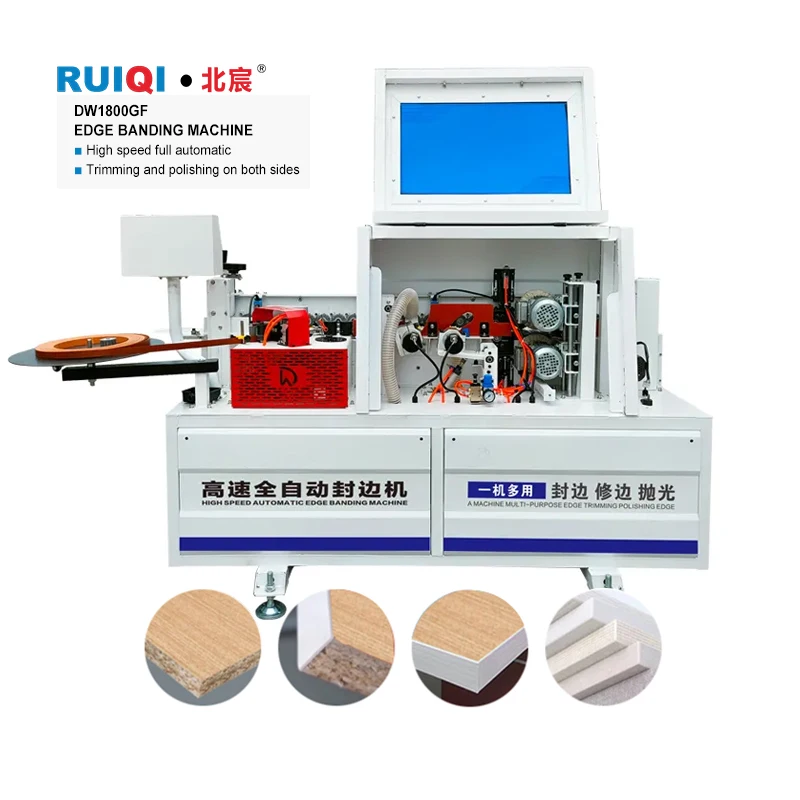
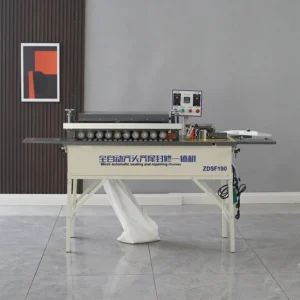
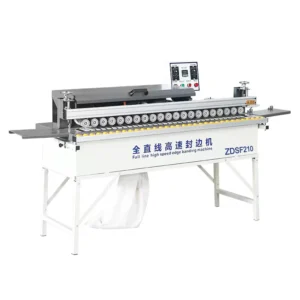
Precision Assembly Standards — Every DW1800 unit moves through our four-stage quality control system before leaving the factory floor, ensuring the mechanical tolerances your customers expect.
Technical Specifications
| Parameter |
Value |
| Model |
DW1800 |
| Product Type |
Automatic Edge Banding Machine |
| Total Power |
4.9KW |
| Voltage Options |
380V/220V/415V (configurable) |
| Edge Banding Thickness |
0.3-3MM |
| Edge Banding Height |
0-50MM |
| Feed Speed |
0-14M/min |
| Trimming Motor Power |
800W*2 at 24000r/min |
| Polishing Motor Power |
380W*2 |
| Glue Pot Capacity |
4000ml |
| Minimum Sheet Size |
20CM L × 10CM W |
| Air Source Pressure |
0.4-0.6Mpa |
| Machine Dimensions |
220×65×125CM |
| Machine Weight |
320KG |
| Control Panel Language |
Chinese, English (other languages available) |
| Plug Options |
EU, USA, AU, UK |
Application Suitability
| Application |
Material or Output |
| Custom Cabinet Production |
MDF and particleboard panels with PVC edge banding |
| Plywood Furniture Manufacturing |
Plywood sheets with veneer or PVC edge materials |
| Retail Fixture Fabrication |
ABB boards and organic glass plates |
| Workshop Panel Processing |
Solid wood panels and similar hardness substrates |
Why Voltage Confirmation Must Precede the Quotation
A machine wired for the wrong grid is dead weight on your customer’s floor.
When you quote an edge banding machine factory solution without locking down local industrial voltage and frequency first, you set up a failure before the container even ships. Motors spin backwards on 60Hz grids when configured for 50Hz, variable frequency drives throw error codes on arrival, and your distributor reputation takes a hit while waiting weeks for replacement transformers [NEED_CITE: voltage and frequency standards by export market]. The DW1800 supports 380V, 220V, and 415V configurations, but the exact voltage must be confirmed against the end user’s facility before production scheduling begins.

Component Sourcing and Assembly Depth
Our DW1800 automatic edge banding machine OEM production starts with high-strength extruded aluminum alloy mobile workstations that receive oxidation treatment for wear resistance. The trimming stations use dual 800W motors running at 24000r/min, paired with precision instrument visual displays for blade angle alignment. Every bearing, motor, and pneumatic valve is sourced against specification sheets and inspected at incoming material stage before reaching the assembly benches.
Quality Control Verification Points
The four-stage QC process covers incoming component inspection, in-process assembly checks, finished product testing, and pre-shipment verification. During the in-process stage, technicians verify the double-sided gluing system applies adhesive uniformly across the 4000ml glue pot delivery path. Finished units run test panels through the complete cycle—front and rear alignment, top and bottom trimming, flexible edge scraping, and polishing—before the final inspection [NEED_CITE: machinery quality control standards for woodworking equipment].
Specification Impact on Production Quality
The 0.3-3MM edge banding thickness range determines which PVC and veneer materials your customers can process without machine adjustment. Feed speed variability from 0-14M/min allows operators to slow down for delicate veneer edges or accelerate for high-volume PVC runs on particleboard. The 0.4-0.6Mpa air source pressure requirement ensures pneumatic cylinders maintain consistent pressure on pressure rollers, directly affecting glue line visibility on finished panels. Trimming motors at 24000r/min produce clean cuts on PVC edges without chipping or tear-out, critical for furniture panels where edge quality is visible to end consumers.
The Cost of Skipping Pre-Shipment Verification
Distributors who accept machines without factory test records discover tolerance issues only when panels fail assembly at the customer site. Glue pots that haven’t been tested under operating temperature develop leaks during the first production run. Control panels configured in a language the operator cannot read stall commissioning for days while waiting for translated manuals [NEED_CITE: industrial equipment commissioning challenges in export markets]. These problems compound when you’re managing multiple installations across different regions simultaneously.
Manufacturing Accountability for Distributor Partners
Our OEM capability extends from custom logo application on machine housings to private-label packaging designed to your brand specifications. Voltage, plug type, and control panel language are confirmed in writing before production begins, not assumed from regional generalizations. Every unit ships with electrical schematics matching the exact configuration delivered, enabling your service team to troubleshoot without guessing at wiring diagrams. Factory test records document performance on panel thickness ranges matching your market’s typical applications.
Documentation & Verification
- CE declaration of conformity for European market compliance requirements
- Electrical schematic with confirmed voltage, frequency, and plug type for target market
- Factory test record documenting edge quality on your specified panel materials
- Operation and maintenance manual in the language your customers require
- Spare parts list with part numbers for trimming blades, polishing wheels, and pneumatic components
Installation, Commissioning & Support
- Requires 380V/220V/415V three-phase power with dedicated circuit matching confirmed amperage
- Machine arrives fully assembled at 220×65×125CM footprint, requiring level concrete floor
- First commissioning includes glue pot temperature calibration and feed speed adjustment for local materials
- Control panel language set to operator preference before dispatch from factory
- Trimming blade angle alignment verified with precision instrument display during setup
- Recommended spare parts include extra trimming blades and polishing wheels for first operational period
Moving Forward with Your Configuration
To provide accurate lead times and configuration details, we need your target market’s standard voltage and frequency, preferred plug type, and control panel language requirements. Share the typical panel materials and edge banding thicknesses your customers process so we can configure test runs accordingly. Let us know if you require custom branding on machine housings and packaging, and whether you want to schedule a factory visit or request sample processing videos before committing to production quantities.
Frequently Asked Questions
Q: Can you produce the DW1800 with our logo and branded packaging?
A: Yes, OEM logo application on machine housings and private-label packaging are available after design file confirmation. We apply your branding during final assembly stage, and packaging can match your color schemes and labeling requirements for regional distribution.
Q: How do you confirm voltage and plug type before production?
A: We require written confirmation of local voltage, frequency, and plug type before scheduling production. The electrical schematic we provide matches the exact configuration built, and voltage tags are applied to the machine for on-site verification during installation.
Q: Can we visit the factory or request sample testing before ordering?
A: Factory visits are welcome to observe assembly processes and quality control checkpoints. If travel isn’t practical, we can run sample panels matching your specifications and provide video documentation of edge quality results before you commit to production quantities.
Q: What spare parts should we stock for aftermarket support?
A: We recommend stocking trimming blades, polishing wheels, and pneumatic seals based on your expected service volume. The spare parts list provided with each machine includes part numbers and specifications, enabling your service team to maintain inventory for common wear items.
Q: What is the production lead time for OEM-configured units?
A: Lead times depend on order quantity and customization complexity. Standard voltage and language configurations move through production faster than highly customized branding requests. We provide specific timelines after confirming your exact requirements and order volume.