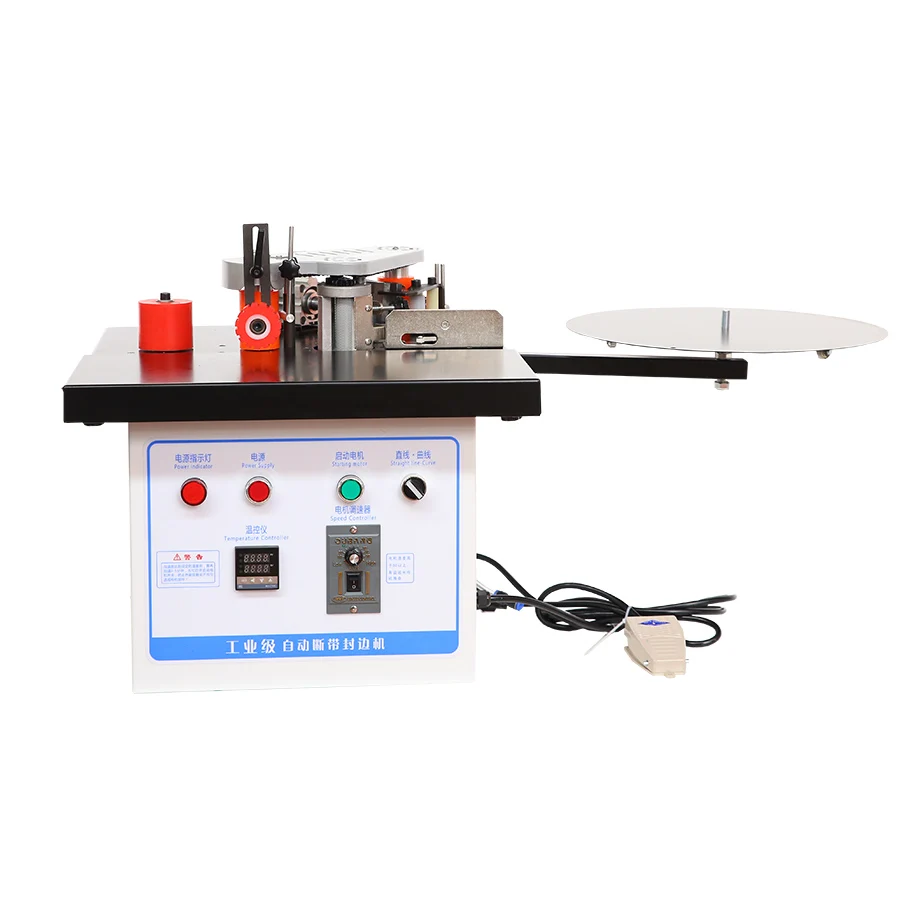
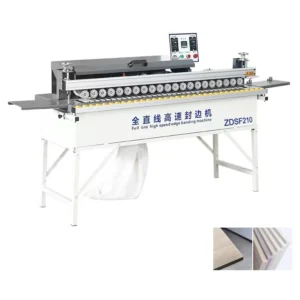
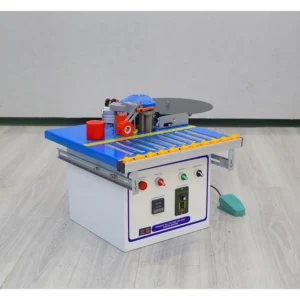
Precision-Machined Components — the ZDSF50 mini edge banding machine is assembled with proprietary cutting mechanisms and verified through a four-stage quality control process before dispatch.
Technical Specifications
| Parameter |
Value |
| Model |
ZDSF50 Mini Edge Banding Machine |
| Product Type |
Mini Edge Banding Machine |
| Rated Power |
1.2 kW |
| Voltage & Frequency |
220V (frequency customization available) |
| Control System |
Manual operation with foot switch and travel switch |
| Overall Dimensions (L×W×H) |
54×54×56 cm |
| Net Weight |
26 kg |
| Edge Banding Speed |
0–6 m/min |
| Panel Thickness Range |
10–60 mm |
| Strip Thickness Range |
0.5–1.5 mm |
| Glue Pot Capacity |
1000 ml |
| Heating Time |
5–10 min |
| Gluing Method |
Double-sided glue-coated rollers |
| Air Supply Requirement |
0.4–0.6 MPa |
| Edge Type Supported |
Straight, Curved, Shaped |
| Belt Breaking |
Pneumatic with foot switch (curve) and travel switch (straight) |
| Pressure Roller |
Adjustable, rubber material |
| Assembly State |
Portable, benchtop |
Application Suitability
| Application |
Material or Output |
| Small joinery workshop production |
MDF, particleboard, and plywood panels for custom cabinet components |
| On-site custom furniture installation |
Solid wood panels and shaped edge profiles requiring portable edge banding |
| Prototyping and low-volume runs |
PVC and veneer edge banding on curved and straight furniture edges |
| Regional distributor entry-level stock |
Compact benchtop units for startup workshops transitioning from manual processes |
The Voltage Trap That Ruins Commissioning Week
Confirming local frequency and phase before production prevents a machine that powers on but cannot run.
I have watched importers receive woodworking equipment that technically matched their voltage order, only to discover the frequency mismatch caused motors to overheat within the first hour of operation. The mini edge banding machine OEM factory must verify not just the voltage but the complete electrical standard of the destination market. A 220V specification means different things in regions operating at 50Hz versus 60Hz, and the motor winding configuration must match accordingly. [NEED_CITE: voltage and frequency standards by export market]
Component Sourcing and Assembly Depth
A mini edge banding machine OEM factory controls the entire assembly process from component inspection through final testing. The ZDSF50 utilizes adjustable rubber pressure rollers that are precision-ground to maintain consistent contact across panel thicknesses from 10 to 60 mm. Each unit undergoes incoming material verification before assembly begins, ensuring that the glue pot, pneumatic cylinders, and roller mechanisms meet tolerance specifications. The double-sided glue-coated roller system requires precise alignment during assembly to prevent uneven adhesive distribution on curved profiles.
Quality Verification Before Crating
The four-stage quality control process includes in-process inspection during assembly and pre-shipment verification with actual panel material. Factory test records document the edge banding performance on straight, curved, and shaped edges using the buyer’s specified strip thickness range of 0.5–1.5 mm. Pneumatic belt breaking mechanisms are tested repeatedly to confirm responsive operation through both the foot switch for curves and the travel switch for straight runs. [NEED_CITE: ISO 9001 quality management system requirements for machinery manufacturing]
Why Panel Thickness Range Dictates Pressure Roller Design
The 10–60 mm panel thickness range requires pressure rollers that can adjust without losing contact pressure on thin stock or causing feed resistance on thick panels. Rubber material selection balances grip against surface marking, particularly important when banding pre-finished MDF or veneered plywood. The adjustable mechanism must maintain parallel alignment across the full thickness spectrum to prevent edge lifting on the top or bottom of the panel. Glue pot capacity of 1000 ml supports continuous operation without frequent refilling during small batch production.

What Happens When Strip Thickness Exceeds Specification
I once received an urgent call from a Middle East customer whose edge bander kept jamming and producing half the rated output. When I arrived at their workshop, I found they were running PVC edge banding twice as thick as the machine’s 0.5–1.5 mm specification. The pneumatic belt breaking system could not cleanly cut the oversized material, causing frequent stops and restarts. The pressure rollers could not maintain consistent contact, resulting in visible glue lines and edge lifting that failed their quality inspection. [NEED_CITE: material specification compliance in woodworking machinery operation]
Why Procurement Verification Matters Here
Every ZDSF50 leaves the facility with a factory test record specific to the buyer’s panel material and edge profile requirements. Voltage customization from 110V to 440V is configured during production rather than adapted after assembly, ensuring motor windings and control components match the destination market. Operation and maintenance manuals are prepared in the agreed language before shipment, not translated generically afterward. The pre-shipment verification includes photographic documentation of the specific unit with packing photographs for customs clearance support.
Documentation & Verification
- Factory test record on your specific panel thickness and edge profile before dispatch
- Electrical schematic confirming voltage and frequency configuration for your market
- Operation and maintenance manual in your agreed language with spare parts list
- Packing photographs of your specific unit for customs and receiving verification
Installation, Commissioning & Support
- Benchtop placement requires stable work surface supporting 26 kg with clearance for 54×54×56 cm footprint
- Dedicated 220V circuit with proper grounding for 1.2 kW motor and heating element
- Pneumatic connection to shop air supply at 0.4–0.6 MPa for belt breaking system
- First-run parameter adjustment for your specific edge banding material thickness and panel type
- Spare parts list identifying wear items including pressure rollers and glue pot components
Moving Forward With Your Requirements
Provide your typical panel material type and thickness range, the edge banding strip material and thickness you plan to run, and your workshop’s electrical specifications including voltage and frequency. If you are evaluating this unit for distribution in your regional market, specify the destination countries and any local certification requirements. For OEM branding requests, confirm your logo specifications and packaging requirements early in the inquiry process.
Frequently Asked Questions
Q: Can the ZDSF50 be OEM-branded with our logo and private-label packaging?
A: Yes, the ZDSF50 supports full OEM customization including your logo placement, private-label packaging, and branded documentation. Logo specifications and packaging design files should be provided during the quotation phase to ensure proper integration into the production schedule. Custom voltage and language configurations are standard options that do not affect lead time significantly.
Q: What voltage and frequency options are available for different export markets?
A: The ZDSF50 is configurable from 110V to 440V with motor windings and control components matched to your specific frequency requirement of 50Hz or 60Hz. Voltage confirmation occurs during the specification review phase before production begins, ensuring the electrical system matches your destination market standards without requiring field modifications.
Q: How is edge banding tolerance verified before shipment?
A: Each unit undergoes pre-shipment testing using panel material and edge banding strip that matches your production specifications. The factory test record documents performance on straight, curved, and shaped edges within your required thickness range. This verification confirms that the double-sided glue rollers and pressure system deliver consistent results on your specific materials.
Q: What is the factory lead time and production scheduling process for OEM orders?
A: Typical production scheduling involves specification confirmation, component sourcing for custom voltage and language requirements, assembly with in-process quality checks, and final pre-shipment verification. OEM orders with private-label packaging may require additional time for packaging material production. Formal quotation includes the estimated production timeline based on current factory capacity.
Q: What spare parts and technical support are provided to distributors after delivery?
A: Each ZDSF50 ships with a spare parts list identifying wear components such as pressure rollers and pneumatic elements. Distributors receive technical documentation including electrical schematics and maintenance procedures to support their service teams. Remote technical guidance is available for troubleshooting, and replacement parts can be ordered directly from the factory for ongoing inventory support.