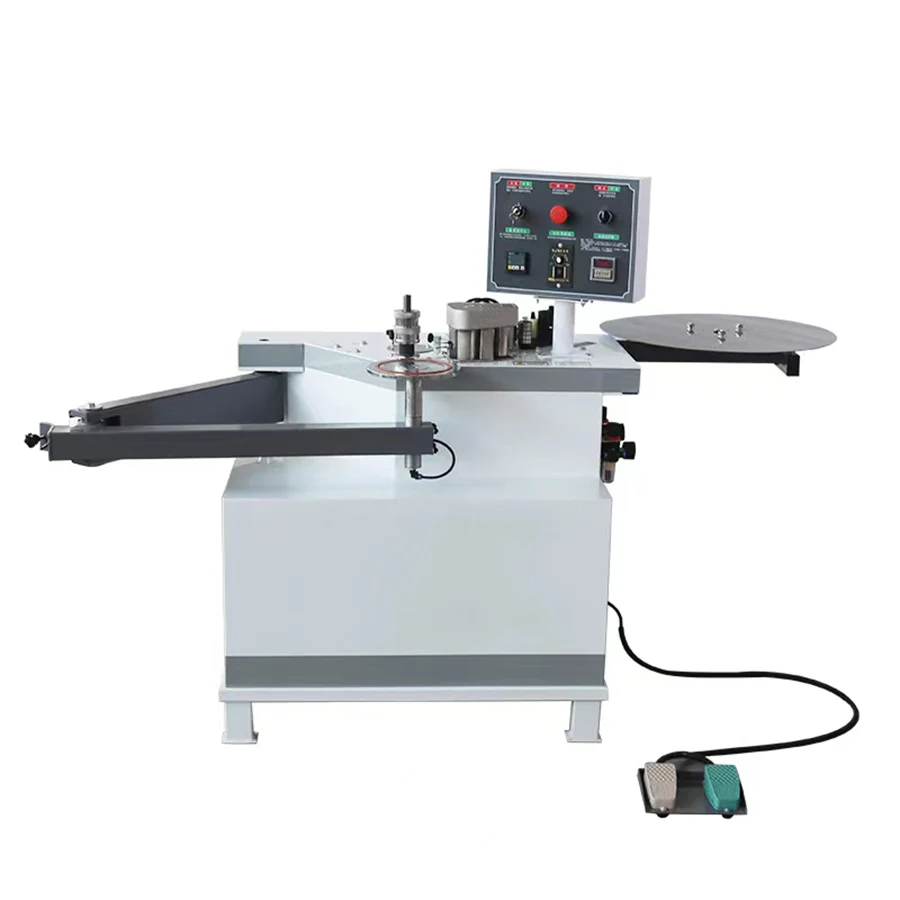
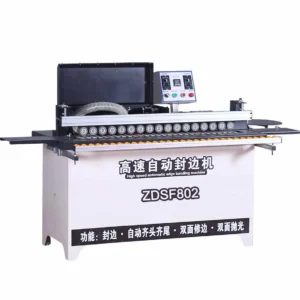
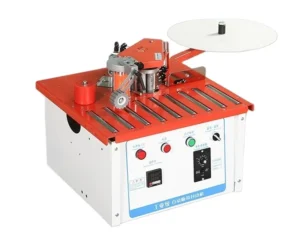
Precision-ground components verified at each assembly stage — every ZDSW-1 folding arm mechanism is built and tested in-house before OEM branding is applied, giving distributors a documented manufacturing trail rather than a trading company’s promise.
Technical Specifications
| Parameter |
Value |
| Model |
ZDSW-1 (W-1 / W-2 / W-3) |
| Product Type |
Folding Arm Manual Edge Banding Machine |
| Voltage & Frequency |
220V 50Hz |
| Total Power |
1.4 kW (W-1, W-2) / 3.4 kW (W-3) |
| Air Supply Requirement |
0.5–0.8 MPa |
| Edge Banding Speed |
0–180 mm/s |
| Edge Band Thickness Range |
0.4–2 mm |
| Edge Band Width Range |
8–50 mm |
| Suction Cup Size |
200×26 mm (W-1) / 300×26 mm (W-2, W-3) |
| Overall Dimensions (L×W×H) |
900×620×820 mm (W-1) / 1200×800×1220 mm (W-2) / 1210×1100×970 mm (W-3) |
| Net Weight |
88 kg (W-1) / 152 kg (W-2, W-3) |
| Control Features |
Intelligent temperature control, speed adjustment, timer |
| Belt Breaking |
Automatic, double-cylinder controlled |
| Hot Air Device |
Bottom-up heating for substrate adhesion |
Application Suitability
| Application |
Material or Output |
| Custom cabinet and wardrobe panel edging |
Plywood, MDF with PVC or melamine edge banding |
| Curved profile furniture components |
Shaped plywood and MDF panels with 0.4–2 mm banding |
| Office furniture and workstation tops |
Melamine-faced particleboard with straight and curved edges |
| Door and window frame trim |
Solid wood and plywood profiles requiring manual feed control |
| Small-batch decorative wood products |
Veneer and PVC banding on mixed substrate geometries |
Why Voltage Confirmation Must Happen Before the Crate Is Nailed Shut
A folding arm manual edge banding machine that arrives with the wrong motor winding is a crate of dead weight sitting on your dock for weeks.
I learned this the hard way early in my career on the assembly floor. A Middle East buyer ordered a unit, and the local grid voltage was never double-checked against the motor plate. The machine arrived, the electrician hooked it up, and nothing happened. Three weeks of waiting for a step-down transformer followed, while the buyer’s production schedule collapsed. With the ZDSW-1, the electrical schematic and voltage confirmation document is reviewed and signed off before the machine enters final assembly — not after it is already bolted to the pallet. [NEED_CITE: voltage and frequency standards by export market]
This Folding Arm Manual Edge Banding Machine factory protocol eliminates the most common and most expensive shipping mistake in the manual machinery category, where the machine’s simplicity makes buyers assume the electrical side is equally straightforward.
Component Sourcing and In-House Precision Work
Every bearing seat, guide rail, and folding arm pivot on the ZDSW-1 is ground and inspected within our own facility. We do not outsource the tolerances that determine whether the edge band tracks straight along a curved plywood profile or drifts and leaves a visible glue line. When a distributor asks what separates this Folding Arm Manual Edge Banding Machine from units assembled from catalog-sourced sub-assemblies, the answer lives in the runout figures on the spindle and the flatness of the glue roller — both held to verified limits before the machine leaves the grinding bench.
Four-Stage QC From Raw Steel to Pre-Shipment Test
Incoming material inspection catches alloy inconsistencies before they become weak folding arms. In-process checks verify that the double-cylinder belt breaking mechanism fires at the same position across repeated cycles. Finished product testing runs actual plywood and MDF panels through curved and straight profiles. Pre-shipment verification records the glue pot temperature stability, suction cup vacuum hold, and hot air device output — all documented before the crate is sealed. [NEED_CITE: CE machinery directive requirements for industrial equipment]
What the Spec Sheet Numbers Actually Mean on the Shop Floor

Reading the Thickness and Speed Relationship
The 0.4–2 mm edge band thickness range paired with 0–180 mm/s feed speed determines which substrates this machine handles cleanly. Thicker PVC banding at 2 mm demands slower feed and higher glue pot temperature to achieve full adhesive penetration, especially on porous MDF edges. The intelligent temperature control with timer lets an operator set a repeatable heat profile so that the first panel of the morning and the fiftieth panel of the afternoon receive consistent adhesion. The enlarged glue pot reduces refill interruptions during longer runs, keeping the thermal mass stable across the batch.
The bottom-up hot air device pre-warms the substrate edge just before the band meets the glue roller. On plywood, where surface moisture and resin content vary from sheet to sheet, this pre-heating step reduces cold spots that cause lifting at the trailing end of a curved profile. The 8–50 mm band width range covers most furniture edging requirements, and the +0.5 mm wheel adjustment lets the operator fine-tune the band overhang for a clean trim.
The Real Cost of Skipping Configuration Checks
When a distributor stocks manual edge banders without confirming the air supply requirement, the end user connects a compressor that cannot sustain 0.5–0.8 MPa and the double-cylinder belt breaker fires late or inconsistently. The result is ragged band ends that require hand trimming — exactly the labor this machine is supposed to eliminate. Similarly, operators working from a control panel in a language they cannot read will guess at temperature settings, producing adhesion failures that only surface when the furniture reaches the customer. [NEED_CITE: common causes of edge banding adhesion failure in manual machines]
Why Distributors Source This Machine From Our Assembly Line
The ZDSW-1 is built on a line where folding arm manual edge banding machines are produced alongside fully automatic models, so the same precision grinding equipment and QC discipline apply across the range. OEM and private label orders receive custom logo application, voltage configuration from 110V to 440V, and multilingual control panels as standard options — not special favors. Spare parts lists ship with every unit, and our technical training materials are available for your own service team to study before the first container arrives. Single-unit sample orders are processed through the same four-stage QC pipeline as production runs, so the machine your engineer evaluates is identical to what your customers will receive months later.
Documentation & Verification
- CE declaration of conformity matched to the ZDSW-1 folding arm configuration
- Electrical schematic with confirmed voltage and frequency for destination market
- Factory test record showing glue pot temperature stability and banding adhesion on specified substrates
- Operation and maintenance manual translated into the agreed language with illustrated spare parts list
- Packing photographs documenting crate condition and component securing before dispatch
Installation, Commissioning & Support
- ZDSW-1 ships partially assembled; video-guided setup covers folding arm mounting and suction cup alignment
- 220V 50Hz supply requires a dedicated 1.4 kW or 3.4 kW circuit depending on W-1/W-2 or W-3 variant
- Air compressor must sustain 0.5–0.8 MPa continuously to ensure reliable double-cylinder belt breaking
- First-run commissioning includes glue pot temperature calibration on the operator’s actual plywood or MDF stock
- W-3 variant at 152 kg requires a stable bench mount; W-1 at 88 kg suits mobile workshop positioning
Before You Send the Inquiry
To configure the right variant for your market, we need to know the substrate mix your customers typically process — plywood, MDF, or melamine-faced board — and whether curved profiles are a regular requirement or an occasional need. Share your destination voltage and frequency so the motor and control panel are specified correctly from the start. If your service team will handle installation and warranty work locally, let us know so we can prepare the technical training package and spare parts inventory plan alongside the quotation.
Frequently Asked Questions
Q: What does OEM and private label customization include for this machine?
A: Logo placement on the machine body and control panel faceplate, voltage winding from 110V to 440V matched to your market, multilingual panel labels and operation manuals, and custom packaging with your branding. Each customization is confirmed on the electrical schematic before production begins, so there are no surprises at pre-shipment inspection.
Q: How deep does your in-house manufacturing go on the ZDSW-1?
A: Folding arm pivots, guide rails, and glue roller assemblies are ground and inspected in our own facility. The double-cylinder belt breaking mechanism and hot air device are assembled and cycle-tested on-site. We do not rebrand third-party sub-assemblies — component sourcing records are available for distributor audit.
Q: Can we visit the factory to see the QC process before placing an order?
A: Factory visits are welcome at any stage. You can observe incoming material inspection, watch the four-stage QC checks on a ZDSW-1 in production, and run your own sample panels through the machine to verify edge banding quality on your target substrates before committing to a container order.
Q: What spare parts support do regional distributors receive?
A: Every ZDSW-1 ships with a detailed spare parts list cross-referenced to assembly diagrams. Distributors receive technical training materials for their service teams covering folding arm adjustment, belt breaking mechanism servicing, and glue pot maintenance. Replacement parts are stocked for dispatch alongside future machine orders or as standalone shipments.
Q: Is a sample processing test available before we confirm a bulk order?
A: Send us your typical panel material — plywood, MDF, or melamine board — along with the edge banding strip you plan to use. We run the ZDSW-1 on those materials, record the glue temperature, feed speed, and adhesion results, and share the test record with photographs so you can evaluate output quality before the purchase decision.